Hello! Welcome to our next lesson.
In our previous session, we established that PCOS is a diagnosis of exclusion, meaning we must rule out other conditions that mimic its symptoms before confirming the diagnosis. Now that we understand the diagnostic framework, we can delve into the specific biochemical signature of PCOS itself.
Today's lesson will address the learning outcome: Describe the typical hormonal profile and metabolic abnormalities found in PCOS. We will explore the characteristic patterns seen in blood tests of women with PCOS, moving beyond the clinical signs to the underlying biochemical imbalances. Understanding this profile is essential, as these changes are not just diagnostic markers; they are the key drivers of the syndrome's symptoms and its long-term health consequences.
We will break this down into two interconnected areas:
- The Hormonal Profile: Focusing on gonadotropins (LH and FSH), androgens, and other related hormones.
- The Metabolic Abnormalities: Centering on insulin resistance, hyperinsulinemia, and dyslipidemia.
Throughout the lesson, we will focus on how these elements are woven together, often creating self-perpetuating "vicious cycles" that define the pathophysiology of PCOS.
1. The Hormonal Profile: An Axis Out of Balance
The foundation of the hormonal disruption in PCOS lies within the Hypothalamic-Pituitary-Ovarian (HPO) axis, a system we've previously discussed. In PCOS, this communication network is dysregulated.
Gonadotropin Imbalance: LH and FSH
A classic, though not universal, finding in PCOS is an altered ratio of the two main pituitary gonadotropins: Luteinizing Hormone (LH) and Follicle-Stimulating Hormone (FSH).
- Luteinizing Hormone (LH): Levels are often elevated. This is thought to be due to an increased pulse frequency of Gonadotropin-Releasing Hormone (GnRH) from the hypothalamus. The pituitary gland responds to these faster GnRH pulses by preferentially secreting LH.
- Follicle-Stimulating Hormone (FSH): Levels are typically normal or low. The chronic, slightly elevated estrogen levels found in PCOS (which we'll discuss shortly) exert negative feedback on the pituitary, suppressing FSH release.
- LH:FSH Ratio: The result of high LH and normal/low FSH is an elevated LH:FSH ratio, often greater than 2:1 or 3:1. While this is a hallmark finding, it's important to know it's not required for diagnosis and is not present in all women with PCOS.
To visualize how this initial imbalance occurs, let's watch a short, clear animation.
Polycystic Ovarian Syndrome (PCOS) - Pathophysiology, Symptoms, Treatment
This clip from the PhysioPathoPharmaco channel provides an excellent animated explanation of how the lack of progesterone feedback in anovulatory cycles leads to increased GnRH pulsatility and a subsequent rise in the LH to FSH ratio.
Please watch from the beginning to 02:51. Focus on the cause-and-effect chain: Lack of ovulation -> no progesterone surge -> increased GnRH pulse frequency -> increased LH relative to FSH.
Hyperandrogenism: The Core Hormonal Feature
The most direct consequence of elevated LH is the overstimulation of the theca cells in the ovary, which are primarily responsible for producing androgens. This leads to hyperandrogenemia—the biochemical hallmark of PCOS.
- Elevated Androgens: Blood tests will often show high levels of total testosterone, free testosterone, and/or androstenedione.
- Decreased Sex Hormone-Binding Globulin (SHBG): Insulin, which is often high in PCOS, suppresses the liver's production of SHBG. SHBG is a protein that binds to testosterone in the blood, rendering it inactive. Low SHBG means that a greater proportion of testosterone is unbound or "free," and therefore biologically active. This is why the Free Androgen Index (FAI), a calculation based on total testosterone and SHBG, is often a more sensitive marker of androgen excess than total testosterone alone.
- Adrenal Androgen Contribution: In about 20-30% of women with PCOS, there is also an increase in androgens produced by the adrenal glands, most notably dehydroepiandrosterone sulfate (DHEA-S).
The video below explains this process, linking the high LH levels directly to androgen production and introducing the concept of decreased SHBG.
Poly Cystic Ovarian Syndrome (PCOS) / Stein–Leventhal syndrome / Hyperandrogenic anovulation
Dr. G Bhanu Prakash explains how high LH stimulates theca cells and how insulin and androgens work together to suppress SHBG, increasing the level of active hormones.
Please watch from 06:27 to 10:41, and then from 13:01 to 15:40. Pay attention to how elevated LH drives androgen production and how insulin further amplifies hyperandrogenism by reducing SHBG.
Other Key Hormonal Changes
The primary disruptions in gonadotropins and androgens have cascading effects on other hormones.
- Estrogen: With an excess of androgens, the enzyme aromatase in peripheral tissues (especially fat cells) converts these androgens into estrogens, particularly estrone. This results in a state of chronic, unopposed estrogen exposure, as opposed to the normal cyclical rise and fall. This chronic estrogen state is what suppresses FSH, arrests follicle development, and (as we'll see later) can affect the uterine lining.
- Progesterone: Because women with PCOS often do not ovulate (anovulation), the corpus luteum does not form. Without a corpus luteum, there is no production of progesterone in the second half of the cycle. This lack of progesterone is what leads to irregular or absent periods and contributes to the vicious cycle by preventing the normal feedback on GnRH.
- Anti-Müllerian Hormone (AMH): AMH is secreted by the granulosa cells of small, developing ovarian follicles. In PCOS, there is an abundance of these small follicles that have been arrested in their development. Consequently, AMH levels are typically significantly elevated in women with PCOS.
2. The Metabolic Abnormalities: A System Under Stress
PCOS is now recognized as much more than a reproductive disorder; it is fundamentally a metabolic condition. The metabolic disturbances are deeply intertwined with the hormonal imbalances.
Insulin Resistance (IR) and Hyperinsulinemia
This is arguably the most critical metabolic defect in PCOS, affecting 50-70% of women with the condition, including many who are of normal weight.
- Insulin Resistance (IR): This is a state where the body's cells (particularly muscle, fat, and liver cells) do not respond effectively to the hormone insulin. As a result, the body has difficulty moving glucose from the blood into the cells for energy.
- Hyperinsulinemia: To overcome this resistance and keep blood glucose levels normal, the pancreas compensates by producing and secreting more and more insulin. This results in chronically high levels of insulin in the blood.
Why is Hyperinsulinemia a Problem in PCOS?
High insulin levels powerfully exacerbate the hormonal dysregulation in a vicious cycle:
- It stimulates ovarian androgen production: Insulin acts as a "co-gonadotropin" with LH, directly stimulating theca cells to produce more androgens.
- It stimulates adrenal androgen production: Insulin can also enhance androgen synthesis in the adrenal glands.
- It reduces SHBG: As mentioned earlier, insulin suppresses SHBG production by the liver, increasing free, active androgen levels.
This creates a feedback loop: Insulin Resistance -> Hyperinsulinemia -> More Androgens -> Worsening Insulin Resistance.
Resistance to the Insulin and Elevated Level of Androgen
To understand this crucial 'vicious cycle,' let's turn to the review article 'Resistance to the Insulin and Elevated Level of Androgen' from Frontiers in Endocrinology. It clearly lays out this central concept.
Please read the section 'Increased Level of Insulin (Hyperinsulinemia), Insulin Resistance, and Hyper-Androgenemia (Vicious Cycle)' and the section 'PCOS and Hyperinsulinemia'. Focus on how IR and hyperandrogenemia are described as stimulating each other.
Dyslipidemia
The metabolic disruption of insulin resistance also affects how the body handles fats (lipids), leading to a characteristic pattern of dyslipidemia that increases cardiovascular risk. The typical profile includes:
- Elevated Triglycerides (TGs)
- Low High-Density Lipoprotein (HDL) Cholesterol (the "good" cholesterol)
- Often, an increase in Low-Density Lipoprotein (LDL) Cholesterol (the "bad" cholesterol)
This lipid profile is very similar to that seen in other insulin-resistant states, like type 2 diabetes.
Chronic Low-Grade Inflammation
There is growing evidence that PCOS is associated with a state of chronic, low-grade inflammation. This may be driven by factors like insulin resistance and androgen excess, which can cause adipose (fat) cells to become enlarged and dysfunctional, leading them to release pro-inflammatory substances (cytokines) into the bloodstream.
Summary: The Complete Picture
To consolidate this information, let's review a comprehensive article and then look at a summary chart.
Polycystic ovary syndrome: pathophysiology and therapeutic ...
The review 'Polycystic ovary syndrome: pathophysiology and therapeutic...' in the BMJ provides a state-of-the-art overview of these concepts. It synthesizes the neuroendocrine, androgenic, and insulin-related pathways.
Please read the sections 'Neuroendocrine disruption,' 'Classical pathway of androgen synthesis,' and 'Hyperinsulinism.' This will tie together the concepts of GnRH, LH/FSH, androgens, and the central role of insulin.
The typical hormonal and metabolic profile of PCOS can be summarized as follows:
| Category | Finding in PCOS | Primary Mechanism |
|---|---|---|
| Gonadotropins | ↑ LH, Normal/↓ FSH, ↑ LH:FSH Ratio | Abnormal GnRH pulsatility; chronic estrogen feedback. |
| Androgens | ↑ Testosterone (Total & Free), ↑ Androstenedione | LH overstimulation of theca cells; hyperinsulinemia. |
| Binding Globulins | ↓ SHBG | Insulin suppression of liver synthesis. |
| Estrogens | Normal/↑ Estrone | Peripheral conversion of excess androgens. |
| Progestins | ↓ Progesterone | Anovulation (no corpus luteum formation). |
| Other Hormones | ↑ AMH | Increased number of small antral follicles. |
| Glucose/Insulin | Insulin Resistance, ↑ Insulin | Intrinsic cellular defects, exacerbated by obesity/androgens. |
| Lipids | ↑ Triglycerides, ↓ HDL, ↑ LDL | Effects of insulin resistance on lipid metabolism. |
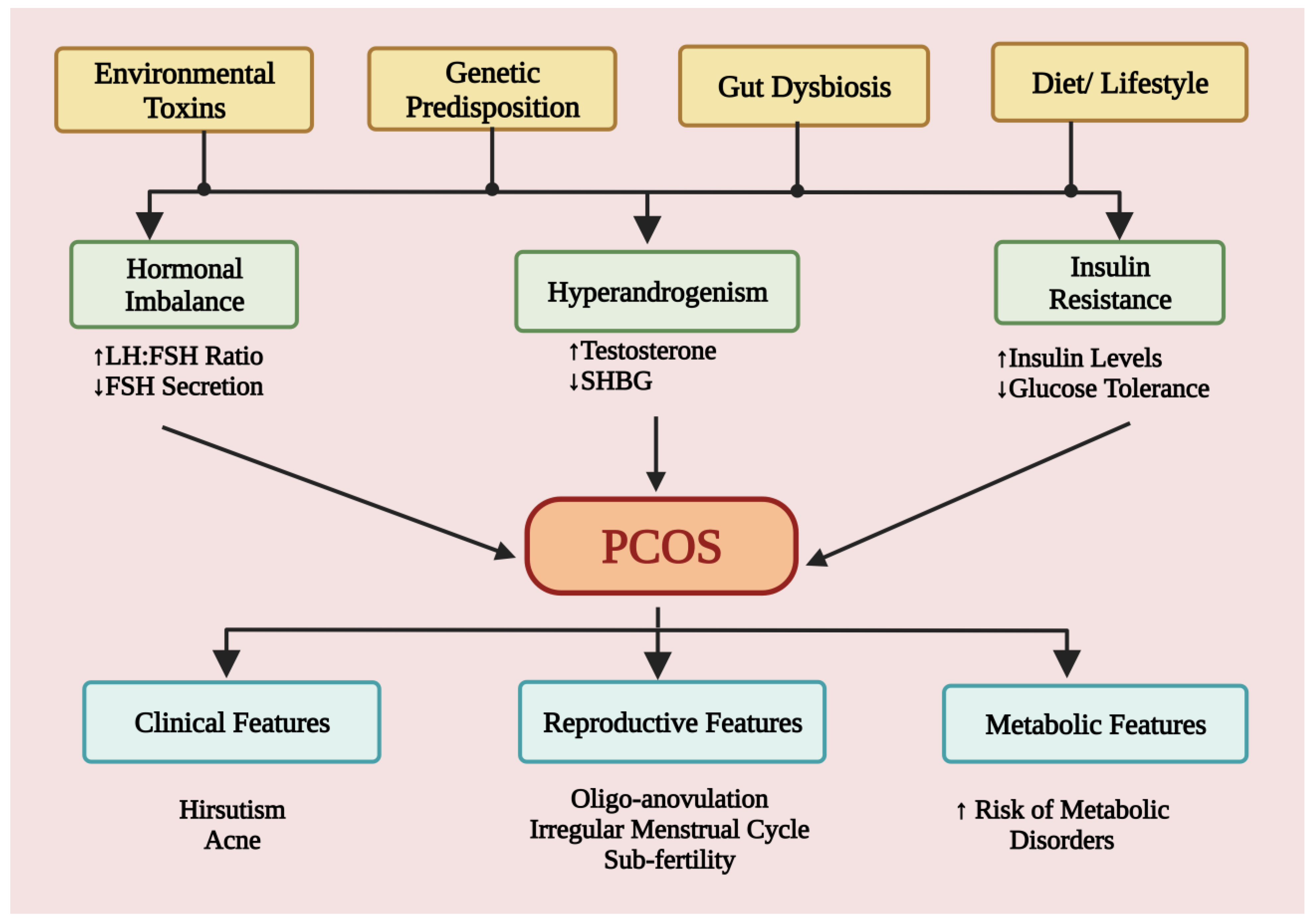
The following flowchart provides a powerful visual summary of how genetic and environmental factors lead to the hormonal and metabolic abnormalities that define PCOS.
Test your understanding!
A patient with PCOS has a blood test that shows very low levels of Sex Hormone-Binding Globulin (SHBG). Which other abnormality is most directly responsible for causing this, and what is the primary consequence of low SHBG?
- Cause: High FSH; Consequence: Low estrogen.
- Cause: High Insulin (Hyperinsulinemia); Consequence: Increased free (active) testosterone.
- Cause: Low Progesterone; Consequence: Increased LH.
- Cause: High Androstenedione; Consequence: High estrone.
Show answer
The correct answer is 2. Hyperinsulinemia directly suppresses the liver's production of SHBG. The primary consequence of low SHBG is that less testosterone is bound in the bloodstream, leading to higher levels of free, biologically active testosterone, which is what drives clinical signs like hirsutism and acne.
Conclusion
Today, we have mapped out the characteristic hormonal and metabolic landscape of PCOS. Far from being a simple collection of unrelated lab values, this profile reveals a complex and deeply interconnected web of dysregulation.
Key Takeaways:
- The hormonal profile of PCOS is typically marked by elevated LH, normal or low FSH, and a resulting high LH:FSH ratio.
- This gonadotropin imbalance drives hyperandrogenism—high levels of androgens like testosterone—which is the central hormonal feature of PCOS.
- Insulin resistance and compensatory hyperinsulinemia are core metabolic abnormalities that create a vicious cycle, amplifying androgen production and reducing SHBG, thereby increasing androgen activity.
- Other key findings include low progesterone (from anovulation), elevated AMH, and a pro-atherogenic lipid profile (high TGs, low HDL).
Preview of the Next Lesson:
We have now described the key biochemical abnormalities found in PCOS. In our next lesson, we will explore what these abnormalities lead to over time. We will focus on the learning outcome: Describe the long-term metabolic consequences of PCOS, including type 2 diabetes, dyslipidemia, and cardiovascular disease. We will see how the insulin resistance and dyslipidemia we discussed today place women with PCOS at a significantly higher risk for major health problems later in life.