Hello! Welcome to the fourth lesson in our module on the physiology of the normal menstrual cycle.
Introduction
In our last lesson, we traced the journey of a group of follicles through the follicular phase, ending with a single, dominant Graafian follicle that has grown large and is producing very high levels of estradiol. This hormonal peak is the crucial signal that brings the follicular phase to its dramatic conclusion.
Today's lesson focuses on this climax, addressing the learning outcome: Explain the LH surge mechanism and its role in triggering ovulation. We will explore how high estradiol levels flip a hormonal switch from negative to positive feedback, unleashing a massive surge of Luteinizing Hormone (LH) from the pituitary. We will then dissect the three critical jobs this LH surge performs to make ovulation possible. Understanding this pivotal event is essential, as its failure is a direct cause of the anovulation seen in PCOS.
1. The Switch: Estradiol's Positive Feedback
Throughout most of the follicular phase, estradiol exerts a negative feedback effect on the pituitary, suppressing FSH secretion. However, once the dominant follicle drives estradiol levels above a certain threshold (typically >200 pg/mL) and maintains them there for about 50 hours, something remarkable happens. Estradiol's effect on the brain and pituitary flips from inhibitory to stimulatory. This is a classic example of positive feedback.
High, sustained estradiol acts on two levels:
- The Hypothalamus: It increases the frequency and amplitude of Gonadotropin-Releasing Hormone (GnRH) pulses.
- The Pituitary: It dramatically increases the sensitivity of the gonadotroph cells to GnRH, causing them to release massive quantities of stored LH.
This dual effect creates an explosive, self-amplifying loop: more GnRH causes more LH release, and the pituitary's increased sensitivity amplifies this response. The result is the LH surge.

To see this process in action, the following video segment provides an excellent visual explanation of this hormonal switch.
Female Reproductive Cycle | Ovulation
This clip from Ninja Nerd clearly illustrates how rising estrogen flips the feedback from negative to positive, leading to the LH surge. It also mentions the concurrent role of inhibin.
Please watch the video from 20:10 to 24:46. Focus on how estrogen's role changes towards the end of the follicular phase and how this leads to the massive increase in LH, but not FSH.
2. The Anatomy of the LH Surge
The LH surge is the central, indispensable event of the ovulatory cycle. Without it, ovulation does not occur. Let's look at its key characteristics.
This text provides a concise and clear description of the LH surge and its essential functions. It will serve as the foundation for the rest of our lesson.
Please read the section titled 'Luteinizing hormone (LH)'. Then, read the second bullet point under the section 'Estradiol'. Focus on the description of the surge's magnitude, duration, the hormonal interplay that causes it, and its key functions.
As the reading highlights, the LH surge is defined by:
- Magnitude: A 10- to 20-fold increase in circulating LH levels.
- Duration: It lasts for approximately 36 to 48 hours.
- Timing: Ovulation occurs about 36 hours after the onset of the surge, and about 12-24 hours after its peak.
Test your understanding!
A patient is using an over-the-counter ovulation prediction kit, which tests for the presence of LH in urine. She gets a positive result on Tuesday morning. Based on the typical timing of the ovulatory cycle, when is she most likely to ovulate?
Show answer
She is most likely to ovulate on Wednesday. A positive test indicates the LH surge has begun. Since ovulation typically occurs about 36 hours after the onset of the surge, ovulation would be expected on the following day.
3. The Three Critical Roles of the LH Surge
The LH surge is not just a single-purpose trigger; it's a multi-functional signal that orchestrates the final, critical steps of follicular maturation and rupture. Let's break down its three main jobs.
Role 1: Resumption of Oocyte Meiosis
The egg (oocyte) inside the dominant Graafian follicle is immature. It has been arrested in the first stage of a cell division process called meiosis (specifically, Prophase I) since before birth. The LH surge is the signal that "wakes up" the oocyte and tells it to resume this division.
The oocyte completes Meiosis I, resulting in two cells:
- A large secondary oocyte, which contains all the vital cytoplasm and genetic material for fertilization.
- A small first polar body, which is essentially a small packet of discarded chromosomes.
The secondary oocyte immediately begins Meiosis II but arrests again (in Metaphase II), where it will wait for fertilization.
The Molecular Mechanism:
Your background and goals suggest an interest in the deeper mechanisms. The process of meiotic resumption is a fascinating molecular cascade initiated by the LH surge.
Luteinizing Hormone Action in Human Oocyte Maturation ...
This highly detailed review article, 'Luteinizing Hormone Action in Human Oocyte Maturation', explains the molecular signaling pathways that the LH surge activates. We will focus on the key steps that release the oocyte from meiotic arrest.
This is an in-depth resource. Read the following sections to build a picture of the molecular cascade: Start with the 'Introduction', focusing on the second paragraph ('Oocyte meiotic maturation begins...') to get an overview of the process from GV to MII oocyte. Read the short paragraph right after 'Fig. 1' (starting with 'LH triggers an explosion...'). This provides a quick summary of the molecular events. Read the section 'Follicle C-natriuretic Peptide and Natriuretic Peptide Receptor 2' to understand what keeps the oocyte arrested (the CNP/NPR2 system). Briefly read 'Epidermal Growth Factor Network' and 'Gap Junction Communication' to see how the LH signal is transmitted through the follicle. Finally, read 'Oocyte Maturation Promoting Factor...' to understand the final step: the activation of MPF, the engine that drives meiosis. Focus on the overall sequence: LH signal → shuts down inhibitory signals (like CNP) → reduces cAMP inside the oocyte → activates MPF → meiosis resumes.
In summary, the oocyte is held in arrest by high levels of an internal signaling molecule, cyclic AMP (cAMP). The LH surge triggers a cascade that ultimately leads to the activation of an enzyme (PDE3A) inside the oocyte, which breaks down cAMP. The drop in cAMP levels activates a master protein complex called Maturation Promoting Factor (MPF), which acts as the engine to drive the oocyte through the first meiotic division.
Role 2: Triggering Follicular Rupture (Ovulation)
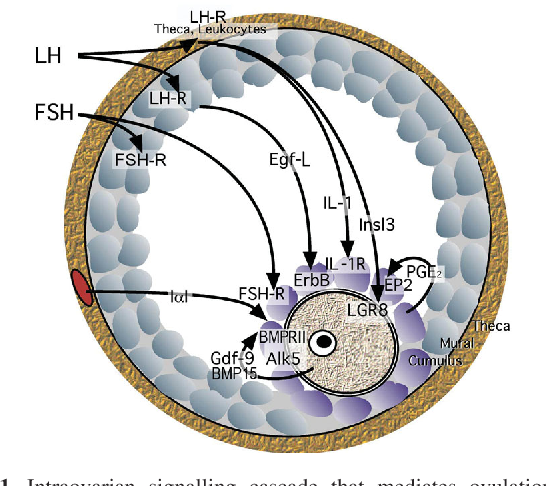
About 36 hours after the surge begins, the follicular wall ruptures, releasing the newly matured secondary oocyte. The LH surge initiates this rupture by triggering a process that strongly resembles an inflammatory reaction within the follicle.
Key events include:
- Increased Blood Flow: LH causes vasodilation of the blood vessels around the follicle, increasing local blood flow and permeability. This leads to swelling.
- Enzymatic Digestion: The surge activates proteolytic enzymes, such as collagenase and plasmin, within the follicle. These enzymes begin to digest the collagen and other proteins that make up the follicular wall, weakening it from the inside.
- Prostaglandin Synthesis: LH stimulates the production of prostaglandins, which further contribute to the breakdown of the follicular wall and may induce contractions of smooth muscle cells in the ovary, helping to expel the oocyte.
Eventually, a weakened spot on the surface of the follicle, called the stigma, gives way, and the oocyte, surrounded by a cloud of cumulus cells, is released.
Role 3: Luteinization of Follicle Cells
The final job of the LH surge is to prepare the follicle for its post-ovulation role. It triggers a transformation of the granulosa and theca cells, a process called luteinization. These cells begin to change their structure and function, most notably by starting to produce large quantities of progesterone.
This pre-ovulatory rise in progesterone is important. It helps facilitate the positive feedback of the LH surge and begins preparing the uterine lining for potential pregnancy. After ovulation, these luteinized cells will form the corpus luteum, the primary endocrine structure of the second half of the menstrual cycle.
Conclusion
The LH surge is the dramatic and indispensable climax of the follicular phase. It is the missing link in many cases of anovulatory infertility, including PCOS, where this signal often fails to occur correctly.
Key Takeaways:
- Sustained high levels of estradiol from the dominant follicle switch the hypothalamic-pituitary axis from negative to positive feedback.
- This switch triggers a massive, 10- to 20-fold increase in LH secretion from the pituitary, known as the LH surge.
- The LH surge has three essential functions:
- Resumes oocyte meiosis, maturing the egg from a primary to a secondary oocyte by activating Maturation Promoting Factor (MPF).
- Triggers follicular rupture (ovulation) through an inflammatory-like cascade involving proteolytic enzymes and prostaglandins.
- Luteinizes the granulosa and theca cells, causing them to produce progesterone and preparing them to become the corpus luteum.
Preview of the Next Lesson:
We've now seen how the LH surge triggers ovulation. In the next lesson, we will zoom in on the event itself: "Describe the process of ovulation at the cellular and molecular level." We will examine the final moments of follicular rupture and the mechanism by which the fallopian tube captures the newly released oocyte.