Hello! Welcome to the third lesson in our module on the physiology of the normal menstrual cycle.
Introduction
In our last lesson, we explored the LH surge, the powerful hormonal signal triggered by high estradiol levels from the mature Graafian follicle. We learned that this surge has three critical jobs: resuming oocyte meiosis, initiating follicular rupture, and luteinizing the follicular cells.
Today, we will zoom in on the second of those jobs. Our learning outcome is to describe the process of ovulation at the cellular and molecular level. We will move beyond the general concept of rupture and dissect the precise, coordinated cascade of events that the LH surge unleashes within the follicle. This process, which resembles a controlled inflammatory reaction, is a fascinating example of biological engineering. Understanding these molecular details is crucial for grasping why ovulation can fail, a central issue in PCOS.
1. The LH Signal and the Ovarian Response
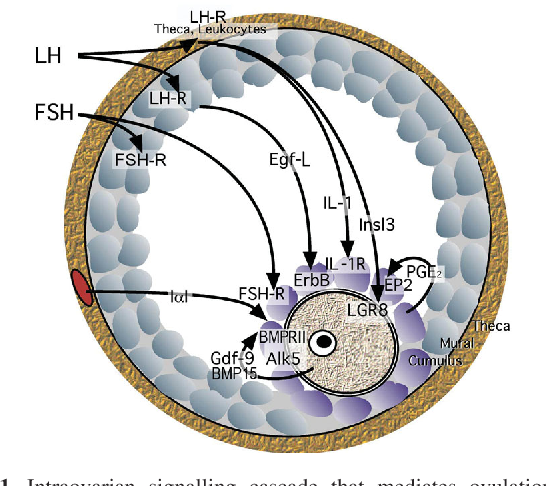
Ovulation occurs approximately 10-12 hours after the peak of the LH surge, or about 36 hours after its onset. When this surge of LH reaches the ovary, it binds to LH receptors on both the theca and granulosa cells of the dominant follicle. This binding event is the starting gun for a complex intracellular signaling race.
At a molecular level, the activation of the LH receptor triggers a cascade involving several key players:
- Second Messengers: It increases intracellular levels of cyclic AMP (cAMP), which in turn activates Protein Kinase A (PKA).
- Gene Expression: PKA then activates transcription factors—proteins that switch specific genes on or off. This leads to a massive reprogramming of the follicle's genetic activity.
- Signal Amplification: The LH signal also rapidly activates the Epidermal Growth Factor (EGF) signaling network within the follicle. This network acts as a crucial amplifier and relay system, ensuring the ovulatory signal spreads efficiently to all the granulosa cells.
The outcome of this initial signaling is the coordinated production of three classes of molecules that are the primary executioners of ovulation: prostaglandins, proteolytic enzymes, and steroid hormones like progesterone.
2. The Molecular Machinery of Follicular Rupture
Think of the wall of the Graafian follicle as a reinforced structure composed of cells and a tough extracellular matrix, rich in collagen. For the oocyte to be released, a specific point in this wall must be weakened and broken down. This is accomplished by the following interconnected pathways.
a) The Prostaglandin Pathway: The Inflammatory Mediators
The LH surge causes a dramatic increase in the expression of the gene PTGS2 (also known as Cyclooxygenase-2 or COX-2). This enzyme is the critical rate-limiting step in the synthesis of prostaglandins, particularly Prostaglandin E2 (PGE2) and Prostaglandin F2α (PGF2α).
These prostaglandins are powerful local hormones that contribute to the inflammation-like environment of ovulation by:
- Increasing blood flow (hyperemia) to the follicle.
- Increasing the permeability of blood vessels, causing the follicle to swell.
- Stimulating the activity of other enzymes involved in breaking down the follicular wall.
The importance of this pathway is highlighted by a key clinical observation: women taking high doses of prostaglandin synthetase inhibitors (like the NSAIDs indomethacin or celecoxib) can experience a failure of follicular rupture, a condition known as Luteinized Unruptured Follicle (LUF) syndrome.
To learn more about the specific enzymes and their roles, let's turn to a detailed research review.
New insights into the ovulatory process in the human ovary
The following sections from the review 'New insights into the ovulatory process in the human ovary' by Jo et al. detail the critical molecular players. We will start with the role of prostaglandins.
Please read the section titled 'Prostaglandins' (it begins on page 31). Focus on identifying the key enzyme (PTGS2) and other molecules involved in prostaglandin synthesis and transport. Note the evidence from inhibitor studies in both animals and humans that confirms their essential role.
b) The Proteolytic Pathway: Deconstructing the Wall
The structural integrity of the follicular wall is maintained by its extracellular matrix (ECM). The LH surge activates a family of proteolytic enzymes (proteases) that are designed to digest this matrix.
The key proteases involved are:
- Matrix Metalloproteinases (MMPs): A family of enzymes, including collagenases that specifically break down the collagen fibers giving the follicular wall its strength.
- A Disintegrin and Metalloproteinase with Thrombospondin Motifs (ADAMTS): A specific member, ADAMTS1, is essential. Its expression is strongly induced by the LH surge and is a downstream target of progesterone action. Mice lacking the gene for ADAMTS1 fail to ovulate.
- Plasmin: Another protease activated during this process.
These enzymes work in a highly localized manner at the apex of the follicle—the point on the ovarian surface where it bulges. They progressively digest the ECM, thinning the follicular wall and creating a point of weakness known as the stigma.
New insights into the ovulatory process in the human ovary
Now, let's examine the enzymes responsible for breaking down the follicle wall. The same review article provides an excellent summary.
Please read the section titled 'Proteolytic systems' (it begins on page 33). Read the introductions to the subsections 'Matrix metalloproteinases' and 'A disintegrin and metalloproteinase (ADAM) and ADAM with thrombospondin motifs (ADAMTS)'. You don't need to memorize every specific enzyme, but focus on understanding that different families of proteases (MMPs, ADAMTS) are induced and work together.
c) The Role of Progesterone and Transcription Factors
As we learned in the last lesson, the LH surge triggers luteinization and a switch from estrogen to progesterone production, even before ovulation occurs. This pre-ovulatory progesterone is not just a prelude to the luteal phase; it is an active participant in ovulation itself.
Progesterone acts via its nuclear receptor (PGR), which is a transcription factor. When progesterone binds to PGR in the granulosa cells, the complex travels to the cell's nucleus and activates the expression of genes necessary for ovulation, most notably the gene for the protease ADAMTS1. This demonstrates how the different molecular pathways are deeply interconnected. Without progesterone and its receptor, the production of key proteolytic enzymes is impaired, and ovulation fails.
Test your understanding!
A new experimental drug is found to be a potent antagonist of the progesterone receptor (PGR). If this drug is administered to a woman just after her natural LH surge begins, what is the most likely outcome for that cycle?
Show answer
The most likely outcome is a failure of ovulation. By blocking the progesterone receptor, the drug would prevent progesterone from activating the transcription of essential genes, such as ADAMTS1. Without this key proteolytic enzyme, the follicular wall would not break down properly, leading to a Luteinized Unruptured Follicle (LUF).
3. The Final Act: Rupture and Oocyte Release
The events we've discussed culminate in the final moments of ovulation.
- Stigma Formation: The coordinated enzymatic attack weakens the follicular wall at its apex, forming the avascular (lacking blood vessels) stigma.
- Rupture: The combination of the digested, weakened wall at the stigma and the increasing pressure from the accumulation of follicular fluid causes the follicle to rupture.
- Extrusion: The secondary oocyte, which completed its first meiotic division just hours earlier, is gently extruded from the follicle. It is not a violent explosion but a slow release. The oocyte is surrounded by a protective cloud of granulosa cells known as the cumulus oophorus. This entire structure is called the cumulus-oocyte complex (COC).
- Capture: As ovulation approaches, the finger-like projections at the end of the fallopian tube, the fimbriae, become engorged with blood and begin to sweep over the surface of the ovary. Their cilia create gentle currents that guide the newly released COC into the opening of the fallopian tube, where it will begin its journey toward the uterus.
The following video provides an excellent visualization of this entire physical process, tying together the concepts of enzymatic breakdown, follicular swelling, rupture, and capture.
Female Reproductive Cycle | Ovulation
This segment from Ninja Nerd offers a clear, dynamic illustration of the physical events of ovulation, from the action of proteases on the follicle wall to the capture of the oocyte by the fimbriae.
Please watch the video from 24:46 to 30:13. Focus on how the video depicts the action of 'proteases' weakening the follicle, the increase in follicular fluid, the 'popping out' of the secondary oocyte, and the subsequent action of the fimbriae.
Conclusion
Today, we have dissected the intricate process of ovulation at the cellular and molecular level. We've seen that it is far from a simple mechanical event, but rather a sophisticated biological program triggered by the LH surge.
Key Takeaways:
- Ovulation is an inflammation-like process orchestrated by the LH surge.
- The LH surge induces the synthesis of prostaglandins (via the PTGS2/COX-2 enzyme), which increase blood flow and contribute to the breakdown of the follicle wall.
- The surge also triggers the production of proteolytic enzymes (like MMPs and ADAMTS1) that digest the collagen in the follicular wall, creating a weak point called the stigma.
- Progesterone, produced by the newly luteinizing cells, acts as a crucial transcription factor (via its receptor, PGR) to turn on genes required for ovulation, such as ADAMTS1.
- The combination of enzymatic digestion and increased intrafollicular pressure leads to rupture at the stigma and the release of the cumulus-oocyte complex.
- The fimbriae of the fallopian tube then sweep over the ovary to capture the oocyte.
Preview of the Next Lesson:
With the oocyte now on its way, what becomes of the follicular structure left behind on the ovary? In our next lesson, we will address the learning outcome: "Describe the hormonal changes and corpus luteum function during the luteal phase." We will explore the transformation of the ruptured follicle into the corpus luteum and its critical role in governing the second half of the menstrual cycle.