Hello! Welcome back to our course on PCOS.
Introduction
In our last lesson, we dissected the elegant "two-cell, two-gonadotropin" theory, which explains how the ovary produces estrogen. Today, we'll see this theory in action as we explore the first half of the menstrual cycle.
This lesson addresses the learning outcome: Describe the hormonal changes and follicular development during the follicular phase of the menstrual cycle. The follicular phase is a dynamic period where the ovary prepares a single follicle for ovulation. Understanding this phase is critical, as its disruption—specifically, the failure of a single follicle to achieve dominance—is a hallmark of PCOS.
Let's start with a high-level view of the entire menstrual cycle to orient ourselves. The follicular phase, as the name suggests, is all about the follicle.
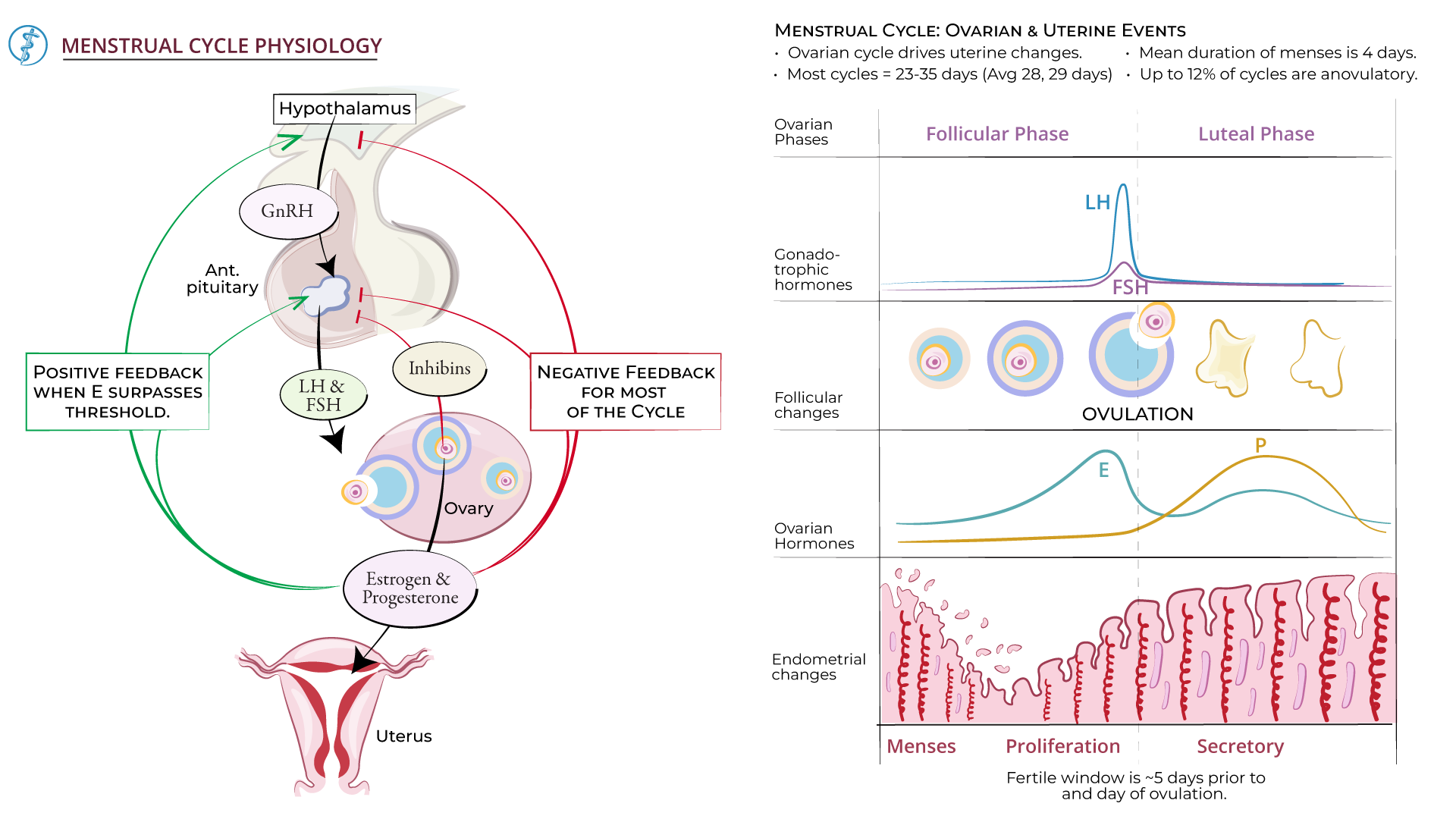
1. The Starting Gun: Initiation of the Follicular Phase
The follicular phase doesn't begin in a vacuum; it's triggered by the end of the previous cycle.
At the end of the luteal phase (if no pregnancy occurs), the corpus luteum degenerates. This causes a sharp decline in the hormones it was producing: progesterone, estrogen, and inhibin A.
This hormonal drop is the key. The hypothalamus and pituitary are released from the strong negative feedback that these hormones were exerting. In response, the pituitary gland begins to increase its secretion of Follicle-Stimulating Hormone (FSH). This rise in FSH, beginning a few days before menstruation, is the starting signal for the follicular phase.
The Normal Menstrual Cycle and the Control of Ovulation
To understand this initial trigger in more detail, let's read a short section from a comprehensive text on the menstrual cycle.
Please read the first three paragraphs of the section titled 'THE FOLLICULAR PHASE'. Focus on how the decline in hormones from the corpus luteum (steroids and inhibin A) directly leads to the rise in FSH that recruits the new cohort of follicles.
This "FSH window" allows a group of small, resting antral follicles to begin a period of rapid growth. This process is known as recruitment.
2. The Journey of the Follicle: From Recruit to Dominant
Once recruited by FSH, the follicles embark on a journey of development. The ultimate goal is to produce one single, large, mature follicle called a Graafian follicle. This journey involves massive cellular proliferation and hormonal production.
Let's watch a detailed animation that illustrates this entire process, from a tiny primordial follicle to the magnificent Graafian follicle.
Female Reproductive Cycle | Ovulation
The following video from Ninja Nerd provides a clear, step-by-step visualization of follicular development. It beautifully illustrates the concepts we're discussing.
Please watch from 03:54 to 20:30. As you watch, pay close attention to: FSH's role (from 06:28): How it stimulates the granulosa cells to multiply and produce estrogen (revisiting the two-cell theory). Follicular Fluid (from 10:55): The formation of pockets of fluid that eventually merge to form a large cavity called the 'antrum'. Meiosis (from 15:10): The crucial maturation of the egg (oocyte) from a 'primary oocyte' to a 'secondary oocyte', which signifies the completion of the first meiotic division. Negative Feedback (from 20:30): How rising estrogen starts to suppress FSH and LH secretion.
3. The Race for Dominance: Selection and Atresia
The video beautifully illustrated the growth process. Now, let's formalize the competitive aspect of this journey. It's not just growth; it's a race where only one follicle can win. This process occurs in three stages:
- Recruitment (Days 1-4): As we discussed, the rise in FSH at the start of the cycle recruits a cohort of 5-15 small antral follicles.
- Selection (Days 5-7): As this cohort of follicles grows, their granulosa cells multiply and, through the two-cell mechanism, produce increasing amounts of estradiol and inhibin B. These two hormones exert negative feedback on the pituitary, causing serum FSH levels to decline.
- Dominance (Day 8 onwards): The declining FSH level creates a competitive environment. Only one follicle, which has become the most sensitive to FSH (by developing the most FSH receptors), can continue to thrive. This "chosen one" is the dominant follicle. The other follicles in the cohort, starved of sufficient FSH stimulation, can no longer sustain their growth. Their local environment becomes androgen-dominant, and they undergo a process of programmed cell death called atresia.
This selection of a single dominant follicle is a cornerstone of a healthy ovulatory cycle.
The Normal Menstrual Cycle and the Control of Ovulation
This process of competition and selection is crucial. Let's read a clear description of these stages and the importance of the follicle's internal hormonal environment.
First, read the two paragraphs under the heading 'Development of the dominant follicle has been described in three stages...'. This formally defines Recruitment, Selection, and Dominance. Then, read the paragraph at the very end of the 'THE FOLLICULAR PHASE' section, which starts with 'In the ovary, the primordial follicles...'. This explains the critical difference between the estrogenic microenvironment of the dominant follicle and the androgenic environment of the follicles destined for atresia.
Test your understanding!
Considering the process of selection, why is it that rising estrogen levels from the developing follicles ultimately lead to the death of all but one of those very follicles?
Show answer
It's a feedback loop. The rising estrogen (along with inhibin B) from the entire cohort of growing follicles sends a negative feedback signal to the pituitary, causing it to reduce FSH secretion. As FSH levels fall, only the follicle that has become most efficient at capturing and using FSH (the one with the most receptors and best blood supply) can survive. The other less-developed follicles become "starved" of the FSH they need to continue growing and producing estrogen, leading to their demise (atresia). In essence, the follicles collectively cause the FSH support to be withdrawn, leading to a "survival of the fittest" scenario where only the most developed follicle wins.
4. A Symphony of Hormones
Let's put all the hormonal changes together and see how they interplay throughout the follicular phase.

Here is a summary of the key hormonal trends during the follicular phase:
- FSH: Starts high (triggering recruitment), then gradually declines from the mid-follicular phase onwards due to negative feedback from estradiol and inhibin B.
- LH: Starts low and is relatively stable. In the second half of the phase, as estrogen levels rise, LH begins to slowly increase because estrogen starts to sensitize the pituitary to GnRH. Its pulse frequency increases from about every 90 minutes to every 60 minutes.
- Estradiol: Starts very low. As the dominant follicle grows exponentially, its expanding population of granulosa cells churns out more and more estradiol, leading to a rapid rise in serum levels in the late follicular phase.
- Inhibin B: Produced by the granulosa cells of the developing follicles. Its levels rise in the early follicular phase, contributing significantly to the negative feedback that suppresses FSH.
The Hypothalamic-Pituitary-Ovarian Axis and Control of ...
This article provides an excellent summary of the hormonal interplay during the follicular phase, tying together the actions of GnRH, the gonadotropins, and the ovarian hormones.
Please read the entire section titled 'Follicular Phase'. It provides a concise summary of the roles of GnRH, FSH, LH, and ovarian hormones (estradiol and androgens) in driving the development and selection of the dominant follicle.
Conclusion
The follicular phase is a precisely orchestrated sequence of events designed to mature a single, healthy oocyte for ovulation. It is a story of hormonal signals, cellular growth, and intense competition.
Key Takeaways:
- The follicular phase is initiated by a rise in FSH, caused by the decline of progesterone and estrogen from the previous cycle.
- FSH recruits a cohort of antral follicles and stimulates their growth and estrogen production (via the two-cell, two-gonadotropin mechanism).
- As follicles grow, they produce estradiol and inhibin B, which cause FSH levels to fall via negative feedback.
- This drop in FSH leads to the selection of a single dominant follicle, which is the most sensitive to FSH. The other follicles undergo atresia.
- The dominant follicle continues to mature into a Graafian follicle, containing a secondary oocyte and producing large amounts of estradiol.
Preview of the Next Lesson:
The follicular phase culminates in a dominant follicle producing extremely high levels of estradiol. This hormonal peak sets the stage for the most dramatic event of the cycle. In our next lesson, we will see how these high estradiol levels flip a switch in the pituitary, turning negative feedback into powerful positive feedback. This will unleash the LH surge, the direct trigger for ovulation.