Hello! Welcome to your next lesson in the "Management Strategies for PCOS" module.
In our last session, we established the fundamental principles of why lifestyle modification—encompassing diet, exercise, and behavioral strategies—is the cornerstone of PCOS management. We discussed the "why" behind this approach: it directly targets the core pathophysiological drivers of insulin resistance and obesity.
Today, we will build directly on that foundation to address the learning outcome: Describe the evidence for specific dietary and exercise interventions in managing PCOS. We will move from general principles to specific, evidence-backed strategies, examining which dietary patterns and exercise protocols have been shown to be most effective in clinical studies.
Specific Dietary Interventions: A Look at the Evidence
While the previous lesson outlined general dietary principles (like prioritizing low-GI carbs and healthy fats), research has investigated several specific, named dietary patterns for PCOS. Let's explore the evidence for the most prominent ones.
For a thorough, evidence-based overview, we will refer to a recent systematic review that synthesizes the findings from numerous studies.
The Role of Lifestyle Interventions in PCOS Management
The systematic review 'The Role of Lifestyle Interventions in PCOS Management' from the journal Nutrients provides a detailed summary of the evidence for various dietary patterns. It will be our primary guide for this section.
Please read section '3. Dietary Habits and Supplements in PCOS Management'. As you read, focus on the following key dietary patterns and the evidence cited for each: Low-Glycemic-Index (GI) Diet Ketogenic Diet (KD) Anti-Inflammatory Rich Diet DASH (Dietary Approaches to Stop Hypertension) Diet (mentioned in section 3.6) Pay attention to the outcomes measured in the studies, such as improvements in HOMA-IR, androgen levels, and weight.
Let's break down and expand upon what you've just read.
1. Low-Glycemic Index (GI) Diet
As you've seen, the evidence for a low-GI diet is strong. Its primary mechanism is improving insulin sensitivity by preventing sharp spikes in blood sugar. Stable insulin levels, in turn, help reduce ovarian androgen production. The review you read highlights studies showing that a low-GI diet can:
- Improve menstrual regularity.
- Reduce HOMA-IR (a marker of insulin resistance), fasting insulin, and total testosterone.
- Improve cholesterol levels (total cholesterol, LDL).
The following video clip provides a concise summary of the benefits of a low-GI approach and the importance of pairing carbohydrates with protein and fat.
PCOS Diet, Supplements, Herbs & Lifestyle Recommendations + Do You NEED to Lose Weight?
This clip from registered dietitian Abbey Sharp reinforces the evidence for a low-GI diet and provides practical context.
Please watch the segment from 02:07 to 04:41. Notice the emphasis on improving insulin sensitivity and the practical advice of pairing carbs with protein and fat to stabilize blood sugar, which is a core application of the low-GI principle.
2. DASH Diet
The DASH diet, as you read in both the FOGSI paper from the last lesson and the Nutrients review, is consistently shown to be one of the most effective dietary patterns for PCOS. While originally designed for hypertension, its principles—rich in fruits, vegetables, whole grains, and low-fat dairy, while low in saturated fat, cholesterol, and sugar—make it ideal for managing PCOS.
A second review paper provides further focused evidence on the DASH diet.
The Influence of Dietary Patterns on Polycystic Ovary Syndrome ...
The review 'The Influence of Dietary Patterns on Polycystic Ovary Syndrome Management' also from Nutrients specifically analyzes randomized controlled trials (RCTs) and has a dedicated section on the DASH diet.
Please read sections '3.1.1. DASH Diet' and '4.1. Calorie-Restricted DASH Diet'. Note the consistent findings from multiple RCTs showing significant improvements in weight, BMI, fasting insulin, and HOMA-IR compared to control diets, even when calories are matched.
The evidence from these reviews confirms that a calorie-restricted DASH diet is effective for improving both anthropometric measures (weight, BMI) and metabolic markers (insulin sensitivity) in women with PCOS.
3. Other Notable Diets
- Anti-Inflammatory/Antioxidant-Rich Diets: The review LINK you read highlighted that PCOS involves chronic low-grade inflammation and oxidative stress. Therefore, a diet rich in anti-inflammatory foods (like omega-3 fatty acids from fish) and antioxidants (from fruits, vegetables, and spices like cardamom) can help mitigate this aspect of the pathophysiology, improving inflammatory markers like hs-CRP and TNF-α.
- Ketogenic Diet (KD): The evidence shows that KDs can lead to significant short-term weight loss and improvements in hormones. However, the review also rightly points out concerns about its long-term sustainability and nutritional completeness. It's a therapeutic option but requires careful medical supervision.
- High-Protein/Low-Carbohydrate Diets: As you saw in review LINK, the evidence for these diets is more mixed. While some studies show benefits, others find no significant difference compared to standard diets when calories are matched. This suggests that while macronutrient composition matters, an overall healthy pattern like the DASH diet may be a more reliable approach.
Beyond Weight Loss: An Intuitive and Compassionate Approach
The intense focus on diet and weight in PCOS management can have a significant psychological downside. The constant pressure to "lose weight" can lead to disordered eating, weight cycling (yo-yo dieting), and increased stress, all of which can worsen the metabolic and hormonal state of PCOS.
The next video segment features a powerful discussion with a dietitian specializing in PCOS who advocates for a more compassionate and intuitive approach to eating.
PCOS Diet, Supplements, Herbs & Lifestyle Recommendations + Do You NEED to Lose Weight?
Let's return to Abbey Sharp's video, this time focusing on the interview with dietitian Julie Duffy Dillon. This section critically examines the 'just lose weight' advice and proposes an alternative framework.
Please watch from 10:42 to 22:56. Pay close attention to the following points: The link between dieting, weight cycling, and increased cortisol and inflammation. The concept of honoring cravings as biological signals rather than moral failures. The importance of eating enough, especially protein, to manage cravings and energy. The shift from 'body love' to 'body respect' as a more achievable and helpful goal.
This perspective is vital. It shifts the goal from a specific number on the scale to nourishing the body, managing insulin, and reducing inflammation in a sustainable, psychologically healthy way. This aligns perfectly with the behavioral principles we discussed in the last lesson.
Specific Exercise Interventions: What the Evidence Says
In the last lesson, we established the principle of combining aerobic and resistance exercise. Now, let's look at the specific evidence for different types and amounts of exercise.
The Role of Lifestyle Interventions in PCOS Management
Let's revisit the systematic review 'The Role of Lifestyle Interventions in PCOS Management' to examine the evidence for specific exercise modalities.
Please read section '4. Physical Activity (Aerobic Exercise and Resistance Training) and PCOS' and look at Figure 4. Identify the recommended weekly duration for exercise and the different types of aerobic exercise studied (e.g., HIIT, MICT).
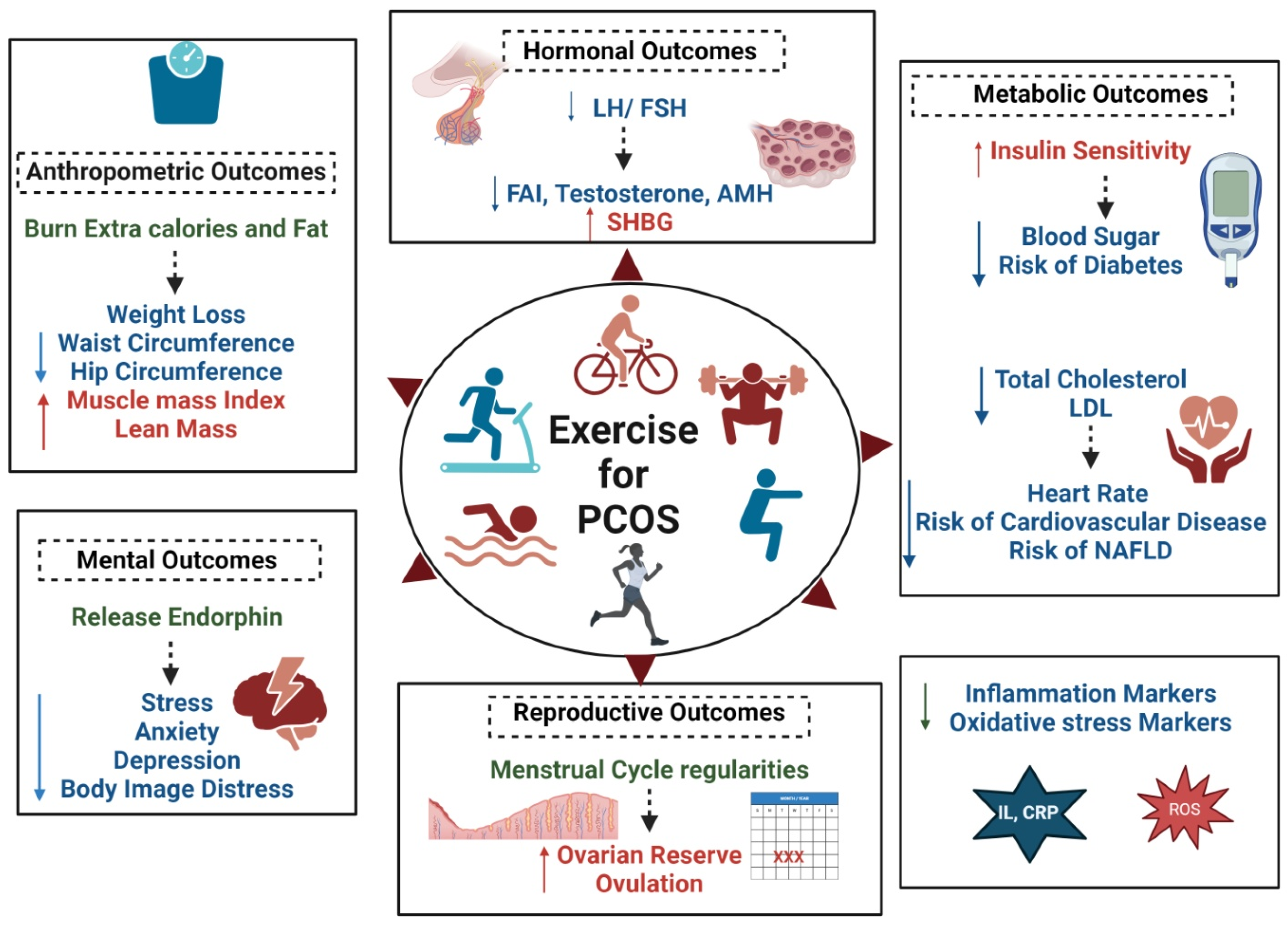
Based on the evidence, here are the key takeaways for exercise prescription:
- Aerobic Exercise: This is crucial for cardiovascular health and improving insulin sensitivity.
- International guidelines recommend at least 150 minutes/week of moderate-intensity activity (like brisk walking) or 75 minutes/week of vigorous-intensity activity (like running).
- For significant weight loss, 250+ minutes/week of moderate-intensity activity is often needed.
- Studies have shown that various forms, including High-Intensity Interval Training (HIIT) and Moderate-Intensity Continuous Training (MICT), are effective. The best choice is often the one the individual will adhere to consistently.
- Resistance Training: This is key for building lean muscle mass, which increases the body's capacity for glucose uptake and boosts resting metabolic rate. It is recommended on at least two non-consecutive days per week.
- Combination is Best: The synergistic effect of combining aerobic and resistance training often yields the best results for both body composition and metabolic health.

Test your understanding!
A patient with PCOS asks which diet is definitively the "best" one to follow. Based on the evidence we've reviewed, what is the most accurate response?
a) The Ketogenic Diet is the best because it leads to the fastest weight loss.
b) There is no single "best" diet; however, patterns that are low-glycemic, anti-inflammatory, and nutrient-dense, like the DASH diet, have strong evidence for improving metabolic health in PCOS.
c) Any diet is fine as long as it restricts calories to below 1200 per day.
d) A high-protein diet is superior to all others for reducing androgen levels.
Show answer
The correct answer is b). The evidence does not support one single "best" diet. While KD can be effective, it has sustainability issues. Calorie restriction alone isn't the only factor; nutrient quality is key. The evidence for high-protein diets is mixed. Therefore, recommending a general pattern that incorporates proven principles (low-GI, anti-inflammatory), with the DASH diet as a prime example, is the most evidence-based approach.
Conclusion
In this lesson, we have moved from the general principles of lifestyle modification to the specific, evidence-based dietary and exercise interventions used in PCOS management. It's clear that while weight management is a central goal for many, the focus should be on improving metabolic health through sustainable, high-quality nutrition and consistent physical activity.
Key Takeaways:
- Dietary patterns like the DASH diet and low-GI diets have strong evidence supporting their use in improving insulin resistance, hormonal profiles, and anthropometric measures in PCOS.
- Diets rich in anti-inflammatory and antioxidant compounds target the chronic inflammation associated with PCOS.
- A compassionate, intuitive eating approach that prioritizes nourishment over restriction can improve adherence and prevent the negative psychological and metabolic consequences of chronic dieting.
- Specific exercise recommendations include at least 150 minutes of moderate-intensity aerobic activity per week, combined with resistance training on at least two days, to maximize benefits for both body composition and insulin sensitivity.
Preview of the Next Lesson:
Now that we have a thorough understanding of the foundational lifestyle interventions, we will turn our attention to pharmacological treatments. In the next lesson, we will begin by discussing the most commonly used medications for managing the symptoms of hyperandrogenism and menstrual irregularity: combined oral contraceptives.