Hello! Welcome to the next lesson in our module on PCOS management.
In our last session, we focused on combined oral contraceptives (COCs), a first-line treatment for managing the hyperandrogenic symptoms and menstrual irregularities of PCOS in women not seeking pregnancy. We concluded that while COCs are excellent for hormonal and symptom control, they don't address the underlying metabolic root of the problem: insulin resistance.
Today, we turn our attention to a medication that does exactly that. This lesson will address the learning outcome: Explain the mechanism of action of metformin and its role in managing metabolic and reproductive aspects of PCOS.
We will explore how metformin, a drug originally developed for type 2 diabetes, became a cornerstone in treating the metabolic dysfunction at the heart of PCOS, and how correcting this dysfunction can, in turn, improve reproductive health.
Why Metformin? Revisiting the Role of Insulin in PCOS
Before we dive into how metformin works, let's quickly refresh our understanding of why an insulin-sensitizing drug is so crucial in PCOS. As we've established in previous modules, many women with PCOS have insulin resistance, which triggers a vicious cycle.
To recap this central concept, please watch the following short clip.
Polycystic Ovarian Syndrome (PCOS) - Pathophysiology, Symptoms, Treatment
The video 'Polycystic Ovarian Syndrome (PCOS) - Pathophysiology, Symptoms, Treatment' from PhysioPathoPharmaco provides an excellent summary of the destructive feedback loop involving insulin and androgens in PCOS.
Please watch the segment from 02:51 to 04:27. Focus on how hyperinsulinemia directly stimulates the ovaries and adrenal glands to produce more androgens, and how those androgens, in turn, worsen insulin resistance.
This cycle—where insulin resistance leads to high insulin (hyperinsulinemia), which drives androgen excess, which then exacerbates insulin resistance—is a key therapeutic target. Metformin's primary purpose in PCOS is to break this cycle.
The Mechanism of Action: How Metformin Works
Metformin belongs to a class of drugs called biguanides and is considered a first-line therapy for type 2 diabetes. Its application in PCOS stems from its powerful effects as an insulin-sensitizing agent. Let's break down its mechanism.
The following reading provides a clear and structured explanation of metformin's molecular actions.
Mechanism of Action: How Metformin Works in PCOS
The article 'Mechanism of Action: How Metformin Works in PCOS' from Liv Hospital details the key molecular pathways that metformin influences. This will form the basis of our understanding.
Please read the section titled 'How Metformin Works in PCOS: The Molecular Mechanism'. Pay close attention to: The central role of the AMPK pathway. Metformin's primary effect on hepatic glucose production. Its secondary impact on glucose uptake in other tissues.
As you've just read, metformin’s actions are complex, but we can summarize the main points:
-
Reduced Hepatic Glucose Production: This is metformin's principal effect. It primarily acts on the liver to decrease the production of glucose (a process called gluconeogenesis). By reducing the amount of sugar the liver releases into the bloodstream, it lowers overall blood glucose levels.
-
Activation of AMPK: Metformin achieves this largely by activating an enzyme called AMP-activated protein kinase (AMPK). Think of AMPK as a master metabolic switch or an "energy sensor" within the cell. When a cell is low on energy (high AMP:ATP ratio), AMPK is activated and switches the cell from energy-consuming processes (like making glucose) to energy-producing processes.
-
Increased Peripheral Glucose Uptake: Metformin also improves insulin sensitivity in peripheral tissues, such as skeletal muscle and fat cells. It encourages these cells to take up more glucose from the blood in response to insulin, partly by promoting the translocation of glucose transporters (like GLUT4) to the cell surface.
The image below provides a detailed view of the molecular events inside a liver cell.
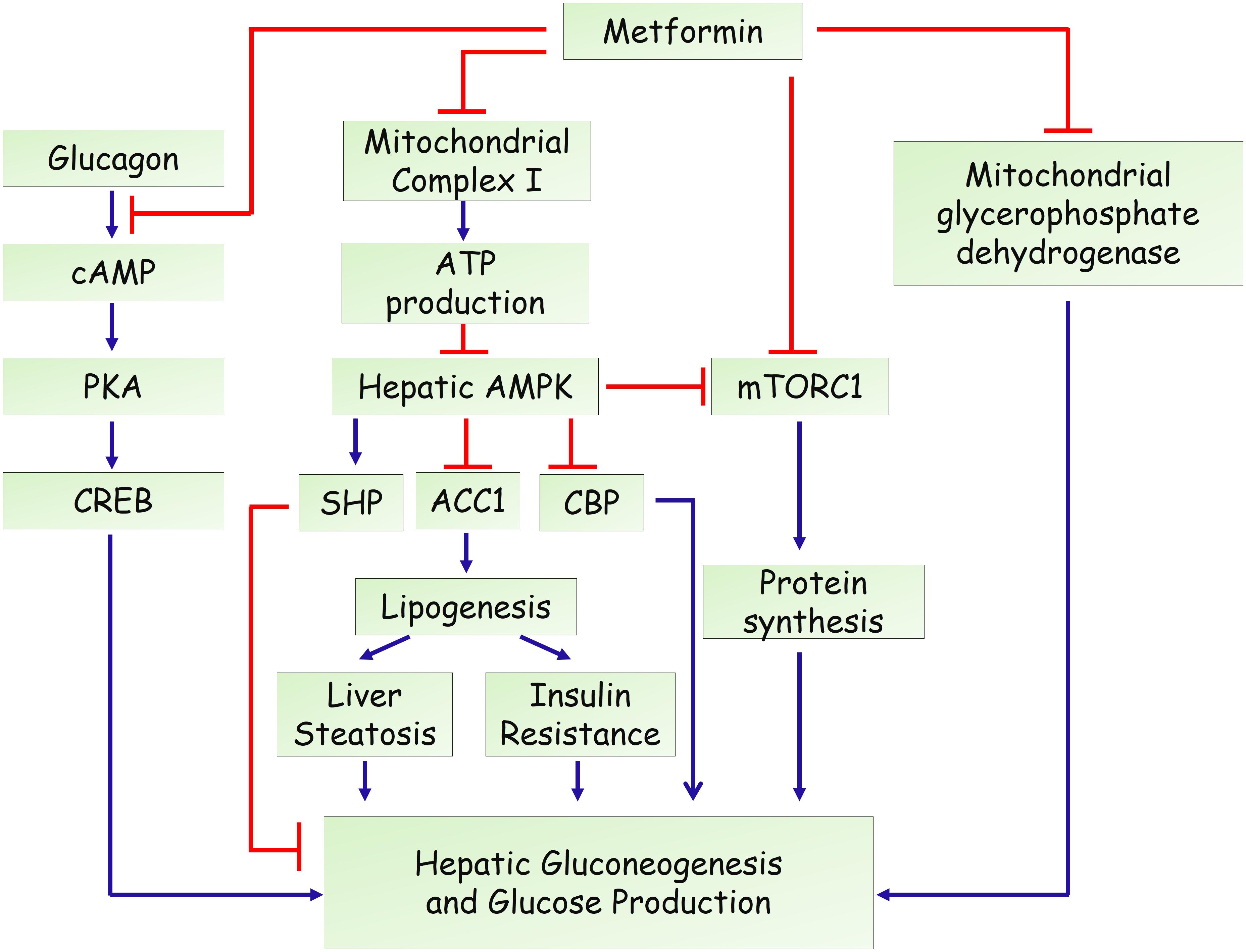
In essence, metformin makes the body more efficient at handling glucose, meaning the pancreas doesn't have to produce as much insulin to do the same job. This reduction in circulating insulin is the key to breaking the PCOS vicious cycle.
Role in Managing Metabolic Aspects of PCOS
By improving insulin sensitivity and lowering insulin levels, metformin directly addresses the metabolic disturbances of PCOS.
Metformin in polycystic ovary syndrome - PubMed Central - NIH
Now, let's explore the clinical benefits that result from this mechanism. This comprehensive review article from the NIH's PubMed Central offers a deep dive into metformin's long-term protective effects.
Please read the section 'Long-term effects of metformin in patients with polycystic ovary syndrome' (Section 3.4). Focus on how metformin provides protective effects against cardiovascular disease, fatty liver disease (MASLD), metabolic syndrome (MS), and endometrial cancer (EC).
The clinical benefits for metabolic health are significant:
- Improved Glycemic Control: By lowering blood glucose and insulin levels, metformin significantly reduces the risk of progression from pre-diabetes to type 2 diabetes, a major long-term risk for women with PCOS.
- Weight Management: While not a dedicated weight-loss drug, metformin often results in modest weight loss or, importantly, prevents the weight gain commonly associated with hyperinsulinemia.
- Improved Lipid Profile: It can help lower triglycerides and LDL cholesterol, contributing to better cardiovascular health.
- Reduction of Long-Term Risks: As you read, long-term use is associated with a reduced risk of major PCOS comorbidities, including:
- Metabolic Syndrome: A cluster of conditions including hypertension, high blood sugar, excess body fat, and abnormal cholesterol levels.
- Metabolic Dysfunction-Associated Steatotic Liver Disease (MASLD): Also known as fatty liver disease.
- Cardiovascular Disease.
Test your understanding!
A patient with PCOS and insulin resistance is started on metformin. Her doctor explains that the primary way this medication will help her long-term health is by reducing her liver's production of glucose. How does this single action lead to widespread metabolic benefits, such as a lower risk of type 2 diabetes?
Show answer
By reducing the liver's glucose output, the overall glucose load in the bloodstream decreases. This means the pancreas is under less pressure and can secrete less insulin to maintain normal blood sugar levels. This lowering of chronic insulin levels (hyperinsulinemia) is the key. It improves the body's overall insulin sensitivity, reduces the drive for fat storage, and directly tackles the central metabolic defect, thereby lowering the long-term risk of the pancreas becoming exhausted and the patient developing type 2 diabetes.
Role in Managing Reproductive Aspects of PCOS
By correcting the underlying metabolic dysfunction, metformin also has profound effects on the reproductive system.
Mechanism of Action: How Metformin Works in PCOS
Let's return to the Liv Hospital article to see how the metabolic improvements translate into hormonal and reproductive benefits.
Please read the section 'Metformin’s Effects on Hormonal Balance'. Note its effects on androgen levels, SHBG, and the regulation of menstrual cycles.
The key reproductive benefits are:
-
Reduction in Hyperandrogenism: This is a direct consequence of lowering insulin levels. With less insulin stimulating the theca cells of the ovary and the adrenal glands, androgen production falls. This can lead to clinical improvements in acne and hirsutism. Metformin may also help increase levels of Sex Hormone-Binding Globulin (SHBG), which binds free testosterone, further reducing its biological activity.
-
Restoration of Menstrual Regularity and Ovulation: The reduction in ovarian androgens can help restore the normal feedback mechanisms of the HPO axis. This can lead to the resumption of regular, spontaneous ovulation and menstrual cycles in some women.
Metformin for Fertility: A Nuanced View
While metformin can restore ovulation, it's important to understand its place in fertility treatment. It is not considered a first-line agent for ovulation induction in women seeking immediate pregnancy.
PCOS & Ovulation Induction: How Can You Ovulate With PCOS?
Dr. Natalie Crawford, a reproductive endocrinologist, provides an excellent clinical perspective on where metformin fits in the context of fertility treatment for PCOS.
Please watch the segment from 07:45 to 11:46. Pay attention to the results of the landmark study comparing metformin, Clomid (clomiphene citrate), and a combination of the two. Note the conclusion about metformin's role as an 'adjunct' rather than a primary fertility drug.
As the video explains, studies have shown that dedicated ovulation induction agents like clomiphene citrate or letrozole are more effective than metformin alone at achieving pregnancy. However, metformin remains an important adjuvant (add-on) therapy. By improving the underlying metabolic environment, it can help make the ovaries more responsive to other fertility treatments.
Deeper Dive: Direct Ovarian and Endometrial Effects
Given your interest in the deep theoretical aspects, it's worth noting that research suggests metformin's benefits aren't just systemic. It may also have direct effects within the reproductive tract.
The scientific review "Metformin in polycystic ovary syndrome" (LINK) discusses evidence that metformin can:
- Promote Follicular Development: By directly influencing the granulosa cells that support the growing egg, potentially through pathways involving autophagy and cell proliferation.
- Enhance Endometrial Receptivity: By improving the ability of the uterine lining to support a pregnancy, possibly by increasing glucose transporters (like GLUT4) and modulating local hormone receptors.
These direct mechanisms are still an active area of research but highlight how deep metformin's influence on reproductive health may be.
Conclusion
In this lesson, we have dissected the mechanism and multifaceted role of metformin in managing PCOS. It stands apart from purely hormonal treatments like COCs by targeting the foundational metabolic disturbance of insulin resistance.
Key Takeaways:
- Metformin's primary mechanism of action is the reduction of hepatic glucose production, primarily through the activation of the AMPK pathway.
- This action lowers circulating insulin levels, helping to break the vicious cycle of insulin resistance and hyperandrogenism that drives PCOS pathophysiology.
- Its role in metabolic management includes improving glucose control, aiding in weight management, and reducing long-term risks of type 2 diabetes and cardiovascular disease.
- Its role in reproductive management includes reducing androgen levels, restoring menstrual cyclicity, and improving ovulation, often used as an adjunct to primary fertility treatments.
Preview of the Next Lesson:
While COCs and metformin are powerful tools, some women may still struggle with persistent signs of androgen excess, particularly hirsutism. In our next lesson, we will discuss medications that are specifically designed to block the effects of androgens at their target tissues. We will cover: "the use and mechanisms of anti-androgen medications for treating clinical hyperandrogenism."