Hello! Welcome to the fifth lesson in our module on the management of PCOS.
In our previous lessons, we discussed foundational treatments that target the underlying hormonal and metabolic imbalances in PCOS. We covered combined oral contraceptives (COCs), which regulate the menstrual cycle and lower androgen production, and metformin, which targets the core issue of insulin resistance to reduce both metabolic dysfunction and androgen excess.
However, even with these treatments, the clinical signs of hyperandrogenism—particularly hirsutism (excess hair growth)—can be persistent and distressing. This is where a more direct approach is needed. Today's lesson addresses the learning outcome: Describe the use and mechanisms of anti-androgen medications for treating clinical hyperandrogenism.
We will explore a class of medications designed not just to reduce the production of androgens, but to block their action at the target tissues, providing direct symptomatic relief.
The Strategy: How to Counteract Androgen Excess
Before diving into specific drugs, let's establish the main pharmacological strategies for combating hyperandrogenism in PCOS:
- Suppressing Androgen Production: This is what COCs do by lowering LH levels, and what metformin does by reducing insulin's stimulatory effect on the ovaries.
- Increasing Androgen Binding: COCs achieve this by boosting the liver's production of Sex Hormone-Binding Globulin (SHBG), which "soaks up" free testosterone from the blood.
- Blocking Androgen Action at the Receptor: This involves using drugs that prevent androgens from binding to their receptors in tissues like hair follicles and sebaceous glands.
- Inhibiting Androgen Conversion: This strategy prevents the conversion of testosterone into its more potent form, dihydrotestosterone (DHT).
Today, we will focus on strategies 3 and 4. The image below provides a helpful classification of anti-androgen medications based on their mechanism.

First-Line Approach: The Anti-Androgenic Effects of COCs
As we've discussed, COCs are the first-line pharmacological treatment for the hyperandrogenic symptoms of PCOS in women who do not wish to conceive. It's useful to quickly review why they are so effective.
To see a concise summary of these mechanisms, please watch the following clip.
Hirsutism: Diagnosis, Examination, Management – Gynecology | Lecturio
The video 'Hirsutism: Diagnosis, Examination, Management' from Lecturio Medical effectively summarizes the multiple ways in which oral contraceptive pills combat hyperandrogenism.
Please watch from 04:43 to 05:55. Focus on the three main mechanisms mentioned: decreased LH secretion, increased SHBG production, and inhibition of 5-alpha reductase activity by progestins.
To summarize the video and our previous discussions, COCs work by:
- Suppressing Ovarian Androgen Production: The estrogen and progestin in the pill provide negative feedback to the pituitary, reducing LH secretion and thus decreasing the stimulation of ovarian theca cells to produce androgens.
- Increasing SHBG: The estrogen component stimulates the liver to produce more SHBG. More SHBG means less free, biologically active testosterone is available to act on tissues.
- Direct Anti-Androgenic Progestin Effects: Some progestins used in modern COCs have direct anti-androgenic properties. For example, drospirenone is structurally similar to spironolactone (which we will discuss next) and acts as an androgen receptor antagonist. Other progestins can inhibit the enzyme 5-alpha reductase.
Second-Line and Adjunctive Therapies: True Anti-Androgens
For women whose symptoms (especially moderate-to-severe hirsutism) do not sufficiently improve after at least six months on a COC, or for whom COCs are contraindicated, specific anti-androgen drugs may be added.
A crucial point for all the medications in this category is their teratogenicity. They can cause severe birth defects in a male fetus by interfering with normal sexual development. Therefore, reliable contraception is mandatory for any woman of reproductive potential taking these drugs. This is why they are often prescribed in combination with a COC, which provides both contraception and synergistic anti-androgenic effects.
Let's explore the main players in this category. The following reading provides a great overview of these drugs and their clinical effects.
Clinical Targeting of Androgen Excess
The research article 'The Mechanism of Androgen Actions in PCOS Etiology' from the journal Medicina provides an excellent, detailed summary of the various anti-androgen drugs used in PCOS.
Please read section 3 of the article, titled 'Clinical Targeting of Androgen Excess—Potential for Mitigating Against PCOS'. Focus on the descriptions of spironolactone, flutamide, cyproterone acetate, and finasteride, noting their mechanisms and reported effects on PCOS symptoms.
Based on this reading and other evidence, let's break down each medication.
1. Spironolactone (An Androgen Receptor Antagonist)
Spironolactone is the most commonly used anti-androgen for PCOS in many parts of the world, including the US.
- Primary Mechanism: Its main job is to act as a competitive antagonist at the androgen receptor. It binds to the receptor in target cells (like in hair follicles) and blocks testosterone and DHT from binding, thereby preventing them from exerting their effects.
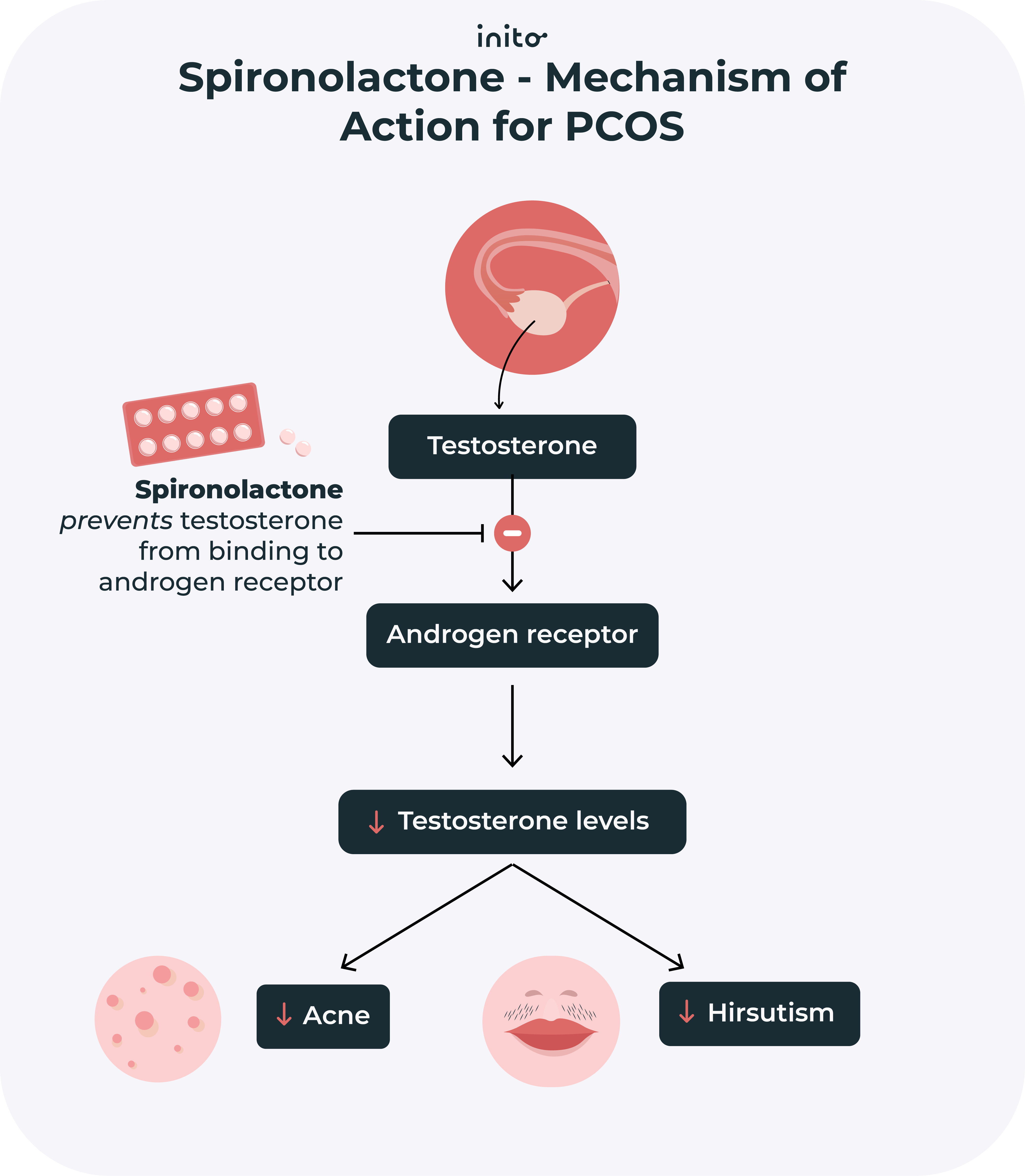
- Secondary Mechanisms: It also has weaker effects, including inhibiting 5-alpha reductase and competing with testosterone for binding to SHBG.
- Clinical Use: It is effective for treating hirsutism and acne. It is often started at a low dose and gradually increased. Because it is also a potassium-sparing diuretic (originally developed to treat high blood pressure), it can affect electrolytes, which requires monitoring.
2. Finasteride (A 5-Alpha Reductase Inhibitor)
Finasteride works through a completely different, more specific mechanism.
- Mechanism: It selectively inhibits the Type 2 5-alpha reductase enzyme. This enzyme is responsible for converting testosterone into the much more potent androgen, dihydrotestosterone (DHT), within the hair follicle and skin. By blocking this conversion, finasteride significantly reduces the androgenic stimulation in these target tissues without lowering circulating testosterone levels.
- Clinical Use: It is primarily used for hirsutism and sometimes for androgenic alopecia (hair loss).
Test your understanding!
A patient with PCOS is successfully using a COC, which has reduced her androgen production. However, she still has significant hirsutism. Her doctor is considering adding either spironolactone or finasteride. Explain how the mechanisms of these two drugs differ in how they would address her persistent hirsutism.
Show answer
The two drugs would address her hirsutism through distinct mechanisms at the level of the hair follicle:
- Spironolactone would work by blocking the androgen receptor itself. Even though testosterone and DHT are still present, spironolactone would prevent them from binding to the receptor and signaling the hair follicle to grow.
- Finasteride would work one step earlier in the pathway. It would block the 5-alpha reductase enzyme, preventing testosterone from being converted into the more powerful DHT. This reduces the potency of the androgen signal reaching the receptor, but it doesn't block the receptor itself from the remaining testosterone.
3. Other Anti-Androgens
There are other potent anti-androgens, though their use is often limited by side effect profiles or availability.
- Flutamide: This is a non-steroidal, pure androgen receptor antagonist. As you read in the PMC article, it is very effective for hirsutism and acne. However, its use is severely limited by a risk of hepatotoxicity (severe liver damage), making it an uncommon choice for a non-lethal condition like PCOS.
- Cyproterone Acetate (CPA): This is a powerful anti-androgen that also has strong progestogenic activity. It works by blocking the androgen receptor. It is not available as a standalone drug in the US but is widely used in other countries, often formulated with ethinyl estradiol in a combined oral contraceptive pill (e.g., Diane-35).
Summary of Treatment Approach for Hyperandrogenism
To put it all together, the management of clinical hyperandrogenism in PCOS follows a stepwise approach:
Polycystic Ovarian Syndrome - StatPearls
Let's consult the StatPearls article on PCOS, a peer-reviewed clinical reference, to solidify our understanding of the treatment hierarchy for hirsutism.
Please read the subsection 'Symptom-based Treatment for Hirsutism, Alopecia, and Acne'. Focus on the roles of OCPs as first-line treatment and when adjuvant anti-androgens should be considered.
Based on this, the typical clinical ladder is:
- First-Line: Lifestyle modifications (diet and exercise) plus a combined oral contraceptive (COC), preferably one with a neutral or anti-androgenic progestin. This is the starting point for most women not seeking pregnancy.
- Evaluation: Assess the response after at least 6 months. It takes this long for changes in hair growth cycles to become clinically apparent. Cosmetic measures (like shaving, waxing, or laser hair removal) are used during this time.
- Second-Line / Adjunctive Therapy: If hirsutism is moderate to severe, or the response to COCs alone is inadequate, an anti-androgen is added to the COC. Spironolactone is the most common choice.
- Contraception is Key: It is critical to reiterate that if an anti-androgen is used without a COC, another highly reliable form of contraception is essential due to the risk of birth defects.
Conclusion
In this lesson, we have focused on the medications used to directly combat the clinical signs of androgen excess in PCOS. While therapies like metformin and COCs work "upstream" to reduce androgen production, the drugs we discussed today work "downstream" at the target tissue.
Key Takeaways:
- Anti-androgen therapy aims to either block the androgen receptor or inhibit the conversion of testosterone to DHT.
- Combined oral contraceptives (COCs) are the first-line pharmacological treatment for hyperandrogenic symptoms due to their multiple mechanisms (LH suppression, SHBG increase, and direct progestin effects).
- For persistent or severe symptoms, second-line agents are added. Spironolactone (an androgen receptor blocker) is the most common choice.
- Finasteride (a 5-alpha reductase inhibitor) is another option that specifically targets the conversion of testosterone to the more potent DHT.
- More potent drugs like flutamide are limited by significant side effects, such as liver toxicity.
- Because all true anti-androgens are teratogenic, their use requires strict, reliable contraception.
Preview of the Next Lesson:
We have now covered the main pharmacological strategies for managing the menstrual, hyperandrogenic, and metabolic symptoms of PCOS. Our next lesson will shift focus to a major consequence of PCOS: infertility. We will explore the learning outcome: "Outline pharmacological approaches for ovulation induction in women with PCOS seeking fertility."