Hello! Welcome back to your course on storytelling.
In our last lesson, you learned how to identify a story's theme—the central idea that gives it meaning. We saw that theme is the "why" behind a story. Today, we're going to explore the "how" by dissecting its fundamental blueprint. This lesson addresses the learning outcome: Identify the key components of traditional story structure (e.g., exposition, inciting incident, climax, resolution).
By the end of our 60 minutes, you'll be able to recognize the key milestones that give a narrative its shape and momentum, a skill that's foundational for both analyzing and creating stories in film and video games.
The Blueprint of Story: The Three-Act Structure
Nearly every story you've ever loved, from an epic film to a simple folk tale, follows a basic, intuitive pattern: a beginning, a middle, and an end. This concept was first articulated by Aristotle over two thousand years ago and remains the most common framework for storytelling today. In modern screenwriting and narrative design, this is known as the Three-Act Structure.
Let's get a formal definition.
Three Act Structure in Film: Definition and Examples
The article 'Three Act Structure in Film' provides a great, concise overview of this concept. We'll read the sections that define the structure and touch on its history.
Please read the first few sections of the article, starting from the top down to the end of the section titled 'Act III: Resolution or Payoff'. Focus on understanding the primary role of each act: Act I: Setup Act II: Confrontation Act III: Resolution
As the article explains, these three acts provide a container for the story's events.
- Act I (The Beginning) introduces the characters and their world.
- Act II (The Middle) develops the story by presenting escalating conflict.
- Act III (The End) resolves the story and its central conflict.
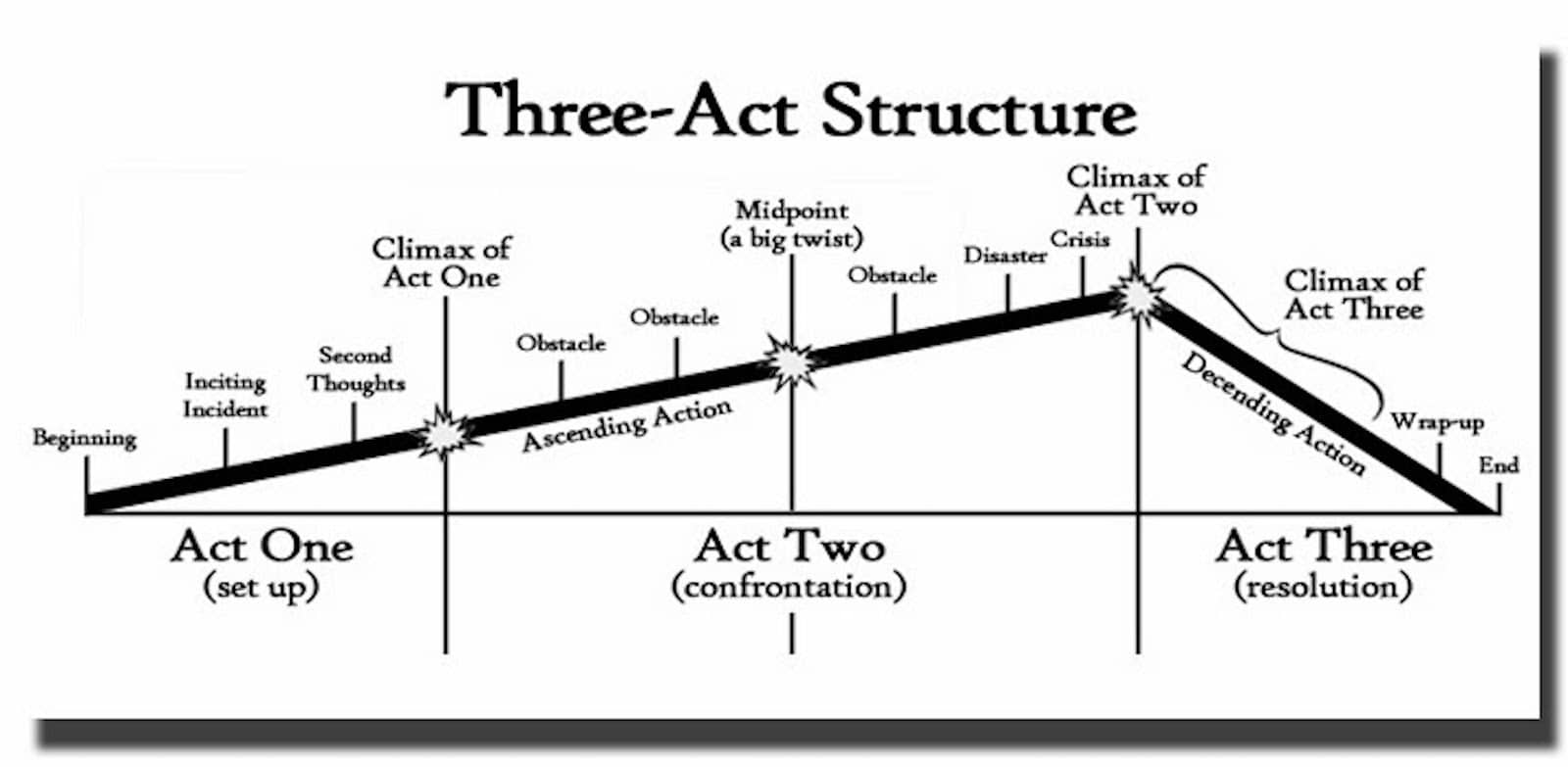
This diagram gives you a clear visual map of the journey, showing how tension rises and falls across the three acts.
The Key Beats: A Story's Milestones
The three acts are not just arbitrary divisions; they are separated by crucial turning points called story beats or plot points. These are the specific, significant moments that push the story forward. Let's break them down.
We'll use a fantastic video from StudioBinder that explains these beats using Jurassic Park as a running example.
Three Act Structure Explained — The Secret to Telling a Great Story
The video 'Three Act Structure Explained' breaks down the structure into eight key moments. It's a comprehensive guide that we will go through piece by piece.
We will watch this video in segments as we discuss each part of the structure. For now, just get ready to press play.
Act I: The Setup
The first act is all about establishing the "normal world" before the adventure begins. It typically takes up the first 25% of the story.
-
Exposition and The Status Quo: This is the "before" picture. We meet the protagonist and learn about their ordinary life, their goals, and their flaws. In video games, this is often where you learn the basic controls in a relatively safe environment.
-
The Inciting Incident: This is the moment that shatters the protagonist's normal life. It's an event that introduces the central conflict and poses a dramatic question that the rest of the story will answer. It's the stray meteor, the mysterious letter, the call for help.
{
"type": "video",
"title": "Three Act Structure Explained — The Secret to Telling a Great Story",
"id": "LINK",
"video_id": "tvqjp1CxxD8",
"relevant_section_indices": [
2
],
"par_intro": "Let's see how the video explains the Inciting Incident. Pay attention to how it's presented as a choice for the protagonist.",
"par_directions": "Watch the segment from 06:15 to 08:12."
}
    Often, the protagonist will initially **refuse the call to adventure**, a beat that highlights the stakes and makes their eventual decision to engage more meaningful. They might say, "I'm just a simple farmer," or "This mission is too dangerous."

3.  **The First Plot Point (Break into Act 2)**: This is the true point of no return. The protagonist makes a choice that locks them into the story's central conflict. They board the spaceship, accept the quest, or step through the portal. This beat marks the end of Act I and propels us into Act II.

    ```grasp
{
  "type": "video",
  "title": "Three Act Structure Explained — The Secret to Telling a Great Story",
  "id": "[LINK](https://www.youtube.com/watch?v=tvqjp1CxxD8)",
  "video_id": "tvqjp1CxxD8",
  "relevant_section_indices": [
    3
  ],
  "par_intro": "Now, watch how the First Plot Point functions as a threshold the character cannot go back across.",
  "par_directions": "Watch the segment from 08:12 to 11:09."
}
Act II: The Confrontation
This is the longest act, typically making up the middle 50% of the story. The protagonist, now committed to their journey, faces a series of escalating obstacles. The stakes get higher, and the challenges become more difficult.
-
The Midpoint: Occurring halfway through the story, the Midpoint is a major turning point. It often shifts the protagonist's role from reactive to proactive. They might discover a crucial piece of information, suffer a major setback, or have a revelation that changes their understanding of the conflict. The stakes are raised dramatically, and the goal often becomes clearer and more urgent.
{
"type": "video",
"title": "Three Act Structure Explained — The Secret to Telling a Great Story",
"id": "LINK",
"video_id": "tvqjp1CxxD8",
"relevant_section_indices": [
5
],
"par_intro": "The Midpoint is a crucial beat that re-energizes the narrative. See how Jurassic Park's iconic T-Rex scene functions as a perfect Midpoint.",
"par_directions": "Watch the segment from 14:37 to 17:47."
}
#### Act III: The Resolution

The final 25% of the story. All the plotlines converge as the story races toward its conclusion.

5.  **The Third Plot Point (The Low Point)**: Just before the end, everything seems lost. The hero faces their darkest moment—a major defeat, the death of a mentor, or the revelation of a terrible truth. This "dark night of the soul" forces them to look inward and gather the strength they need for the final confrontation.

    ```grasp
{
  "type": "video",
  "title": "Three Act Structure Explained — The Secret to Telling a Great Story",
  "id": "[LINK](https://www.youtube.com/watch?v=tvqjp1CxxD8)",
  "video_id": "tvqjp1CxxD8",
  "relevant_section_indices": [
    7
  ],
  "par_intro": "This beat serves as the launchpad for the Climax. Notice how it's often a mix of a 'false victory' followed by a devastating low moment.",
  "par_directions": "Watch the segment from 20:47 to 23:01."
}
-
The Climax: This is it—the final showdown between the protagonist and the antagonistic force. The central dramatic question is answered. Will the hero defuse the bomb? Will they defeat the villain? Will they win the love of their life? The Climax is the most intense, high-stakes moment of the entire story.
-
The Resolution (or Dénouement): After the storm of the Climax comes the calm. The Resolution shows the aftermath. We see the protagonist in their new reality, a "new status quo." This is where the theme is often crystallized, as we see how the character has—or has not—changed as a result of their journey.
{
"type": "video",
"title": "Three Act Structure Explained — The Secret to Telling a Great Story",
"id": "LINK",
"video_id": "tvqjp1CxxD8",
"relevant_section_indices": [
8
],
"par_intro": "Finally, let's watch the video's explanation of the Climax and Resolution, which bring the story to a satisfying close.",
"par_directions": "Watch the final segment from 23:01 to 27:06."
}
### Story Structure in Video Games

Your goal includes understanding storytelling in video games, where things can be more complex. A 100-hour open-world game can't follow this structure in the same way a 2-hour movie does. So how does it apply?

The key is to think of structure as a **fractal**. The overall main story of a game like *The Last of Us* or *God of War* will have a clear three-act structure. But, critically, individual levels, chapters, and even side quests are often designed as their own miniature three-act stories.

```grasp
{
  "type": "reading",
  "title": "How to Apply The Three-Act Structure in Video Games",
  "id": "[LINK](https://gamedesignskills.com/game-design/three-act-structure/)",
  "url": "https://gamedesignskills.com/game-design/three-act-structure/",
  "relevant_section_indices": [
    1
  ],
  "par_intro": "This article, 'How to Apply The Three-Act Structure in Video Games,' does an excellent job explaining this concept. It shows how game designers use this structure for both the main plot and smaller quests to create consistently engaging experiences.",
  "par_directions": "Please read the sections titled 'So, does the three-act structure work in video games?', 'The three-act structure in the main quest storyline', and the example of 'The Witcher 3's' side quest. Focus on how the structure is applied at both macro (main story) and micro (side quest) levels.",
  "estimated_time": "10 minutes"
}
As the article illustrates with The Witcher 3, a simple monster-hunting contract can have:
- Act I: You accept the contract (Inciting Incident) and investigate the scene.
- Act II: You follow tracks, fight lesser monsters, and learn the monster's true nature (Rising Action, Midpoint).
- Act III: You confront the main monster (Climax) and collect your reward (Resolution).
This modular approach ensures that even short play sessions feel satisfying and complete, while still contributing to the larger narrative.
Test your understanding!
Think of a film or game you know very well. Can you identify its core structural beats? Try to pinpoint the following five moments in the story:
- Inciting Incident: What event kicks off the story?
- First Plot Point: When does the hero commit to the adventure (point of no return)?
- Midpoint: What happens halfway through that raises the stakes or changes the goal?
- Climax: What is the final, decisive confrontation?
- Resolution: What does the "new normal" look like at the very end?
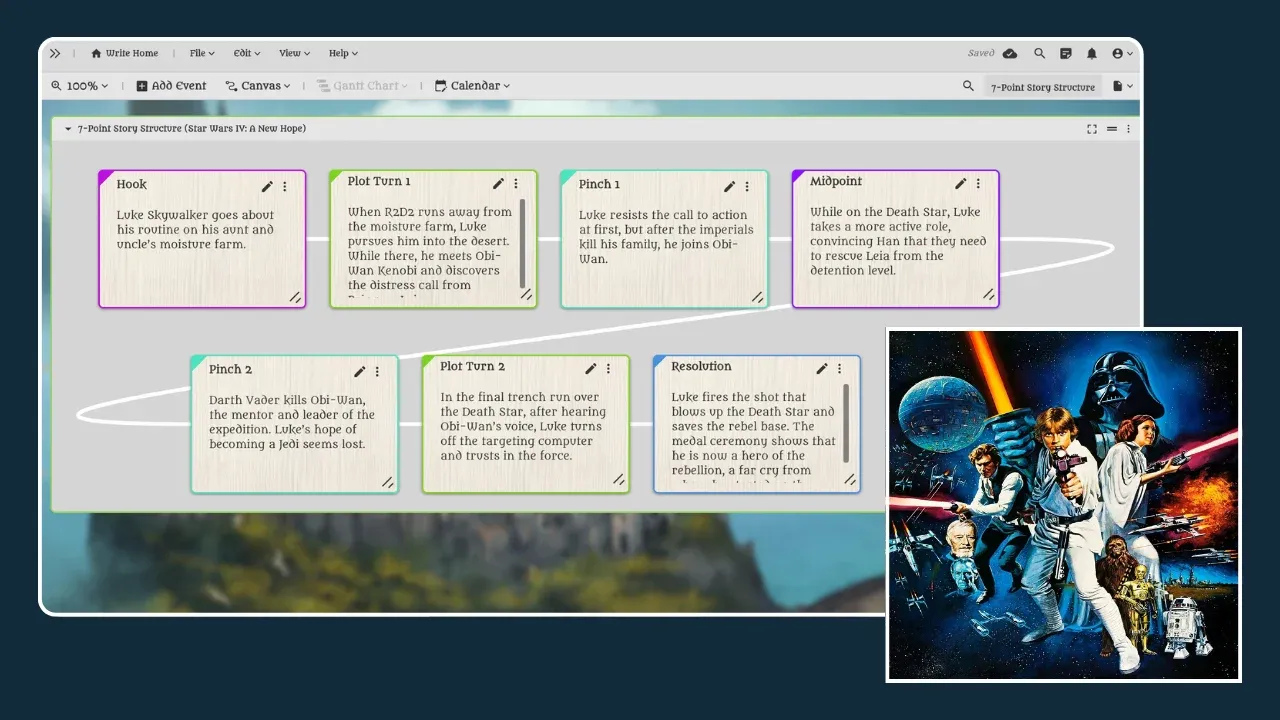
Use the image below of the 7-Point Structure applied to Star Wars: A New Hope as a guide. (Note: The 7-Point Structure is just a slightly different mapping of the same core beats).
Show answer
Your answer will depend on the story you chose, but let's use a game example: The Last of Us.
- Inciting Incident: A wounded Marlene tasks Joel with smuggling Ellie out of the Boston QZ. Joel, initially reluctant, accepts for the promise of getting his stolen weapons back.
- First Plot Point: Joel discovers Ellie is immune. After Tess is killed, she makes him promise to get Ellie to the Fireflies. This is no longer a simple smuggling job; it's Tess's dying wish and has much higher stakes. Joel is locked in.
- Midpoint: After surviving the encounter with Bill and getting a truck, Joel and Ellie's journey truly begins as they drive out of Boston. However, they are ambushed in Pittsburgh, forcing them to work together with Henry and Sam. This marks a shift from a solo journey to being part of a fragile team, and Joel begins to slowly open up.
- Climax: The confrontation at the Firefly hospital. Joel learns the doctors must kill Ellie to create a vaccine. He fights his way through the hospital to "rescue" her.
- Resolution: Joel lies to Ellie, telling her the Fireflies had found others who were immune and couldn't make a cure. They arrive at the safe community in Jackson. The "new normal" is one of physical safety but built on a foundation of emotional dishonesty, setting the stage for the sequel.
Conclusion
Today, we've mapped out the skeleton of traditional storytelling. The Three-Act Structure is not a rigid formula that stifles creativity, but a powerful framework that helps create a psychologically resonant and emotionally satisfying journey for the audience. By understanding its key components, you've gained a crucial tool for analyzing stories and a reliable blueprint for building your own.
Key Takeaways:
- Traditional narrative is built on the Three-Act Structure: a beginning (Setup), a middle (Confrontation), and an end (Resolution).
- The acts are defined by key turning points, or beats, including the Exposition, Inciting Incident, Plot Points, Midpoint, Climax, and Resolution.
- These beats guide the protagonist's journey, escalate stakes, and provide a satisfying narrative arc.
- In video games, this structure is fractal: it applies to the main plot as well as to individual missions and side quests, providing structure to both long and short play sessions.
Preview of the Next Lesson:
Structure provides the roadmap for a story, but what is the engine that drives it forward from one beat to the next? The answer is conflict. In our next lesson, we will explore the main types of narrative conflict and analyze how conflict is used to drive plot progression in film and games.