Hello! Welcome back to your course on storytelling.
In our first lesson, we established a method for active analysis, learning to ask "why" creators make certain choices. We broke down stories into their literary, dramatic, and cinematic components. Today, we're going to zoom in on one of the most important of those literary elements: theme. This lesson is all about learning to identify the core theme or central message of a story. By the end of our session, you'll be able to distinguish theme from similar concepts and spot how it's woven into the fabric of a film or game.
What is a Story's Theme?
If the plot is what happens in a story, the theme is what the story is about on a deeper level. It's the central idea, argument, or question about life and the human condition that the story explores. It's the "so what?"—the reason the story matters.
Let's start with a clear and practical explanation of what theme is and why it's so fundamental to storytelling.
What is Theme — 5 Ways to Layer Theme into a Screenplay
This video from StudioBinder, 'What is Theme — 5 Ways to Layer Theme into a Screenplay,' provides an excellent introduction. It clearly defines theme and distinguishes it from plot and moral.
Please watch the first section of the video, from the beginning to 04:39. Pay close attention to how it defines theme as the 'central and unifying idea' and contrasts it with a story's moral.
As the video explains, a theme isn't just a topic; it's a perspective on that topic. It often explores a universal question that connects with the audience on an emotional or philosophical level.
Clearing Up the Confusion: Theme vs. Topic vs. Moral
One of the biggest hurdles in identifying theme is that the word is often used interchangeably with other concepts like "topic" and "moral." Understanding the difference is key to sharp analysis.
To help solidify these distinctions, let's turn to a short, focused article that breaks them down clearly.
Understanding Story Theme: What It Is and Isn't
The article 'Understanding Story Theme: What It Is and Isn't' from My Story Doctor is excellent at clarifying these easily confused terms. We will focus on the sections that define what theme is and, just as importantly, what it isn't.
Please read the sections titled 'So What Is Theme?', 'What Theme Is Not', and 'Theme vs. Topic vs. Moral'. These sections will give you a robust framework for telling these concepts apart.
Let's summarize the key differences from that reading:
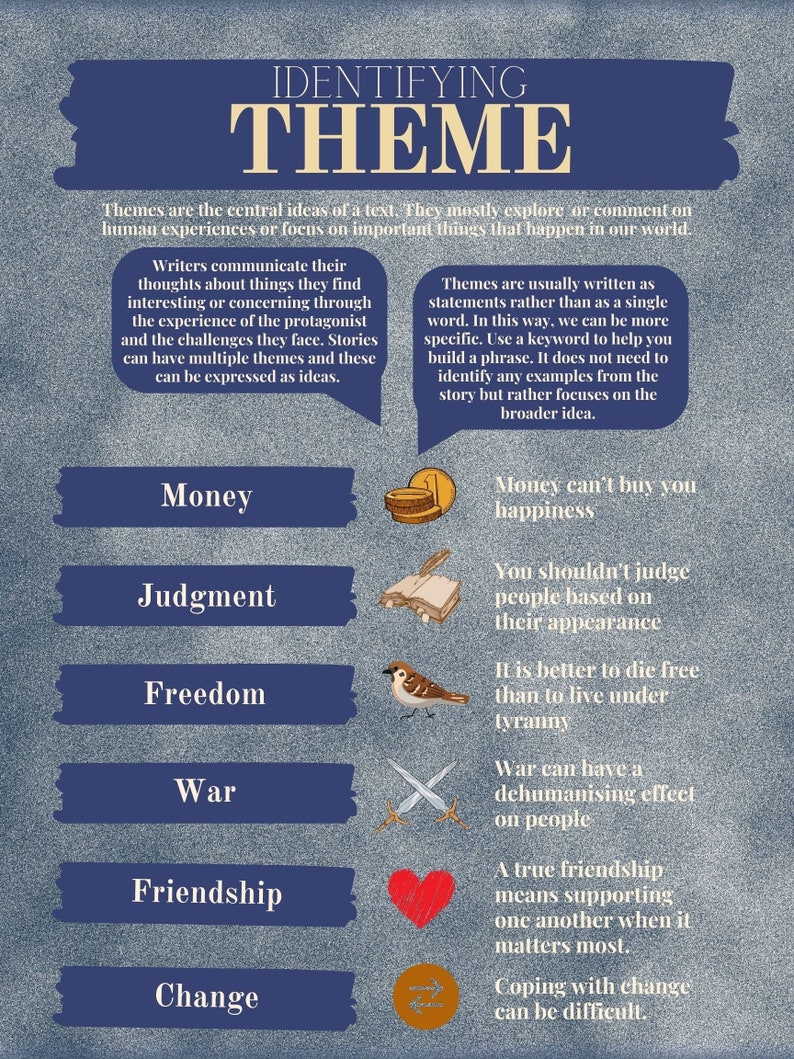
- Topic: A one-word subject. It's neutral and broad. (e.g., "Love," "War," "Justice")
- Theme: A statement or question about the topic. It has a point of view. (e.g., "Love requires vulnerability," "War destroys the innocence of youth," "Can justice ever truly be fair?")
- Moral: A direct lesson or rule to live by. It's an answer, while a theme is often an exploration or a question. (e.g., "Always be kind," "Slow and steady wins the race.")
This infographic provides a great visual summary of how a broad topic can be focused into a specific thematic statement.
Test your understanding!
Let's take the topic "Family."
Turn this topic into:
- A thematic statement.
- A moral.
Can you see the difference?
Show answer
Here are some examples. Your answers may vary, but they should follow the same principles.
- Thematic Statement: "True family is not defined by blood, but by loyalty and sacrifice." (This is an idea the story explores through its characters and plot). Another example could be a question: "Is it possible to escape the toxic patterns of the family you were born into?"
- Moral: "You should always stick by your family." (This is a direct instruction on how to behave).
The theme explores a complex idea, while the moral gives a simple rule. Most modern, sophisticated stories focus on exploring themes rather than delivering morals.
How to Find the Theme in a Story
Now that we know what we're looking for, how do we actually find it? Themes aren't usually stated outright. Instead, they are woven into the story's DNA. Here are a few practical methods you can use.
This next video offers three straightforward techniques for identifying a story's theme.
The YouTuber D4Darious, in his video 'How To Find A Theme,' provides three simple and effective starting points for your analysis.
Watch the segment from 01:39 to 03:30. He outlines three clear methods you can use to uncover the theme.
To recap the video's excellent advice, you can find the theme by looking at:
- The Protagonist's Journey: How does the main character change from the beginning to the end? What have they learned? The nature of their transformation is often a direct reflection of the theme. For example, if a selfish character learns to be selfless, the theme might be about the value of community over individual gain.
- The Central Conflict: What are the opposing forces in the story? Which force wins, and why? The resolution of the main conflict often reveals the story's thematic argument. In Star Wars, the conflict between the Rebellion (hope, spirit) and the Empire (technology, control) explores the theme that faith in something greater than oneself can overcome technological might.
- Explicit Statements: Sometimes, a character (often a mentor or wise figure) will state a thematic idea directly. While this is less common in subtle storytelling, it's a clear signpost when it happens.
Deeper Analysis: How Theme is Expressed
Beyond those starting points, theme is also expressed through more nuanced artistic choices. The first video we watched hints at these, and now we'll explore them more deeply. Characters, setting, and symbols are all powerful tools for reinforcing a theme.
What is Theme — 5 Ways to Layer Theme into a Screenplay
Let's return to the StudioBinder video 'What is Theme.' This time, we'll look at how filmmakers layer theme into their work using specific narrative and cinematic elements.
Please watch from 04:39 to 17:55. This extended clip covers how theme is expressed through: Characters and Dialogue (using The Dark Knight). Setting (using Parasite). Motifs and Symbols (using Everything Everywhere All at Once). A deep-dive case study on how Jordan Peele layers multiple themes in Nope.
This clip shows how theme isn't an afterthought—it's an organizing principle that can guide decisions about every facet of the story, from the set design of a room to the repetition of a specific shape or object.
Theme in Video Games: The Guiding Principle
In video games, theme plays a similarly crucial role, but it also has a unique relationship with gameplay mechanics and player agency. Because of the long and complex development cycles of games, the theme is often one of the first things established to act as a North Star for the entire team.
This article from a game developer explains why theme is so foundational in interactive storytelling.
Writing in Games: The Trinity of Plot, Character Motivation ...
In 'Writing in Games: The Trinity of Plot, Character Motivation ...', James Dyson explains why theme is often prioritized above even plot in game development.
Please read the sections titled 'Theme' and the part of the 'Plot' section that discusses Silent Hill 2 and Bioshock. Notice how the theme informs not just the story, but also the game's mechanics and dialogue.
The examples from the article are fantastic illustrations of theme in action:
- BioShock: The theme of choice is not just in the plot (Ayn Rand-inspired philosophy), but is given directly to the player through the core mechanic of choosing to "harvest" or "save" the Little Sisters. The famous line "A man chooses, a slave obeys" ties the plot, philosophy, and player's actions directly to this central theme.
- Silent Hill 2: The theme of guilt and psychological horror is explored through the plot (James searching for his dead wife), but also through the other characters he meets, who act as twisted reflections of his own inner turmoil.
When analyzing a game, always ask: How do my actions as a player reinforce the story's central theme?
Conclusion
Today we've demystified the concept of theme. It's not just a vague topic, but a specific argument or question that gives a story its meaning and emotional weight. By learning to distinguish it from plot and moral, and by using analytical methods to spot it in a story's characters, conflicts, and design, you have gained a powerful tool for understanding narrative.
Key Takeaways:
- Theme is the central, unifying idea of a story—what it's really about.
- A topic is a word (e.g., "loyalty"), while a theme is a statement about that word (e.g., "Loyalty to a corrupt cause can destroy you"). A moral is a simple lesson ("Be loyal to your friends").
- You can identify theme by analyzing the protagonist's change, the resolution of the central conflict, and the use of characters, setting, and symbols.
- In video games, theme is often a foundational principle that guides both narrative and gameplay mechanics.
Preview of the Next Lesson:
Now that you can identify what a story means, we'll move on to how it's built. In the next lesson, we will dissect the skeleton of a story by learning to identify the key components of traditional story structure, such as the exposition, inciting incident, climax, and resolution. This will give you the blueprint for how stories are put together, piece by piece.