Hello! Welcome back to our journey into the art of storytelling.
In our last lesson, we explored the Three-Act Structure, which you can think of as the blueprint or skeleton of a story. We saw how key beats like the inciting incident and climax provide a roadmap for the narrative journey. But what powers the story along that road? What forces a character to move from the beginning to the end?
The answer is conflict. This lesson directly addresses the learning outcome: Identify the main types of narrative conflict (internal, interpersonal, societal, and environmental). If structure is the blueprint, conflict is the engine. It's the struggle that creates tension, forces characters to act, and makes an audience or player emotionally invested in the outcome.
By the end of this lesson, you'll be able to recognize and categorize the different forms of opposition that make stories compelling, a crucial skill for both analysis and creation.
What is Narrative Conflict?
At its core, conflict is simple: a character wants something, and an obstacle stands in their way. This opposition is the fundamental source of all drama. Without conflict, there is no story; there's just a sequence of events.
To kick things off, let's watch a short video segment that introduces this core idea.
How to Write the Main Conflict of the Story — The Engine of a Narrative
This video from StudioBinder, titled 'How to Write the Main Conflict of the Story,' provides an excellent introduction to why conflict is the 'soul of storytelling.'
Watch the beginning of the video, from 00:00 to 01:51. Focus on the core definition of conflict: the combination of a character's intention and an obstacle.
As the video explains, conflict isn't just about fights and arguments. It's about the fundamental tension between a character's goal and the forces preventing them from achieving it. These forces can be broken down into distinct categories.
The Two Major Categories: Internal and External Conflict
All narrative conflicts fall into one of two broad categories:
- Internal Conflict: A struggle that takes place within a character's mind. This is a battle with their own conscience, fears, desires, or beliefs.
- External Conflict: A struggle between a character and an outside force. This could be another person, the forces of nature, or the rules of a society.
The four types of conflict we are focusing on today can be sorted into these two bins. Internal conflict stands on its own, while interpersonal, environmental, and societal conflicts are all forms of external conflict.
You'll often see these described using the "Person vs. ..." or "Character vs. ..." phrasing. This infographic provides a great visual summary.
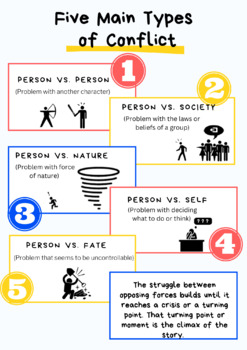
Now, let's dive into each of the four main types, using examples from both film and video games.
1. Internal Conflict (Person vs. Self)
This is the war within. An internal conflict arises from a character's own mind, creating a struggle between competing duties, desires, or beliefs. It's the hero grappling with fear, the villain questioning their own cruelty, or an ordinary person facing a difficult moral choice.
- In film, this is often revealed through a character's difficult decisions, emotional turmoil, or conversations where they express their inner doubts.
- In games, this can be powerfully expressed through player choice. When a game presents you with a difficult moral decision with no clear "right" answer, it's placing you directly inside the protagonist's internal conflict.
The following video segment explores how internal conflict creates compelling, multi-dimensional characters.
How to Write the Main Conflict of the Story — The Engine of a Narrative
Let's return to the StudioBinder video to see examples of internal conflict in action.
Watch the section on 'Inner Conflict' from 01:51 to 05:26. Notice how a character's internal struggle, like Buzz Lightyear's identity crisis or Chiron's struggle in Moonlight, becomes the core of their story.
A classic game example is the protagonist of Spec Ops: The Line, Captain Walker. As the game progresses, his internal conflict grows as he questions the morality of his own actions, leading to a psychological breakdown that the player experiences directly.
2. Interpersonal Conflict (Person vs. Person)
This is the most straightforward type of conflict: a struggle between two or more characters. This doesn't always mean a physical fight. It can be a battle of wits, a clash of personalities, or a competition for the same goal. The classic hero vs. villain dynamic is a prime example.
- In film, this can be anything from Luke Skywalker vs. Darth Vader to the simmering workplace rivalries in The Office.
- In games, this is everywhere. It's the basis of almost every combat encounter, every boss battle, and every competitive multiplayer match.
How to Write the Main Conflict of the Story — The Engine of a Narrative
The next segment of the StudioBinder video covers 'Personal Conflict,' which directly corresponds to the interpersonal conflict we're discussing.
Watch the section from 05:26 to 09:46. Pay attention to the variety of examples, from direct opposition (antagonists) to friction between friends and family.
To see how this applies specifically to games, let's look at an article from renowned game designer Brenda Romero.
This article from Game Developer, 'Types of Conflict in Games,' provides a game-centric view. We'll look at the section on 'Man vs. Man' conflict.
Read the short section titled 'Man vs. Man'. Notice how it translates the concept into game scenarios like 'good vs. evil', 'group vs. group', and competition for a 'top score/ranking'.
3. Environmental Conflict (Person vs. Nature)
This type of conflict pits a character against the forces of nature or their physical surroundings. This could be a struggle for survival against a storm, a wild animal, a harsh landscape, or a disease.
- In film, think of survival stories like The Martian or Cast Away. The primary antagonist isn't a person, but the unforgiving environment itself.
- In games, environmental conflict is often built directly into the level design. A chasm you can't cross, a locked door you need a key for, or a toxic area that drains your health are all forms of environmental conflict that you must overcome.
The StudioBinder video groups this with societal conflict into a larger category, but gives a clear example.
How to Write the Main Conflict of the Story — The Engine of a Narrative
Now we'll watch the segment on 'Extrapersonal Conflict.' While it covers two types, listen for the example of a character battling the wilderness.
Watch the first part of this section, from 09:46 to 10:28. The example from Into the Wild is a perfect illustration of Person vs. Nature.
The Game Developer article brilliantly connects this conflict type to game mechanics.
Let's return to the 'Types of Conflict in Games' article to see how environmental conflict translates into gameplay challenges.
Read the section 'Man vs. Nature/Environment'. This is a key insight for you as a future game storyteller: conflict can be geography, a locked door, or a security system. It's the 'challenge' part of a game's challenge-and-reward loop.
4. Societal Conflict (Person vs. Society)
Here, the character is at odds with the laws, traditions, or norms of a society or institution. This can involve fighting against a corrupt government, challenging an unjust law, or trying to escape the constraints of their culture.
- In film, stories like The Hunger Games (Katniss vs. the Capitol) or Erin Brockovich (a lone individual vs. a powerful corporation) are built on societal conflict.
- In games, this is the foundation of many dystopian and cyberpunk narratives. In games like Deus Ex or Half-Life 2, the player fights against oppressive, totalitarian regimes.
How to Write the Main Conflict of the Story — The Engine of a Narrative
Let's look at the second half of the 'Extrapersonal Conflict' segment, which gives a classic example of societal conflict.
Watch from 10:28 to 11:31. The example of To Kill a Mockingbird, where Atticus Finch combats societal racism, shows how a character can be pitted against an entire culture's ideology.
This is another area where the insights in the Game Developer article are particularly useful for bridging the gap between narrative theory and game design.
Finally, let's read the section on 'Man vs. Society' from the Game Developer article.
Read the 'Man vs. Society' section. Note how it frames this conflict as laws or codes preventing a character from doing what they want, a common setup for quests and main plots in role-playing games.
Test your understanding!
Think about the film Spider-Man: Into the Spider-Verse. Can you identify an example of each of the four types of conflict Miles Morales faces?
- Internal Conflict:
- Interpersonal Conflict:
- Environmental Conflict:
- Societal Conflict:
Show answer
-
Internal Conflict (Person vs. Self): Miles's primary internal conflict is his struggle with self-doubt and fear. He doesn't believe he can live up to the mantle of Spider-Man, and he must overcome this feeling of inadequacy to master his powers.
-
Interpersonal Conflict (Person vs. Person): The most obvious is his conflict with the main antagonist, Kingpin. He also has interpersonal conflicts with his father, who misunderstands him, and even friendly conflicts with Peter B. Parker, who is reluctant to mentor him.
-
Environmental Conflict (Person vs. Nature): A great example is when Miles and Peter are trying to escape the lab and must traverse a snowy forest while being pursued. The harsh weather and difficult terrain are environmental obstacles they must overcome. The collapsing super-collider at the climax is another, massive environmental threat.
-
Societal Conflict (Person vs. Society): Miles struggles with the expectations of his elite boarding school, which represents a societal pressure he doesn't feel he fits into. More broadly, the expectation of what "Spider-Man" should be is a societal construct he has to challenge and redefine for himself.
The Power of Layering Conflicts
Great stories rarely stick to just one type of conflict. They weave multiple types together to create a richer, more complex narrative. An external conflict often forces a character to confront an internal one.
For example, a soldier fighting an enemy in a war (interpersonal) might be forced to make a decision that tests their moral code (internal), all while battling for survival in a harsh jungle (environmental).
The final segment of the StudioBinder video provides a brilliant analysis of how the horror film Hereditary masterfully layers all three of its main conflict types.
How to Write the Main Conflict of the Story — The Engine of a Narrative
This last segment shows how a complex story uses multiple conflict layers simultaneously to build a deeply resonant narrative.
Watch the final section from 11:31 to 14:06. See how Hereditary combines Peter's internal guilt, the family's interpersonal drama, and the external supernatural forces to create a unified, terrifying story.
Conclusion
Today, you've learned to identify the engine of narrative: conflict. By understanding these core categories, you can now dissect stories with a more critical eye, seeing not just what is happening, but why it is compelling.
Key Takeaways:
- Conflict is the struggle between a character and an opposing force, driving the story forward.
- Internal Conflict (Person vs. Self) is a struggle within a character's own mind.
- Interpersonal Conflict (Person vs. Person) is a struggle against another character.
- Environmental Conflict (Person vs. Nature) is a struggle against the physical world or surroundings.
- Societal Conflict (Person vs. Society) is a struggle against laws, institutions, or cultural norms.
- The most powerful stories often layer multiple types of conflict to create depth and complexity.
Preview of the Next Lesson:
Now that you can identify the types of conflict, our next step is to understand their function. In the next lesson, we will analyze how conflict is used to drive plot progression. We'll look at how writers use these different conflict types to raise the stakes, create turning points, and move the story through the structure you learned about previously.