Hello! Welcome to the fifth lesson in our Foundations of Storytelling module.
In our last lesson, we identified the four main types of narrative conflict: internal, interpersonal, environmental, and societal. You learned to spot these struggles in films and games, understanding them as the fundamental building blocks of drama.
Today, we're taking the next crucial step. This lesson is designed to help you analyze how conflict is used to drive plot progression in a film or game. We'll move beyond simply identifying conflict to understanding its function as the engine of the story. You'll learn how writers and designers use a chain reaction of goals and obstacles to move characters through the narrative, from the first scene to the final resolution. This is the mechanism that turns a static situation into a dynamic, compelling plot.
Conflict as the Engine of Plot
We've established that conflict arises when a character wants something (a goal) and something else stands in their way (an obstacle). But how does this simple formula create an entire plot?
The answer lies in a cause-and-effect chain. A character's attempt to overcome an obstacle leads to an outcome. This outcome changes the situation and forces the character to form a new goal, which will inevitably meet a new obstacle. This cycle—Goal -> Conflict -> Outcome -> New Goal—is the heartbeat of your plot.
To explore this idea more deeply, let's look at an article that offers a powerful way to reframe our understanding of conflict.
Conflict in Fiction: What It Really Is and Why It's Important to ...
The article 'Conflict in Fiction: What It Really Is and Why It’s Important to Plot' by K.M. Weiland provides an excellent framework for understanding how conflict functions. It suggests we think of conflict less as 'confrontation' and more as 'obstacle.'
Please read the sections titled 'What Is Plot Conflict?' (covering plot conflict), 'Understanding How Goal/Conflict Function in Plot' (detailing scene structure), and 'What Is the Purpose of Conflict in Fiction?' (explaining its broader purpose). Focus on how the Goal-Conflict-Outcome structure works on a scene-by-scene basis to create forward momentum and raise the stakes.
As the article explains, every scene can be broken down into this fundamental structure. A character enters a scene with an intention, that intention is blocked by an obstacle, and the result of that clash (the outcome) forces the character to recalibrate and move into the next scene with a new intention. The sum of these scenes forms the plot.
Visualizing Plot Progression
This chain reaction of conflict is what builds the Rising Action of a story. Think back to the classic story structures we've discussed. Each obstacle the hero overcomes (or fails to overcome) raises the stakes and propels them further along their journey toward the Climax.
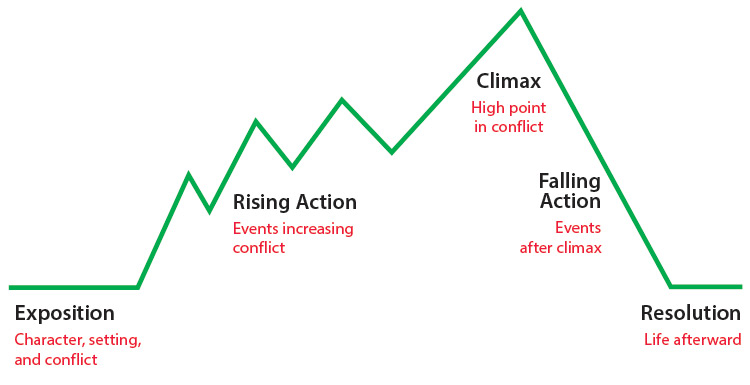
Let's use a film example to make this concrete. Consider the first Indiana Jones film, Raiders of the Lost Ark:
- Initial Goal: Retrieve the Golden Idol.
- Obstacle: His guide betrays him and the temple is full of traps.
- Outcome: He escapes with the Idol, but loses it to his rival, Belloq.
- New Goal: Get briefed by Army Intelligence about the Ark of the Covenant. They want him to get it before the Nazis.
- Obstacle: To find the Ark, he needs the Headpiece to the Staff of Ra, which is held by his old flame, Marion Ravenwood, who is angry at him.
- Outcome: He convinces Marion to partner with him, but a group of Nazi agents arrives to take the Headpiece.
As you can see, each outcome doesn't solve the main problem; it creates a new, more complicated one. The plot progresses not despite the obstacles, but because of them.
How Conflict Drives Plot in Video Games
This concept is even more direct in video games, where the player's primary activity is overcoming obstacles. As a future game designer, understanding how to align gameplay conflict with narrative conflict is one of the most important skills you can develop.
This article uses a classic video game to illustrate this perfectly.
Telling and Selling Stories the Video Game Way
Lara Willard's article, 'Telling and Selling Stories the Video Game Way,' breaks down storytelling into a simple formula: Character + Obstacles + Goal (C+O+G). It demonstrates how this drives progression in both games and traditional stories.
Read the sections 'Character + Conflict', 'C+O+G', and 'C+O+G in Pop Culture'. Pay close attention to the Super Mario Bros. 3 example, which shows how conflict drives the plot on multiple levels: the individual level, the world (like a chapter), and the overall game (the entire story).
The Super Mario example is brilliant in its simplicity. Each level is a self-contained plot: Mario has a goal (reach the end) and faces obstacles (Goombas, pits). The plot of the entire game is the sum of these smaller plots, driving toward the ultimate goal of rescuing the princess from the ultimate obstacle, Bowser.
This flowchart gives a mechanical view of how this works in a game's structure. The player is constantly in a loop of encountering and attempting to overcome obstacles.

Ludonarrative Dissonance: When Gameplay and Plot Clash
A crucial concept in game storytelling is what happens when the conflict of the gameplay (what you do) doesn't match the conflict of the story (what the plot is about). This is called ludonarrative dissonance. ("Ludo" from the Latin for "game").
For example, if the story presents a character as a kind and merciful pacifist, but the gameplay requires the player to violently eliminate hundreds of enemies, there's a disconnect. The gameplay conflict is undermining the plot conflict.
The following video explores this idea using two of the most famous "cinematic" game franchises.
"Cinematic" Games and Their Very Weird Storytelling
In this video essay, '"Cinematic" Games and Their Very Weird Storytelling,' the creator camwing explores the concept of ludonarrative dissonance. This will give you a more sophisticated tool for analyzing how game conflict drives—or fails to drive—the plot.
At about 14 and a half minutes in, watch the section which introduces ludonarrative dissonance using 'Uncharted' as a prime example. Then, near the 28-minute mark, watch how 'God of War (2018)' masterfully avoids this problem by making the gameplay conflict directly serve the narrative plot.
As the video demonstrates, in God of War (2018), the gameplay—brutal, visceral combat—isn't just a fun obstacle course. It directly reinforces the central narrative plot: Kratos's internal struggle with his own violent nature and his desire to be a better father. Every fight is a temptation to fall back into his old ways, making the gameplay an essential part of how the story's conflict progresses. This is a masterclass in using conflict to drive plot in an interactive medium.
Test your understanding!
Let's take the premise for a survival-horror game: "A lone botanist must survive in a research outpost after a genetic experiment goes wrong, creating monstrous, carnivorous plants."
Using the Goal -> Obstacle -> Outcome/New Goal model, write three plot points that would drive the story forward. How does each obstacle escalate the situation?
Show answer
Here is one possible sequence:
-
Goal: Get to the main communication hub to send a distress signal.
- Obstacle: The main hallway is blocked by a giant, pulsating vine that snaps at anything that moves.
- Outcome/New Goal: The botanist realizes she can't get through with force. She remembers reading about a powerful herbicide stored in the chemical lab. Her new goal is to get to the lab.
-
Goal: Reach the chemical lab to get the herbicide.
- Obstacle: The lab is sealed by an electronic lock, and the power to that sector is out. Smaller, faster "vine-creepers" now patrol the corridors.
- Outcome/New Goal: She must get to the emergency generator to restore power to the lab door, all while avoiding the new, more mobile threat.
-
Goal: Turn on the emergency generator.
- Obstacle: The generator room is now a nest for the vine-creepers, and the "mother plant" seems to be drawing power directly from the generator's fuel line. Turning it on might make the central monster even stronger.
- Outcome/New Goal: She faces a choice: risk empowering the main enemy to get the herbicide, or try to find another, unknown solution. This introduces an internal conflict (a difficult choice) on top of the external ones.
Notice how each step raises the stakes—from a simple physical barrier to a more complex problem involving new enemies and, finally, a difficult moral and strategic dilemma.
Conclusion
You've now moved from knowing what conflict is to understanding how it works. You have the analytical tools to see the cause-and-effect chain that forms a story's plot.
Key Takeaways:
- Conflict is the engine of plot, best understood as an obstacle standing in the way of a character's goal.
- Plot progresses through a cycle: a character's action meets an obstacle, the outcome of which forces a new action.
- This chain of escalating conflict and rising stakes forms the Rising Action of a story.
- In video games, this loop of overcoming obstacles is the core of gameplay. The most effective narrative games are those where the gameplay conflict reinforces the plot conflict, avoiding ludonarrative dissonance.
Preview of the Next Lesson:
We've seen how conflict drives a story forward along a path. But what shape can that path take? In our next and final lesson for this module, we will compare the effects of linear and non-linear narrative structures on the audience/player experience. We'll explore the difference between a single, fixed storyline and narratives that branch and change based on choice, a topic that is especially relevant to your goal of designing stories for games.