Introduction
In our last lesson, we concluded our exploration of liability by noting that the most comprehensive legal frameworks don't just react to harm, but also try to prevent it. We highlighted the EU's dual approach of proactive regulation and reactive liability rules as a leading global model.
This lesson marks the beginning of our deep dive into that model and its global counterparts. We will address the first learning outcome in our module on "Comparative AI Governance": to contrast the EU's precautionary, risk-based approach to AI regulation with other global philosophies.
Rather than immediately dissecting the articles of the EU AI Act, we will first seek to understand the why behind it. What core principles drive the EU's thinking? How does this philosophy differ from the approaches being taken in the United States, China, and emerging economies like India? By the end of this lesson, you will be able to identify the distinct geopolitical and legal philosophies shaping the global conversation on AI governance.
1. The European Union: A Rights-Based, Precautionary Approach
The EU's regulatory philosophy is fundamentally shaped by a commitment to protecting fundamental rights and applying the precautionary principle. This means the primary goal is not just to foster economic growth but to ensure that technology serves a human-centric, ethical, and safe society. Where there is a potential for significant harm, the EU's approach is to regulate proactively (ex-ante) rather than waiting for harm to occur and then reacting (ex-post).
This philosophy translates into a risk-based model, which is the cornerstone of the EU AI Act. Instead of regulating the technology itself, the Act regulates its use, with the intensity of the regulation scaling with the level of risk the application poses to health, safety, and fundamental rights.
To get a clear overview of this risk pyramid, let's watch a brief explainer.
The following video, 'The EU's AI Act Explained' from EU Made Simple, provides a concise breakdown of the four-tiered risk classification system that is central to the EU's regulatory approach.
Please watch the segment from 00:38 to 02:52. As you watch, focus on the four categories of risk (unacceptable, high, limited, minimal) and the types of AI systems that fall into each.
This risk-based approach, which we will examine in detail in our next lesson, is a direct expression of the EU's precautionary philosophy: the higher the potential for harm, the stricter the upfront obligations.
The "Brussels Effect"
The EU's large, wealthy single market gives its regulations an outsized global influence—a phenomenon known as the "Brussels Effect." Because global companies want to access the EU market, they often find it more efficient to adopt the EU's stringent standards across all their operations rather than maintaining different product versions for different regions.
This means the EU AI Act is not just a piece of European legislation; it has the potential to become a de facto global standard.
The Brussels Effect: How the EU Rules the World - TLDR News
The video 'The Brussels Effect: How the EU Rules the World' by TLDR News EU explains this concept clearly. We will watch the introduction and a segment on GDPR, which is the most famous example of the Brussels Effect in action.
Please watch from the beginning to 02:31, and then the segment from 05:16 to 07:11. Notice how market incentives, rather than legal force, compel global companies to adopt EU standards.
Understanding the Brussels Effect is crucial because it frames the EU AI Act not just as a regional policy, but as a significant exercise in global regulatory power.
2. A World of Difference: Contrasting Global Philosophies
The EU's rights-first approach is not the only model. Other global powers have adopted starkly different philosophies, leading to a fractured global regulatory landscape. The following image provides a useful high-level summary of these diverging paths.
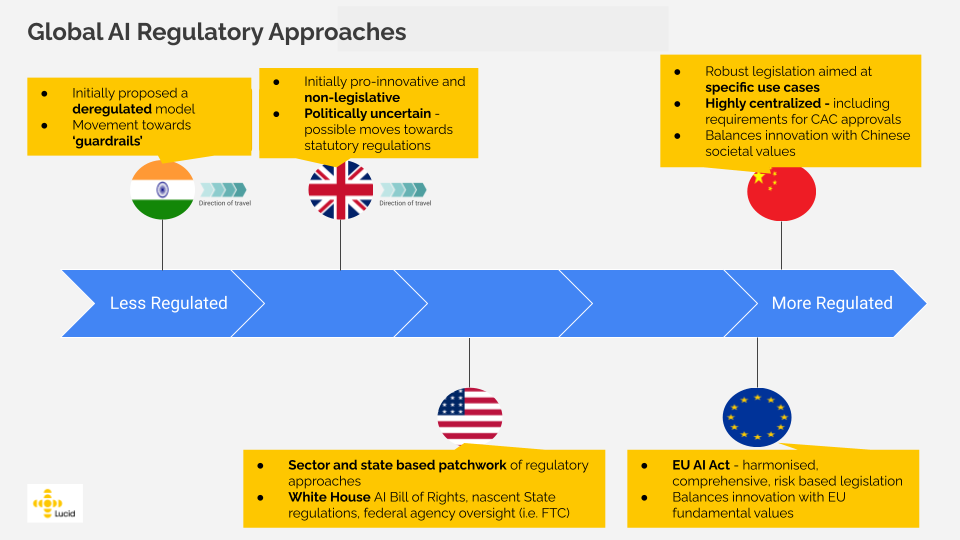
To understand these differences more deeply, we will consult a comprehensive report that classifies national AI governance frameworks into distinct models.
Global AI Governance Frameworks A Comparative Study
The report 'Global AI Governance Frameworks: A Comparative Study' provides a sophisticated analysis of how different nations approach AI regulation. We will use it to structure our comparison.
Please read Section 4.1 'Landscape Mapping - The Four Classification Models' (pp. 14-15) and Section 4.3 'Key Areas of Global Convergence and Divergence' (pp. 18-19). As you read, focus on the core philosophy, key mechanisms, and state role associated with 'Model 1: Pro-Innovation/Soft Law' and 'Model 2: Statutory/Risk-Based', as well as the 'Hard Law vs. Soft Law' divide.
Drawing from this report and other sources, let's break down the main competing philosophies.
A. The United States: The "Pro-Innovation" / Market-Led Approach
The US has largely adopted a "soft law" and sector-specific approach. Instead of a single, overarching AI law like the EU's, it relies on a patchwork of existing laws, voluntary guidelines, and actions from sector-specific regulators.
- Core Philosophy: "Market-Led Flexibility." The government's role is seen as a "referee" that intervenes ex-post (after the fact) to punish specific harms, rather than an ex-ante "guardian" that sets strict rules beforehand.
- Key Mechanisms:
- Voluntary frameworks, most notably the NIST AI Risk Management Framework (RMF).
- Guidance and enforcement actions from existing agencies like the Federal Trade Commission (FTC).
- Sector-specific rules for healthcare, finance, etc.
- Primary Goal: To foster rapid innovation and maintain technological leadership, avoiding regulatory burdens that might slow down the private sector.
B. China: The "State-Driven" / Security-Focused Approach
China's model is characterized by centralized, state-led control and is deeply intertwined with its national security and social governance objectives.
- Core Philosophy: "State-Led Strategic Ambition" and "Protective Oversight." The state is an "architect" that actively builds and directs the AI ecosystem to achieve national goals.
- Key Mechanisms:
- Binding, mandatory laws focused on specific technologies (e.g., algorithmic recommendations, deep synthesis).
- Strong central government oversight via bodies like the Cyberspace Administration of China (CAC).
- Emphasis on data localization and state access to data for security purposes.
- Primary Goal: To ensure social stability, maintain state control over information, and achieve technological sovereignty. The definition of "high-risk" is often tied to the potential to "mobilize public opinion or disrupt social order."
C. The "Hybrid" Model: A Path for Emerging Economies
Many nations, including India, are charting a middle course that rejects the binary choice between the US and EU models. This is often referred to as a "Hybrid" or "Strategic" approach.
- Core Philosophy: "State-Led Strategic Ambition." Like China, the state acts as an "architect," but with a dual focus: securing state interests while creating a flexible environment for private sector growth.
- Key Mechanisms:
- A blend of "hard law" for strategic areas (e.g., India's Digital Personal Data Protection Act 2023 for data sovereignty) and "soft law" (e.g., NITI Aayog's Responsible AI guidelines) for the broader market.
- Use of "regulatory sandboxes" to co-develop rules with industry.
- Primary Goal: To drive national economic transformation and build sovereign capacity while attracting foreign investment. This often involves balancing the adoption of global standards for trade with a "Global South" focus on infrastructure independence and data sovereignty.
A second academic paper reinforces this comparative view.
Legal Frameworks for AI Regulation: A Comparative Study
To solidify our understanding, let's review a concise academic analysis that directly compares these jurisdictions.
Please read the section 'Comparative Analysis of AI Regulatory Frameworks' on pages 218-220. This provides a clear, point-by-point comparison of the EU, US, China, and India, reinforcing the concepts we've just discussed.
3. Synthesizing the Differences
The diverse approaches to AI regulation can be summarized by comparing them across several key dimensions.
| Dimension | European Union | United States | China | Hybrid Model (e.g., India) |
|---|---|---|---|---|
| Core Philosophy | Precautionary & Rights-Based | Pro-Innovation & Market-Led | State-Driven & Security-Focused | State-Led Strategic Ambition |
| Primary Goal | Protecting Fundamental Rights & Safety | Fostering Innovation & Economic Leadership | Ensuring Social Stability & National Sovereignty | Economic Growth & Digital Sovereignty |
| Legal Approach | Hard Law (Binding Regulation) | Soft Law (Voluntary Guidelines) & Existing Sectoral Law | Hard Law (Binding, Centralized Directives) | Mix of Hard Law (for core assets) & Soft Law (for market) |
| State's Role | Guardian (Ex-ante rule-setter) | Referee (Ex-post enforcer) | Architect & Guardian (Total ecosystem control) | Architect (Directs ecosystem, protects core) |
| Key Mechanism | Horizontal, Risk-Based Tiers (EU AI Act) | Decentralized Enforcement (FTC) & Voluntary Standards (NIST) | Centralized Approvals & Tech-Specific Rules (CAC) | Agile Governance, Sandboxes, Digital Public Infrastructure |
Test your understanding!
A startup has developed a novel AI system for use in university admissions to screen and rank applicants. The company wants to market its product globally. Based on the regulatory philosophies we've discussed, what primary challenge or requirement would they likely face in each of the following markets?
- European Union:
- United States:
- China:
Show answer
- European Union: The AI system would almost certainly be classified as "high-risk" under the EU AI Act because it concerns access to education. The startup would face stringent ex-ante compliance obligations, including rigorous risk assessments, data quality requirements, human oversight mechanisms, and the need for a conformity assessment before the product could be sold in the EU.
- United States: The challenge would be navigating a patchwork of regulations. There is no single federal AI law. The startup might face scrutiny from the FTC for potential unfair or deceptive practices if the algorithm is biased. They could also face lawsuits based on existing anti-discrimination laws. Adherence to the voluntary NIST AI RMF would be a key best practice to demonstrate due diligence.
- China: The primary challenge would be state control and approval. The startup would likely have to register its algorithm with the government (CAC), be transparent about its recommendation and ranking logic to the regulator, and comply with strict data localization and security laws. The algorithm's function would be scrutinized for its alignment with state-defined social and educational priorities.
Conclusion
In this lesson, we have moved beyond the technicalities of AI to the geopolitical philosophies that govern it. We've established that the EU's approach—precautionary, rights-based, and risk-stratified—is a deliberate choice that stands in contrast to the market-driven "soft law" approach of the US, the state-controlled model of China, and the strategic hybrid models emerging in countries like India.
Key Takeaways:
- The EU's regulatory philosophy is built on the precautionary principle and the protection of fundamental rights, leading to a proactive, ex-ante, risk-based legal framework.
- The "Brussels Effect" grants the EU significant global influence, potentially making its AI Act a de facto international standard for companies wanting access to its market.
- Global AI governance is characterized by competing philosophies: the EU's "guardian" state, the US's "referee" state, China's "architect" state, and the hybrid models of emerging economies.
- These differences are not abstract; they translate into concrete variations in legal status (hard vs. soft law), enforcement philosophy (ex-ante vs. ex-post), and primary policy goals (rights vs. innovation vs. security).
Preview of the Next Lesson:
Now that we have a firm grasp of the philosophy behind the EU AI Act, we are ready to examine its mechanics. In the next lesson, we will dissect the four-tiered risk pyramid in detail, exploring exactly what makes an AI system "unacceptable," "high," "limited," or "minimal" risk under EU law.