Introduction
Welcome back. In our previous lesson, we established the core philosophical underpinnings of the world's major AI governance regimes. We saw that the European Union has adopted a precautionary, rights-based approach, which translates into a proactive, risk-based regulatory framework. The heart of this framework, the EU AI Act, is built around a "risk pyramid."
This lesson will dissect that pyramid. Our goal is to explain the EU AI Act's risk-based classification system, covering the unacceptable, high, limited, and minimal risk categories. By the end of this lesson, you will understand how the Act categorizes any given AI system based on its intended use, and what the primary regulatory consequences are for each category. Mastering this classification is the key to understanding the entire logic of the EU's approach to AI governance.
The Risk-Based Pyramid: A Visual Overview
The fundamental principle of the EU AI Act is proportionality: the regulatory burden on an AI system is directly proportional to the potential risk it poses to health, safety, and fundamental rights. The vast majority of AI applications are expected to face little to no new regulation, while a small fraction of high-stakes applications will face stringent obligations.
This concept is often visualized as a pyramid.
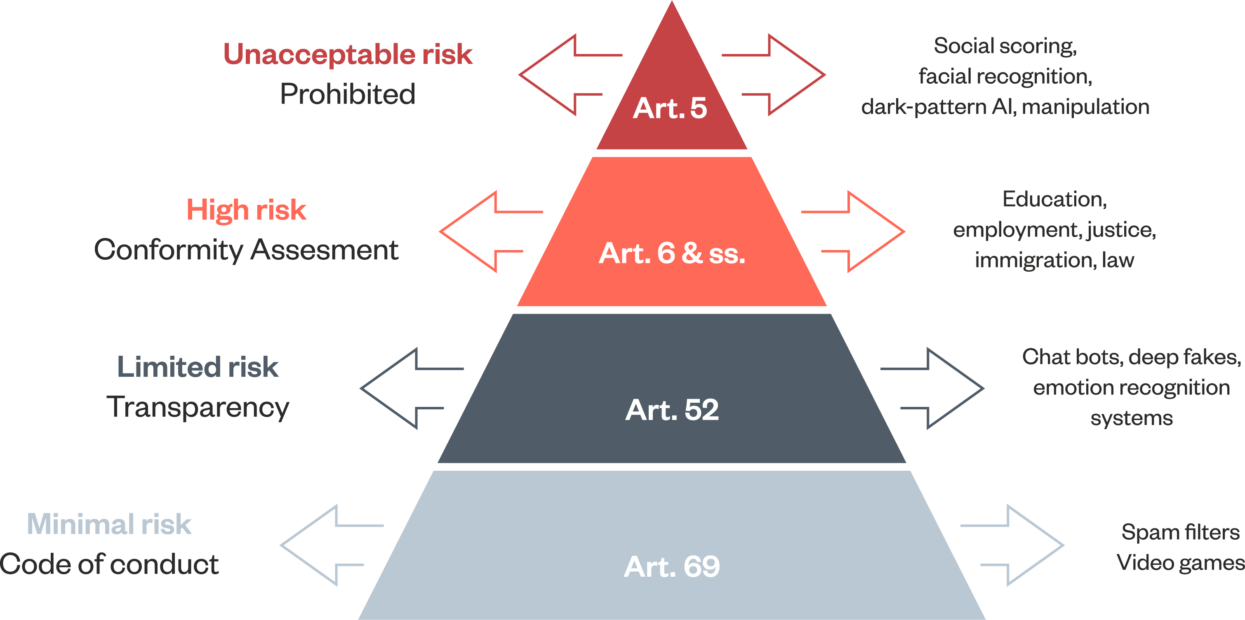
As the pyramid shows, the framework creates four distinct categories:
- Unacceptable Risk: AI practices that are considered a clear threat to EU values and fundamental rights. These are prohibited.
- High Risk: AI systems that could have a significant adverse impact on people's safety or fundamental rights. These are permitted but are subject to strict compliance obligations.
- Limited Risk: AI systems that pose a specific risk of manipulation or deception. These are subject to transparency obligations.
- Minimal Risk: All other AI systems. This is the largest category, and these systems can be developed and used freely, with voluntary codes of conduct encouraged.
To begin our detailed exploration, let's get a concise and legally precise overview from a legal expert.
Debunking the EU AI Act: an overview of the new legal framework
The following video from the Fieldfisher Data & Privacy Team provides an excellent introduction to the risk classification system at the heart of the AI Act.
Please watch from 15:48 to 16:51. The speaker will introduce the risk-based approach and the four categories, setting the stage for our deeper analysis.
Deconstructing the Tiers: A Detailed Analysis
With that overview in mind, we will now examine each tier in detail. We'll use a comprehensive analysis from the specialist website ai-regulation.com, which not only defines each category but also explains the legal and conceptual logic behind them.
Tools for Navigating the EU AI Act: (2) Visualisation Pyramid
This article provides a rigorous breakdown of the risk pyramid. It explains the original design and then provides a granular look at the characteristics and examples for each risk category as defined in the final Act.
Please read two parts of this article: Start with Section 1, 'The Initial Pyramid Designed by the European Commission', to understand the original concept of balancing criticality and quantity. Then, navigate to Section 3, 'The Visualization Pyramid: A Closer Examination'. Read the detailed descriptions of the 'Minimal/No Risk' (3.1), 'Unacceptable Risk' (3.2), 'High-Risk' (3.3), and 'Limited Risk' (3.5) layers. As you read, focus on the criteria used to define each classification and the specific examples provided.
Now, let's synthesize and structure the information from the reading and video, working our way up the pyramid from the least to the most regulated.
Tier 1: Minimal Risk
This is the default category and the foundation of the pyramid. It encompasses all AI systems that do not fall into the unacceptable, high, or limited risk categories.
- Characteristics: The AI system poses negligible or no risk to citizens' rights or safety.
- Examples: AI-enabled video games, spam filters, inventory management systems.
- Regulatory Obligation: There are no specific obligations under the AI Act. The Act encourages providers of these systems to voluntarily adopt Codes of Conduct, which might include some of the principles required for high-risk systems. It is crucial to remember, however, that other laws, such as the GDPR, still apply if the system processes personal data.
Tier 2: Limited Risk
This category addresses AI systems where the primary risk is a lack of transparency that could lead to deception. The goal is to ensure users know when they are interacting with a machine or with artificially generated content.
- Characteristics: The system poses a risk of manipulation or deception if its artificial nature is not disclosed.
- Regulatory Obligation: Transparency. Providers and deployers must ensure users are aware of the AI interaction.
- Examples:
- Chatbots: Users must be informed that they are interacting with an AI system.
- Deepfakes and AI-Generated Content: Content that is artificially generated or manipulated (images, audio, video) must be labeled as such. There are exceptions for creative works or satire.
- Emotion recognition or biometric categorization systems: Individuals exposed to these systems must be informed of their operation.
Tier 3: High Risk
This is the regulatory core of the AI Act. This category does not mean the AI is prohibited, but that it is subject to a comprehensive set of mandatory requirements and a conformity assessment before it can be placed on the market.
An AI system is classified as high-risk in two main ways:
-
AI as a Safety Component: The AI system is a product, or a safety component of a product, that is already covered by existing EU product safety legislation (listed in Annex II of the Act). This includes AI used in toys, aviation, cars, medical devices, and lifts. If the product requires a third-party conformity assessment under that existing legislation, the AI component is automatically high-risk.
-
Standalone AI in Sensitive Areas: The AI system falls into one of several specific, sensitive areas listed in Annex III of the Act because it poses a significant risk to fundamental rights. Key examples include AI systems used for:
- Biometric identification and categorization of natural persons.
- Management of critical infrastructure (e.g., water, gas, electricity).
- Education and vocational training (e.g., scoring exams, evaluating admission).
- Employment and workforce management (e.g., CV-sorting software, promotion evaluation).
- Access to essential services and benefits (e.g., credit scoring, assessing eligibility for public assistance).
- Law enforcement, migration, and the administration of justice.
A crucial nuance in the final Act is an "opt-out" mechanism. A provider of an Annex III system can argue that it is not high-risk if they can document and prove that the system does not pose a "significant risk of harm to the health, safety or fundamental rights of natural persons." This might apply, for example, to a system intended only to improve the results of a previously completed human activity.
Tier 4: Unacceptable Risk
At the apex of the pyramid are AI practices deemed to be in clear contravention of EU values and fundamental rights.
- Characteristics: The practice presents a clear threat to the safety, livelihoods, and rights of people.
- Regulatory Obligation: An outright ban.
- Examples:
- Social scoring by or on behalf of public authorities.
- AI that deploys subliminal or purposefully manipulative techniques to distort behavior in a way that causes harm.
- AI that exploits the vulnerabilities of specific groups (e.g., children, people with disabilities).
- Real-time remote biometric identification in publicly accessible spaces for law enforcement purposes (subject to very narrow, exhaustive exceptions).
- Untargeted scraping of facial images from the internet or CCTV footage to create facial recognition databases.
Test your understanding!
A hospital wants to deploy two new AI systems:
- An AI-powered chatbot on its website to help patients book appointments and find information about hospital services.
- An AI tool to analyze chest X-rays to help radiologists detect early signs of cancer. The tool does not make a final diagnosis but highlights areas of concern for the radiologist to review.
How would each system likely be classified under the EU AI Act, and what would be the primary regulatory obligation for each?
Show answer
-
Appointment Chatbot: This system would be classified as Limited Risk. The primary risk is that a patient might not know they are talking to a machine. Therefore, the main regulatory obligation would be transparency—the hospital must clearly disclose that the user is interacting with an AI chatbot.
-
X-ray Analysis Tool: This system would be classified as High Risk. It falls into two potential categories: it is an AI system used as a medical device (covered by existing EU legislation and likely falling under Annex II) and it also relates to health and safety. The primary obligations would be the full suite of high-risk requirements, including robust data governance, technical documentation, risk management, human oversight (which is already built into its intended use), and undergoing a conformity assessment before it can be used.
An Advanced Topic: General Purpose AI and "Systemic Risk"
As you may have gathered from the reading, the original four-tier pyramid was designed around AI with specific intended purposes. The rise of powerful, flexible models like OpenAI's GPT-4 and Google's Gemini—known as General Purpose AI (GPAI) models—posed a new challenge. Such a model isn't inherently high-risk, but it could be used to build a high-risk application.
To address this, the legislators introduced a parallel regulatory layer targeting the models themselves, based on a concept of "systemic risk."
Tools for Navigating the EU AI Act: (2) Visualisation Pyramid
The standard risk pyramid applies to AI systems in their final application. Let's revisit the ai-regulation.com article to understand how the Act handles the powerful foundation models that underpin many of these systems.
Please read Section 2 of the article, 'Conceptualising the Final AI Act: Is the Pyramid Still Standing?'. Focus on why GPAI models didn't fit neatly into the 'high-risk' category and how the concept of 'systemic risk' was introduced as a solution.
In essence, "systemic risk" is a label applied to the most powerful GPAI models that have high-impact capabilities and could pose large-scale risks to the public. A model is presumed to have systemic risk if the computing power used to train it exceeds a certain threshold (10^25 FLOPs).
Providers of these systemic risk models have their own set of obligations, including:
- Performing model evaluation and adversarial testing.
- Assessing and mitigating potential systemic risks.
- Reporting serious incidents to the AI Office.
- Ensuring a high level of cybersecurity.
Crucially, an AI system built using a systemic risk model is still assessed independently under the risk pyramid based on its own intended purpose. For example, a simple poetry-writing app using GPT-4 would be minimal risk, while a legal advice tool built on the same model could be classified as high-risk.
Conclusion
In this lesson, we have dissected the central mechanism of the EU AI Act: its risk-based classification system. By stratifying AI applications into four tiers, the Act aims to regulate proportionately, focusing intense scrutiny on the areas of greatest concern while allowing innovation to flourish in low-risk domains.
Key Takeaways:
- The EU AI Act's regulatory obligations are proportional to an AI system's risk level, which is divided into unacceptable (banned), high (strict compliance), limited (transparency), and minimal (unregulated).
- The classification is determined by the AI system's intended purpose and context of use, not the underlying technology itself.
- The high-risk category is the most complex, capturing both AI in safety-critical products (Annex II) and AI in sensitive areas affecting fundamental rights (Annex III).
- Powerful General Purpose AI models are subject to a separate set of rules based on the concept of "systemic risk," which applies to the model provider in addition to any rules applying to the final downstream application.
Preview of the Next Lesson:
We have now defined the four tiers, with "unacceptable risk" being the most severe. In the next lesson, Identify AI practices that are prohibited under the EU AI Act, we will take a deep dive into Article 5 of the Act to analyze exactly which AI practices are banned, the legal reasoning for these prohibitions, and the narrow exceptions that apply.