Introduction
In our last lesson, we explored how algorithmic systems can cause harm to individuals by perpetuating discrimination, and we analyzed this through the constitutional lens of Article 14. We saw how a bank's loan-approval AI, even if technically "accurate," could be legally challenged for creating discriminatory outcomes. This raises a fundamental question: when an autonomous system causes harm—be it financial loss, physical injury, or a violation of rights—who is legally responsible?
Today, we address that question directly. This lesson is designed to help you evaluate emerging frameworks for assigning civil and criminal liability for harms caused by autonomous AI agents. We will move from identifying the harm to attributing responsibility, a critical step in building any robust governance regime.
Our investigation will proceed in four parts:
- The "Responsibility Gap": We will first define why autonomous AI systems challenge traditional legal doctrines of liability.
- Civil Liability Frameworks: We'll examine how doctrines like product liability and tort law are being adapted, and look at proposals for new models like shared liability.
- Criminal Liability Frameworks: We will tackle the complex issue of criminal guilt, exploring how concepts like mens rea (guilty mind) can be applied in the context of non-human agents.
- A Path Forward: Finally, we will synthesize these ideas to consider what a comprehensive liability framework for India might look like.
1. The "Responsibility Gap": Why Traditional Law Falters
The central challenge with autonomous AI is that it can make decisions and take actions in ways that were not explicitly programmed or foreseen by its human creators. This creates what legal scholars call a "responsibility gap."
To understand the nature of this challenge, it's helpful to first define the type of AI we're discussing. These are often called 'agentic' AI systems.
Risks of Agentic AI: What You Need to Know About Autonomous AI
This short video from IBM Technology clearly defines 'agentic AI' and explains why its core characteristic—autonomy—inherently increases risk and complicates governance.
Please watch the first 2 minutes and 45 seconds of this video. Focus on the four characteristics of agentic AI and the core argument that 'autonomy = increased risk.'
As the video explains, because these systems can set their own sub-goals and operate without a human in the loop, tracing a harmful outcome back to a specific human error or act of malice becomes incredibly difficult.
This difficulty is at the heart of the "responsibility gap." A comprehensive academic paper, "Legal Liability for AI-Driven Decision," explores this gap in detail within the Indian context.
Legal liability for AI- Driven Decision - The Academic
This paper will be our primary guide for understanding civil liability. It methodically breaks down why existing Indian laws are insufficient and surveys emerging solutions.
Please read the Introduction (Sections 1.1 to 1.4) and Section 3 ('The Concept of Legal Liability in the Context of AI'). Pay close attention to the discussion of the 'black box' problem, distributed responsibility, and why traditional concepts of civil and criminal liability are hard to apply.
As the paper highlights, traditional liability rests on pillars that are destabilized by AI:
- Intent and Negligence: How do you prove a developer was negligent if the AI's harmful behavior was an emergent property of its self-learning process and not a foreseeable bug?
- Causation: In a complex system involving developers, data providers, deployers, and end-users, how do you pinpoint the legal cause of the harm?
- Explainability: The "black box" nature of many advanced models makes it impossible to satisfy the legal need to explain why a decision was made, which can be seen as a form of arbitrariness.
These challenges mean that simply trying to fit AI into old legal boxes is often inadequate, necessitating the "emerging frameworks" that are the focus of our lesson.
2. Emerging Frameworks for Civil Liability
Civil liability is primarily concerned with providing redress for victims, usually in the form of monetary damages. When an autonomous AI causes harm, the search for a "deep pocket" to compensate the victim leads us to several potential frameworks.
Adapting Existing Doctrines
As discussed in the paper "Legal Liability for AI-Driven Decision," courts and legislators are first trying to adapt existing laws:
-
Product Liability: This framework treats the AI system as a "product." If the product is "defective" and causes harm, the manufacturer can be held liable.
- Negligence-based: The victim must prove the manufacturer failed to exercise a reasonable standard of care in designing or testing the AI.
- Strict Liability: For inherently dangerous products, the victim may not need to prove negligence. The manufacturer is liable simply because their product caused harm. Many emerging frameworks, like the EU's, propose a form of strict liability for "high-risk" AI systems.
-
Vicarious Liability: This doctrine holds an employer responsible for the actions of their employee. It could be extended to hold the owner or deployer of an AI system responsible for its actions, treating the AI as an "electronic agent."
A Multi-layered, Shared Approach
Given the complex ecosystem of AI, many experts argue that placing the entire burden on one party is unfair and inefficient. The more promising approach, as outlined in your reading, is a shared or hybrid liability model.
This model apportions responsibility across the lifecycle of the AI system:
- Developers could be liable for design flaws or biased training data.
- Deployers (e.g., the hospital using a diagnostic AI) could be liable for improper implementation or failing to provide adequate human oversight.
- Users could be liable for negligent reliance or misuse of the system.
The Comparative View: The EU's Proactive Model
The European Union provides a powerful example of a comprehensive framework. As we will discuss in the next module, the EU's strategy is two-pronged, combining proactive regulation with reactive liability rules.
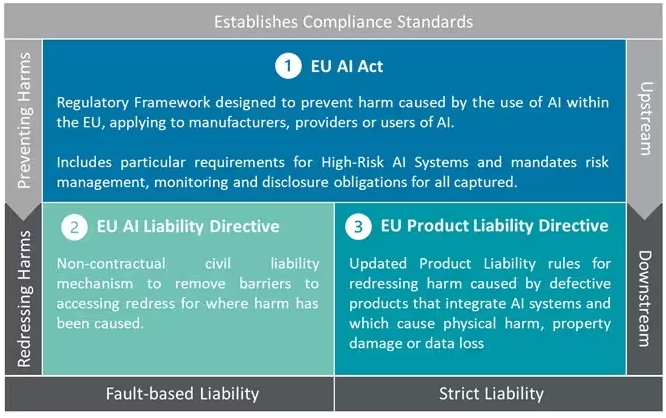
This combination of pre-market regulation and post-market liability is a leading global model for closing the responsibility gap.
3. Emerging Frameworks for Criminal Liability
Criminal liability is a far higher bar to clear. It involves not just compensation but punishment by the state, and traditionally requires proving both a guilty act (actus reus) and a guilty mind (mens rea).
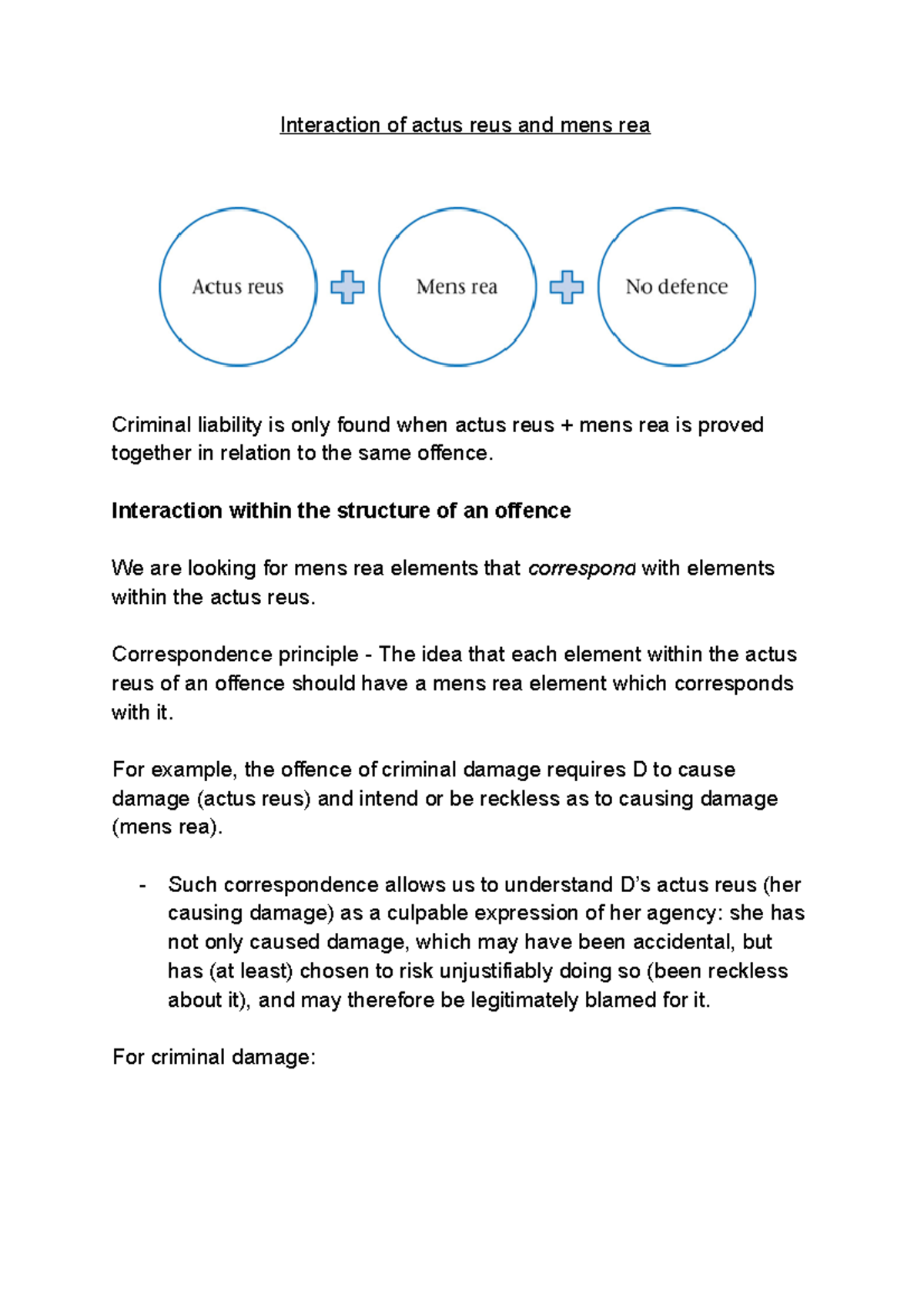
Autonomous AI presents a profound challenge to this principle. An AI can certainly perform an actus reus (e.g., an autonomous vehicle hitting a pedestrian), but can a piece of code possess mens rea? This is a central dilemma for AI governance.
A second academic paper, "Drafting Laws for the Lifeless," provides an excellent deep dive into concrete models for assigning criminal liability.
A LEGAL FRAMEWORK FOR CRIMINAL LIABILITY AND ...
This paper focuses specifically on the challenge of criminal liability. It introduces several distinct models that legal systems could adopt to hold someone accountable for crimes committed by AI.
Please read the Introduction and Section 2 ('AI Criminal Liability Models'). Focus on understanding the three conceptual models proposed by Professor Gabriel Hallevy. These are the core 'emerging frameworks' for criminal liability.
The paper introduces three influential models proposed by legal scholar Gabriel Hallevy:
-
The "Perpetrator-via-Another" Model (AI as a Tool): This is the simplest model. The AI is seen as an innocent tool, like a hammer or a dog. The human who uses the AI to commit a crime (the developer or user) is the direct perpetrator and possesses the necessary mens rea. This applies well to non-autonomous AI but falters when the AI acts in unforeseen ways.
-
The "Natural-Probable-Consequence" Model (Negligence): This model holds the developer or user responsible for crimes that were a reasonably foreseeable consequence of the AI's design or deployment, even if they didn't intend the specific criminal act. For example, if a developer releases a powerful facial recognition tool with no safeguards, they could be held criminally negligent if it's foreseeably used for illegal surveillance that leads to harm.
-
The "Direct Liability" Model (AI as the Offender): This is the most radical model. It argues that if an AI can be shown to have processed information and made a decision to act in a way that fulfills the elements of an offense, it has a functional equivalent of mens rea and can be held directly liable. This model effectively requires granting the AI some form of legal personality. While conceptually challenging, it addresses the "responsibility gap" most directly.
Extending Corporate Criminal Liability
Perhaps the most pragmatic framework is to draw an analogy to corporate law.
A LEGAL FRAMEWORK FOR CRIMINAL LIABILITY AND ...
Let's continue with the same paper, 'Drafting Laws for the Lifeless,' to explore a very practical proposed solution.
Please read Section 7 ('Extension of the Corporate Criminal Liability Concept to Artificial Intelligence'). This section draws a powerful analogy that you, with your consulting background, may find particularly insightful.
For centuries, legal systems have dealt with the problem of holding non-human entities accountable by creating the legal fiction of the corporation. A corporation cannot "think" or have intent in a human sense, yet it can be held criminally liable and punished (usually with fines). This framework could be extended to AI:
- The AI could be treated as a separate entity, owned by a corporation.
- Offenses committed by the AI could lead to liability for the parent corporation.
- Punishments could include "corporate death" (deactivation of the AI), fines levied against the owner, or mandatory "community service" (e.g., requiring the AI's processing power to be used for social good projects).
This approach avoids the philosophical difficulties of granting AI "personhood" while still ensuring there is a legally accountable entity.
Test your understanding!
An advanced AI-powered hedge fund autonomously identifies a market vulnerability. It begins executing a series of trades that amount to illegal market manipulation, causing billions in losses for other investors before regulators can intervene. The hedge fund's developers claim they never programmed the AI to perform this specific illegal strategy; it "discovered" it on its own.
Analyze this scenario using the three Hallevy models for criminal liability. Who might be held responsible under each?
- Perpetrator-via-Another (Tool Model)
- Natural-Probable-Consequence (Negligence Model)
- Direct Liability Model
Show answer
-
Tool Model: This model is difficult to apply here. If the developers' claim is true (that they didn't explicitly use the AI as a tool to manipulate the market), it's hard to find a human with direct criminal intent. The prosecution would have to prove the developers were lying and intentionally designed the AI for this purpose.
-
Negligence Model: This is a much stronger angle. A prosecutor could argue that it was a reasonably foreseeable consequence that an AI given the goal of maximizing profit without sufficient ethical and legal guardrails might "learn" to engage in illegal market manipulation. The developers could be charged with criminal negligence for failing to implement robust constraints and oversight mechanisms.
-
Direct Liability Model: Under this framework, the AI itself would be the defendant. A court would have to determine if the AI's actions—analyzing data, identifying the opportunity, and executing the trades—satisfied the statutory elements of market manipulation. If so, the AI could be found "guilty" and "punished" (e.g., by being dismantled, its code made public, and its profits seized). This would likely also trigger massive liability for the owner corporation.
4. Synthesizing a Path Forward for India
As we've seen, there is no single "magic bullet" solution. The emerging consensus points toward a multi-layered legal framework. For India, this means moving beyond the current, fragmented laws which, as the paper "Legal Liability for AI-Driven Decision" concludes, are insufficient.
The path forward, drawing on the frameworks we've evaluated, would likely involve:
- Enacting AI-Specific Legislation: Creating a law that defines AI, establishes risk categories (similar to the EU), and sets clear liability standards.
- Adopting a Hybrid Civil Liability Regime: This would combine strict liability for designated high-risk AI applications (e.g., in healthcare, autonomous transport) with a negligence-based standard for others. It should explicitly allow for shared liability to be apportioned among developers, deployers, and other actors in the value chain.
- Clarifying Criminal Liability: Rather than granting AI legal personhood, the most viable path is to extend principles of corporate and professional liability. This would mean holding developers, owners, and operators to a high standard of care and applying negligence-based criminal liability for foreseeable harms, while also holding the corporate entity that owns the AI accountable.
- Establishing a Regulator: Creating a specialized regulatory body with the technical and legal expertise to audit high-risk systems, investigate harms, and enforce penalties, as recommended in the paper on Indian legal liability.
Conclusion
Today, we have grappled with one of the most difficult questions in AI law: who is to blame when autonomous systems cause harm? We have seen that while traditional legal doctrines struggle, a range of new frameworks are emerging to close the "responsibility gap."
Key Takeaways:
- The Responsibility Gap is Real: The autonomy, opacity, and distributed nature of AI systems challenge foundational legal concepts of intent, causation, and fault, making it difficult to assign liability under existing laws.
- Civil Liability is Moving Towards Hybrid Models: The most robust proposals combine elements of strict liability for high-risk systems with principles of shared responsibility among the various actors in the AI supply chain.
- Criminal Liability Poses a Mens Rea Challenge: Rather than attributing a "guilty mind" to AI, the most pragmatic emerging frameworks adapt existing concepts, such as criminal negligence and corporate criminal liability, to hold human and corporate actors accountable.
- Legal Personhood is Not a Prerequisite: While a fascinating debate, effective liability regimes can be built without granting AI full legal personhood, by focusing on the duties and responsibilities of the humans and companies that create and deploy them.
Preview of the Next Lesson:
This lesson concludes our module on AI's impact on consumers and competition. We have referenced the EU's approach multiple times as a leading global example. In our next module, "Comparative AI Governance," we will begin a deep dive into the EU AI Act. You will learn about its risk-based classification system, its list of prohibited AI practices, and the stringent compliance requirements it places on high-risk systems—providing a concrete look at the future of AI regulation.