Introduction
In our previous lesson, we established the fundamental language of performance marketing by defining and calculating the core KPIs that measure campaign performance. You now know what to measure. In this lesson, we will build directly on that knowledge to understand why and when to focus on specific metrics. We'll do this by introducing a core strategic framework: the marketing funnel.
Your hands-on experience running Google and Meta ads means you have already been operating within this funnel, likely without a formal structure. This lesson will make that framework explicit, giving you a powerful model for planning campaigns, setting realistic objectives, and optimizing for what truly matters at each stage of the customer journey.
By the end of this lesson, you will be able to map campaign objectives and their corresponding KPIs to the three main stages of the funnel: Top of Funnel (TOFU), Middle of Funnel (MOFU), and Bottom of Funnel (BOFU).
The Funnel as a Strategic System
As a performance marketer, it's easy to get lost in the weeds of individual tactics—adjusting a bid, testing a new headline, or trying a new targeting option. While important, these are just isolated actions. A marketing funnel provides the overarching strategy that makes these tactics work together as a cohesive system, guiding a potential customer from their first point of contact with your brand to their final purchase.
The following video from Brand Master Academy makes an excellent distinction between isolated tactics and a coordinated strategy. Understanding this difference is key to moving from simply running ads to architecting successful, scalable campaigns.
How To Create A Digital Marketing Funnel [6 Step Template]
This video, "How To Create A Digital Marketing Funnel," sets the stage by explaining why a systematic approach is necessary in today's marketing landscape.
Watch the section from tactics versus strategy. Pay close attention to the analogy of a machine: individual parts (tactics) have little impact on their own, but when assembled into a system (a strategy or funnel), they can achieve a significant goal.
The most common model for this system is the sales funnel, typically broken down into three main stages: Top, Middle, and Bottom. You'll often see these referred to by the acronyms TOFU, MOFU, and BOFU.
This short video from the Funnel channel provides a quick and clear overview of what each stage represents.
What is ToFu, MoFu, BoFu? (Top, Middle and Bottom of Funnel Content Explained by a Content Marketer)
This explainer video, "What is ToFu, MoFu, BoFu?", uses a simple social analogy to introduce the three core stages of the marketing funnel.
Please watch the video from the beginning up to the end of the BoFu section. This will give you a solid initial grasp of the purpose of each stage before we dive deeper.
Mapping Objectives to Funnel Stages
As you just saw, each stage of the funnel corresponds to a different phase of the customer's mindset. They move from being unaware of your brand, to considering it among other options, to finally being ready to make a purchase. Our job as marketers is to align our campaign objectives, messaging, and chosen KPIs with the customer's mindset at each specific stage.
The following image provides a detailed visual map of a full marketing funnel, including stages that happen after the initial purchase, like Loyalty and Advocacy. For this lesson, we will focus on the core TOFU, MOFU, and BOFU stages that lead to the first conversion.
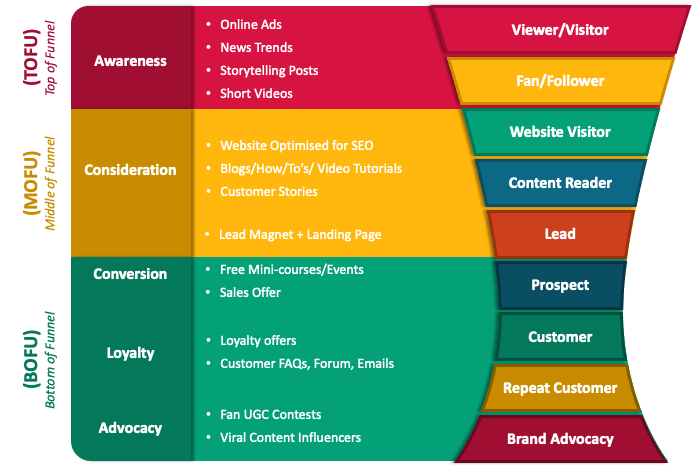
Let's now break down each stage in detail, exploring the customer's intent, our marketing goal, and the most relevant KPIs. The article "ToFu MoFu BoFu Marketing" from Radd Interactive provides an excellent, in-depth guide that we will use to explore each stage.
Top of Funnel (TOFU): The Awareness Stage
At the top of the funnel, your potential customers are either unaware they have a problem or are just beginning to research it. They are not looking for a specific product and are certainly not ready to buy. Your goal is not to sell, but to educate and attract a broad audience, making them aware that your brand exists as a helpful resource in their area of interest.
- Customer Intent: "I'm learning about a topic" or "I have a problem but don't know the solutions."
- Marketing Goal: Build brand awareness, reach new audiences, and generate initial interest.
- Primary KPIs:
- Impressions & Reach: How many people are seeing your ads?
- Cost Per Mille (CPM): How cost-efficient are you at getting in front of people?
- Video Views & View Rate: For video content, are people watching it?
- Click-Through Rate (CTR): Are people curious enough to click? (Less critical here than in later stages).
- KPIs to ignore: ROAS, Conversion Rate, and CPA for sales are irrelevant here. Judging a TOFU campaign by its ROAS is a common mistake that leads to shutting down a vital source of future customers.
ToFu MoFu BoFu Marketing – Online Sales Funnel Strategy
This article section details the strategies and channels used for TOFU marketing.
Please read the section on TOFU marketing. Notice how the recommended channels (SEO, PPC, Social Media) and ad objectives ("Brand Awareness," "Reach") are all designed for broad outreach, not direct sales.
Middle of Funnel (MOFU): The Consideration Stage
Once someone enters the middle of the funnel, they are problem-aware and now actively evaluating different solutions. They know your brand exists, but they are also looking at your competitors. Your goal here is to build trust, demonstrate your expertise, and nurture the relationship to position your solution as the best choice. This is where you might offer a "micro-conversion," like a guide, a webinar, or a newsletter signup, in exchange for their contact information.
- Customer Intent: "I'm comparing different solutions" or "Which brand is the best fit for me?"
- Marketing Goal: Generate qualified leads, build credibility, and educate prospects on your specific value proposition.
- Primary KPIs:
- Click-Through Rate (CTR): A strong indicator of how well your ad resonates with a solution-aware audience.
- Cost Per Click (CPC): How cost-efficient are you at driving engaged traffic?
- Conversion Rate (CVR) for leads: What percentage of users are signing up for your newsletter or downloading your guide?
- Cost Per Acquisition (CPA) for leads: How much does it cost to acquire an email address or a lead?
- Tactics: This is the natural home for retargeting campaigns, which re-engage people who have previously visited your website.
ToFu MoFu BoFu Marketing – Online Sales Funnel Strategy
This next section explains how marketing strategies must adapt for the MOFU stage.
Now, read the section on MOFU marketing. Pay attention to the shift in focus towards more specific content (guides, product overviews) and ad objectives (app downloads, email sign-ups).
Bottom of Funnel (BOFU): The Conversion Stage
At the bottom of the funnel, the customer is ready to make a decision. They have high purchase intent and are often searching for brand names or specific product models. Your goal is simple: make it as easy as possible for them to convert. Your messaging should be direct, with clear calls-to-action (CTAs) like "Buy Now," "Sign Up," or "Request a Demo."
- Customer Intent: "I'm ready to buy" or "I want to purchase [Product Name]."
- Marketing Goal: Drive sales, generate high-intent leads (like demo requests), and maximize return on investment.
- Primary KPIs:
- Conversions (Sales): The ultimate measure of success.
- Conversion Rate (CVR) for sales: How effectively does your ad and landing page close the deal?
- Cost Per Acquisition (CPA) for sales: How much does it cost to acquire a paying customer?
- Return On Ad Spend (ROAS): Is the campaign profitable? This is the king of BOFU metrics.
ToFu MoFu BoFu Marketing – Online Sales Funnel Strategy
Finally, this section covers the all-important conversion stage.
Read the section on BOFU marketing. Note the emphasis on intent-driven keywords and conversion-focused ad objectives on platforms like Facebook and Instagram.
A Practical Example
Let's ground this theory in a concrete scenario. The image below shows a simple funnel with recommended objectives for a campaign whose main goal is to drive sales of a new health product.
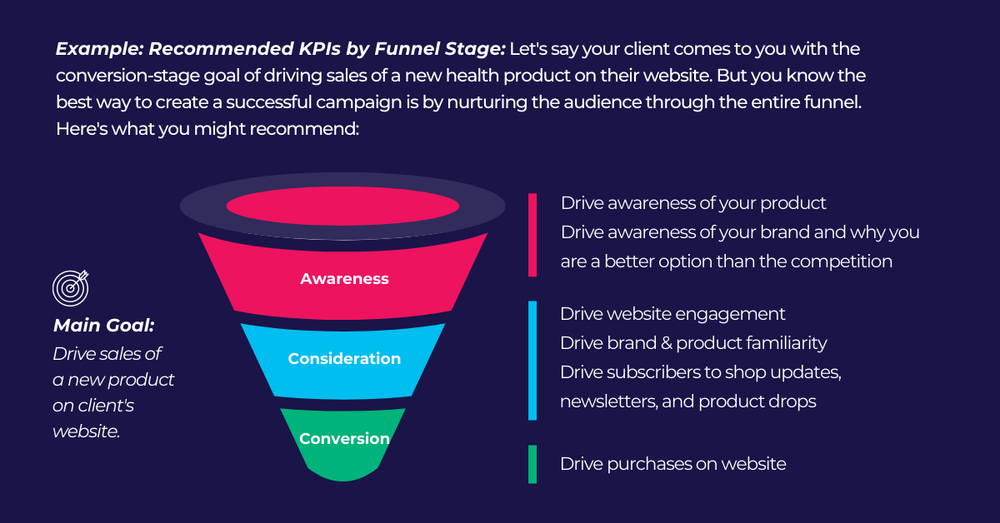
This example beautifully illustrates the mapping we've discussed:
- Awareness (TOFU): The objective is to "Drive awareness of your product." You would measure this with Impressions and Reach.
- Consideration (MOFU): Objectives include "Drive website engagement" and "Drive subscribers to shop updates." You'd measure these with CTR, CPC, and the CPA/CVR for newsletter sign-ups.
- Conversion (BOFU): The objective is to "Drive purchases on website." This is measured directly by the number of purchases, the CPA for each sale, and the overall ROAS.
The article from ScalixAI provides another excellent summary in a clear table format, connecting the funnel stage to customer intent, marketing goals, and example channels.
| Funnel Stage | Customer Intent | Marketing Goal | Example Channels |
|---|---|---|---|
| TOFU | Learning about a problem | Build awareness | Google search ads, blogs, YouTube ads |
| MOFU | Evaluating solutions | Build credibility and trust | Case studies, webinars, retargeting campaigns |
| BOFU | Ready to choose a product | Drive conversions | Demos, pricing pages, branded search ads |
This table serves as a powerful cheat sheet for campaign planning. When you receive a new brief or goal, you can first identify which stage of the funnel it belongs to, which will then immediately inform your choice of channels, messaging, and KPIs.
Conclusion
In this lesson, we elevated your understanding from tactical execution to strategic planning by introducing the TOFU, MOFU, BOFU marketing funnel. You learned that effective performance marketing isn't about applying the same metrics to every campaign, but about aligning your objectives and KPIs with the specific stage of the customer journey you are targeting.
Key Takeaways:
- The Funnel as a System: The marketing funnel provides a strategic framework that coordinates individual tactics (like ads and content) into a cohesive system for guiding customers from awareness to purchase.
- TOFU (Top of Funnel): The goal is Awareness. Focus on metrics like Impressions, Reach, and CPM. Do not focus on sales or ROAS.
- MOFU (Middle of Funnel): The goal is Consideration and lead nurturing. Focus on engagement metrics like CTR and CPC, and micro-conversion metrics like Lead CPA and CVR.
- BOFU (Bottom of Funnel): The goal is Conversion. This is where you focus on the money metrics: Sales, CPA, CVR, and especially ROAS.
- Objective Dictates KPIs: The primary objective of your campaign determines its place in the funnel and which KPIs are most important for measuring its success.
Now that you have this strategic framework, our next lesson will delve into the specific tools you can use to execute it. We will evaluate the trade-offs between different campaign types (e.g., Search, Display, Video) and platforms (Google, Meta) to determine which are best suited for achieving your TOFU, MOFU, and BOFU goals.