Introduction
In our last lesson, we established a strategic foundation for your campaigns by mapping objectives and KPIs to the different stages of the marketing funnel: TOFU, MOFU, and BOFU. You now have a framework for understanding why a campaign exists and how to measure its success at each step of the customer journey.
This lesson builds directly on that framework. Your goal is to evaluate the trade-offs between campaign types and platforms for different business objectives. Given your hands-on experience with Google and Meta Ads, you've already been working with the two most powerful platforms in digital marketing. Now, we will add a strategic layer to your practical knowledge, helping you decide which platform to use, and when, to most effectively achieve your TOFU, MOFU, and BOFU goals. We'll compare their core mechanics, costs, and best-use cases, empowering you to make deliberate, data-informed platform choices.
The Fundamental Divide: Capturing vs. Generating Demand
The most critical distinction between Google Ads and Meta Ads lies in how they engage with user intent. Grasping this concept is the key to strategic platform selection. One platform is primarily about "pulling" in existing demand, while the other is about "pushing" a message to generate new demand.
- Google Ads (Paid Search) is for capturing demand. It's an intent-based or "pull" marketing platform. Your ads appear precisely when a user is actively searching for a solution, product, or service. They have a problem and are looking for an answer right now.
- Meta Ads (Paid Social) is for generating demand. It's an interest-based or "push" marketing platform. Your ads appear in users' social feeds while they are scrolling, connecting with friends, or consuming content. You interrupt their activity to introduce them to something they might not have been looking for, but which aligns with their interests, demographics, or behaviors.
The following infographic provides an excellent high-level summary of these core differences.
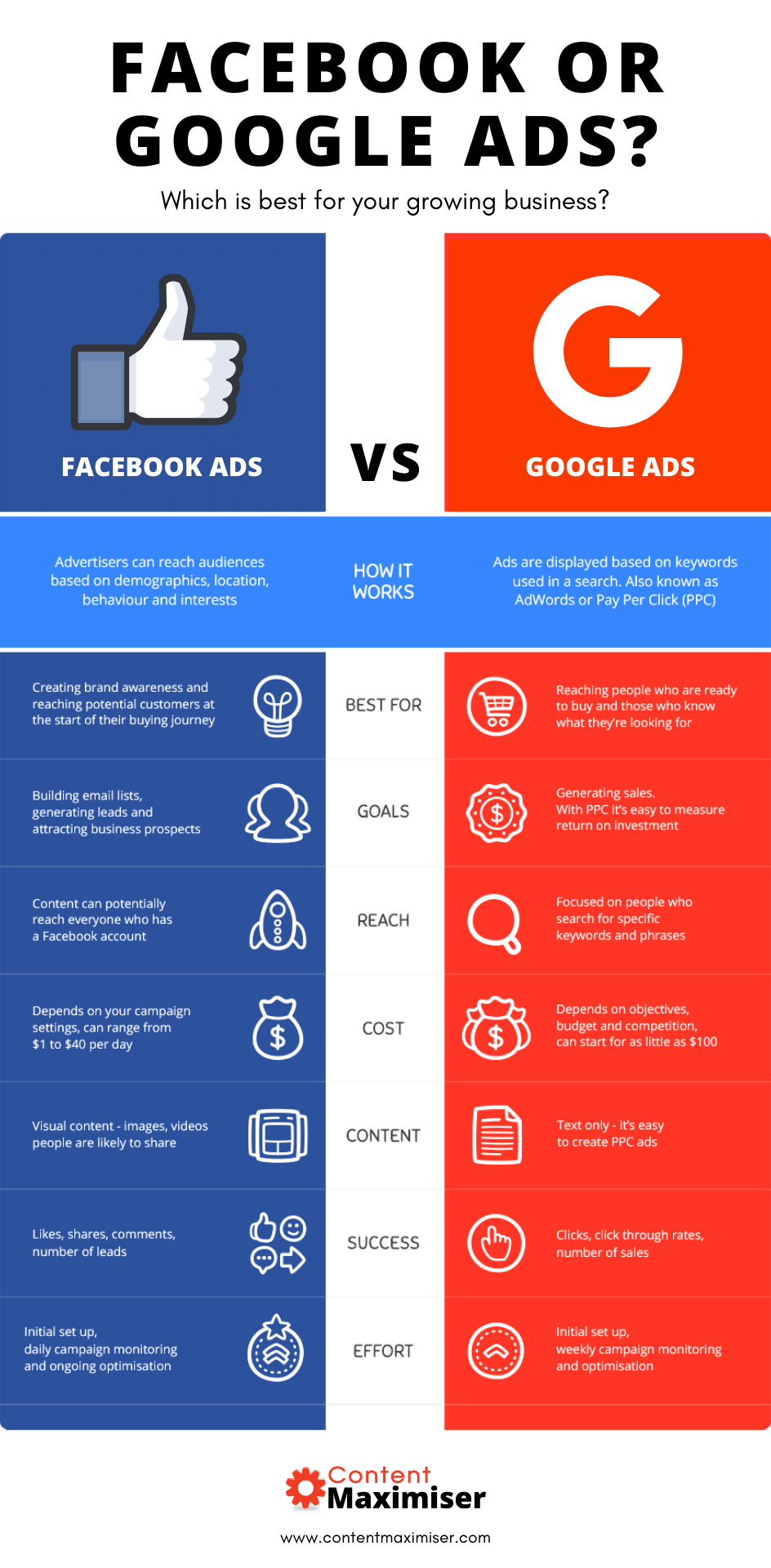
To cement this core distinction, the article "Google Ads vs Facebook Ads" from Gravitate Design provides a clear and concise explanation.
Google Ads vs Facebook Ads: Costs, ROI, and Best Uses
This article starts by defining the fundamental difference between the two platforms and provides a detailed comparison table.
First, read the introductory section, "What Are Google Ads and Facebook Ads?", to understand the "capturing demand vs. generating demand" concept. Then, study the table in the next section, "Key Differences". This table is a valuable reference for contrasting the platforms on everything from user behavior to ad formats.
Aligning Platforms with the Marketing Funnel
Now, let's connect this "capture vs. generate" model directly back to the TOFU, MOFU, BOFU funnel we discussed in the last lesson. Each platform's inherent strengths make it a natural fit for different stages of the customer journey.
-
Top of Funnel (TOFU - Awareness): The goal is to introduce your brand to a cold audience. Since these users aren't searching for you, Meta Ads excels here. Its powerful interest and demographic targeting allows you to "push" visual, engaging content to build awareness and generate initial demand. Google's Display and YouTube ad formats also play a strong role in TOFU for similar reasons.
-
Middle of Funnel (MOFU - Consideration): Users are now aware of their problem and are evaluating solutions. Here, the platforms begin to work in concert. Meta Ads is powerful for retargeting people who have visited your site or engaged with your TOFU ads, nurturing them with case studies, testimonials, or product guides. On the Google Search side, you can capture users searching for non-branded or comparison keywords (e.g., "best CRM for small business"), showing that you are a contender.
-
Bottom of Funnel (BOFU - Conversion): The user is ready to buy. Intent is at its peak, making this the primary domain of Google Search. You can capture high-intent users searching for your brand name or specific product keywords (e.g., "buy Nike Air Max 90"). Google Shopping ads are also exceptionally effective here for e-commerce. At the same time, Meta Ads can close the deal through dynamic retargeting campaigns that show cart abandoners the exact products they left behind.
The article from Gravitate Design has an excellent section that walks through this alignment step-by-step.
Google Ads vs Facebook Ads: Costs, ROI, and Best Uses
This section explicitly maps platform strategies to each funnel stage.
Please read the entire section "Facebook Ads vs Google Ads by Funnel Stage". Pay close attention to the examples of content and ad types recommended for TOFU, MOFU, and BOFU.
Analyzing the Trade-offs: Cost, Performance, and Industry
Choosing a platform isn't just about the funnel; it's also about budget efficiency and what works for your specific industry. Let's examine the quantitative trade-offs.
Cost vs. Value
Generally, Google Search ads have a higher Cost Per Click (CPC) than Facebook Ads. This is a simple matter of supply and demand: you are paying a premium to get in front of someone with active buying intent, and your competitors are bidding for that same valuable click.
While Facebook clicks are often cheaper, you may need more of them to nurture a user toward a conversion. Therefore, it's a trade-off between cost-per-click and lead quality/conversion rate.
This comparison chart gives you a snapshot of average benchmarks.

Notice that while Google Search has the highest CPC, it also has a significantly higher Click-Through Rate (CTR). This reflects the high intent of the user—they are actively looking for what the ad offers.
For a more comprehensive look at performance metrics, including the newer player, TikTok, we can turn to the "Ultimate Showdown" article from Rozee Digital.
Ultimate Google Ads vs Facebook Ads vs TikTok Ads Showdown
This resource provides recent, data-driven comparisons across Google, Meta, and TikTok, including ROI and industry-specific insights.
Focus on two key sections. First, review the table in "Cost Efficiency". This gives you hard numbers for CPC, CPM, CTR, Conversion Rate, and ROI across the three platforms. Next, read the section "Industry-Specific Performance". This provides practical context on which platforms tend to perform best for e-commerce, B2B, and service-based businesses.
Platform-Specific Scenarios
Let's synthesize this into clear scenarios for different business models:
- For a Local Service Business (e.g., plumber, lawyer): The primary goal is immediate lead generation from people with an urgent need. Google Ads is the clear winner. Capturing searches like "emergency plumber near me" is the most direct path to a customer.
- For a DTC E-commerce Brand (e.g., apparel, cosmetics): The product is visual, and the purchase may be more impulsive. Meta Ads is a powerhouse for product discovery (TOFU) and retargeting (MOFU/BOFU). Google Shopping is essential for capturing high-intent buyers at the BOFU stage.
- For a B2B SaaS Company: The sales cycle is long and requires education. A full-funnel approach is critical. Meta Ads can be used for TOFU (promoting a whitepaper to a specific job title) and MOFU (retargeting webinar attendees). Google Ads is crucial for BOFU, capturing leads searching for competitor names or specific software solutions.
The Power of Synergy: Using Both Platforms Together
As you can see from the scenarios, the most sophisticated strategies don't treat this as an "either/or" question. The real power lies in using Google Ads and Meta Ads together, allowing them to hand off the user from one stage of the funnel to the next.
Imagine this common user journey:
- Awareness (TOFU): A user sees an engaging video ad for a new brand of running shoes on their Instagram feed (Meta Ads). They watch it but don't click.
- Interest (MOFU): A week later, they see a retargeting ad on Facebook showing testimonials for the same shoes (Meta Ads). They are intrigued.
- Conversion (BOFU): The following weekend, they decide to buy and search Google for "[Brand Name] running shoes" (Google Ads). They click the search ad and make a purchase.
In this scenario, both platforms were essential. Meta generated the demand, and Google captured it. Neither platform could claim 100% of the credit, but together they created a successful conversion path.
This short video from Ben Heath explains the pros and cons of each platform and makes a strong case for why testing and using both is the optimal approach for any serious business.
Facebook vs Google Ads: Which is Best?
This video, "Facebook vs Google Ads: Which is Best?", provides a practical overview of each platform's strengths and weaknesses and concludes with a powerful argument for diversification.
Please watch the following three segments: The breakdown of Google Ads, where he discusses the power and limitations of search intent. The analysis of Facebook Ads, where he highlights its visual nature and audience-building capabilities. His concluding point on why you should test and use both platforms.
Conclusion
You now possess the strategic lens to look beyond the tactical execution of setting up campaigns on Google and Meta. You understand the fundamental trade-offs between capturing existing demand and generating new demand.
Key Takeaways:
- Google Ads Captures Demand: It leverages user intent ("pull" marketing) and is most powerful at the bottom of the funnel (BOFU) where users are ready to act. It often comes with a higher CPC but also higher conversion rates.
- Meta Ads Generates Demand: It uses audience characteristics to find potential customers ("push" marketing) and excels at the top and middle of the funnel (TOFU/MOFU). It is highly visual and often has a lower CPC.
- Choice Depends on Objective: The right platform depends on your business model and campaign goal. Local services lean on Google, visual e-commerce brands lean on Meta, and B2B requires a strategic mix.
- Synergy is the Goal: The most effective performance marketers don't choose one platform over the other. They orchestrate them to work together, guiding users seamlessly through the entire marketing funnel.
In our next lesson, we will put this knowledge into practice. You will learn how to take a campaign scenario, choose the right platforms based on the objectives we've discussed today, and build a media plan with budget allocation across channels.