Welcome back. In our previous lessons, we have explored the essential tools of narration: we've defined the different points of view, learned to control narrative distance like a camera's zoom lens, and, most recently, practiced crafting a distinct narrative voice. Now, it's time to bring all these skills together.
This lesson serves as the capstone for our module on point of view. You will apply everything you've learned to a single, powerful exercise: writing the same short scene from two different perspectives. This practice is fundamental for any writer, but it is especially crucial for the kinds of complex, multi-layered stories you aim to write. By mastering this, you lay the groundwork for creating mysteries with unreliable narrators, adventures with diverse casts, and plot twists that depend entirely on which character's eyes the reader is looking through.
Your goal for this lesson is to write a short scene from two different points of view to understand their profoundly different effects on the story and the reader.
The Same Scene, A Different Story
Point of view is more than a technical choice; it is the entire filter through which your story is experienced. The same set of events can feel triumphant, tragic, terrifying, or comical depending entirely on whose perspective we inhabit.
A character’s point of view determines what they notice, how they interpret it, and the emotions they feel. This combination of observation and feeling is what we call perspective.
Take a look at the image below. The scene is simple: a family is washing their dog. The third-person narrator gives us a lovely, wholesome overview. But once we switch to the first-person POV of each participant, the story splinters into four completely different emotional realities.

The dog is miserable ("Seriously!? Another bath?"). The boy is thrilled ("I love this hose thing."). The mom is anxious ("Don't spray the soap into the dog's eyes."). The objective facts are the same, but the subjective experience—the story—is entirely different for each one.
This is the effect you are aiming to create. Let's watch a short video that brilliantly illustrates this with a familiar fairytale.
First person vs. Second person vs. Third person - Rebekah Bergman
This animated TED-Ed video, "First person vs. Second person vs. Third person," uses the story of Rapunzel to show how POV transforms a narrative.
Watch from the beginning, paying close attention to the retelling of the Rapunzel story. Notice how the feeling of the story changes when it shifts from a neutral third-person account to the first-person perspectives of the Prince and then Rapunzel herself, from this section.
As you can see, the Prince's version focuses on the physical struggle and messiness of the climb, while Rapunzel's version is filled with impatience and physical discomfort. The story becomes more personal, specific, and engaging.
A Practical Demonstration
This technique of rewriting a scene from multiple viewpoints is a standard exercise that even seasoned authors use to deepen their understanding of their characters. It forces you to move beyond simply plotting events and start inhabiting the minds of the people living through them.
The following article provides a masterclass in this, showing how a writer can manipulate narrative voice within a third-person limited POV to completely alter the tone of a scene.
Third-Person Limited: Analyzing Fiction's Most Flexible Point of View
This article from Writer's Digest offers a clear, practical demonstration of writing a scene from multiple perspectives. It's an invaluable look at the "how-to" of this technique.
Please read the section that begins with the line "Build your own experience". The author provides an example of the same scene rendered three times: once in omniscient, once from the store owner Tom's close-limited POV, and once from his employee Lilly's close-limited POV. Study these three versions carefully.
Let's break down what makes these examples so effective:
- Omniscient: The narrator states, "Tom... was superficial and sexist." This is telling. It's a flat judgment delivered from on high.
- Tom's POV: We are not told Tom is unpleasant. We feel it through his perspective. He doesn't see an old woman; he sees someone "braying hellos" with "stained dentures." His gaze then moves to something he values: the "sleek new light fixtures." His voice reveals his character.
- Lilly's POV: Lilly sees the same woman, but her perspective transforms Mildred into a source of "irresistible enthusiasm" and one of the "bright spots" of her day.
The raw event—an old woman enters a store—is identical. But the story told from Tom's POV is one of annoyance and vanity, while the story from Lilly's POV is one of warmth and human connection. This is the power you are learning to wield.
A key technique used here is called free indirect speech, where a character's thoughts are blended into the third-person narration without using tags like "he thought" or quotation marks. When the narration from Tom's perspective describes Mildred "braying," that's Tom's thought process coloring the prose. It's a powerful way to merge voice and POV seamlessly.
Your Turn: The Scene of the Crime
Now it's time for you to put this into practice. Your interest in mystery and suspense provides the perfect backdrop for this exercise, as controlling perspective is the very heart of that genre.
Look at the image below.
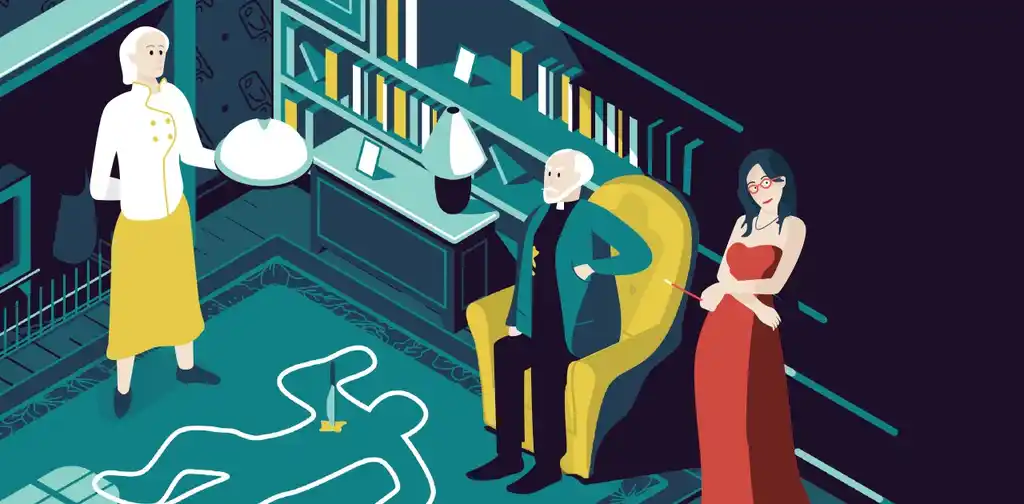
The Scenario: The man outlined in chalk is a wealthy, and widely disliked, tech mogul. The scene is his private study, moments after the lead detective has arrived. The three people in the room are the primary suspects:
- The Personal Chef: She was about to serve the victim his late-night meal.
- The Woman in Red: A rival CEO who had a mysterious meeting scheduled with the victim.
- The Old Man: The victim's reclusive father, from whom he was estranged.
Your Task:
Write the same scene (the first few minutes of the police investigation in the study) from two different points of view. Aim for around 200-250 words for each version.
Version 1: The Chef's Point of View (Third-Person Limited)
What does she notice? The cooling food on her silver tray? The single muddy footprint near the French doors that doesn't belong to anyone present? The detective's accusatory stare? Is her primary emotion fear, indignation, or something else? Let her profession and her current predicament color her thoughts and observations.
Version 2: The Woman in Red's Point of View (Third-Person Limited)
Now, rewrite the scene from her perspective. What does she notice? The flicker of guilt in the old man's eyes? The half-open safe behind a painting? The fact that the detective seems to be ignoring a crucial clue? Is she coolly assessing her escape routes, or is she fighting a rising panic? Her voice should reflect a mind that is analytical, strategic, and accustomed to power.
Take the next 30 minutes for this exercise. Remember the goal is not to solve the crime, but to create two distinct, compelling, and consistent narrative experiences of the exact same moment. Focus on filtering every detail—sights, sounds, thoughts—through the unique lens of your chosen character.
Conclusion
This exercise is one of the most effective ways to level up your writing. It moves you from being a simple reporter of events to a true storyteller, capable of creating deep character empathy and manipulating reader perception.
Key Takeaways:
- Changing the point of view fundamentally changes the story, even if the external events remain the same.
- A character's unique perspective is revealed through what they notice, how they interpret it, and the language (voice) they use to process it.
- Rewriting scenes is a powerful tool for exploring your characters' inner lives and discovering the most effective way to tell your story.
- This skill is the cornerstone of writing effective mystery and suspense, where you must carefully control what the reader knows and when.
You have now completed the core training on Point of View and Narrative Voice. In our next module, we will begin to assemble these narrated moments into larger structures. We'll start by breaking down the essential components of an effective scene: goal, conflict, and outcome, ensuring that every part of your story serves a purpose and drives the narrative forward.