Welcome to your next lesson on the art of narration. In our previous session, we explored how to control narrative distance, treating it as a "zoom lens" to pull the reader closer to or push them further from a character's intimate experience. We discussed how this shapes emotion and pacing.
Today, we will integrate that skill with others to tackle one of the most vital—and often most elusive—elements of powerful writing: narrative voice. If point of view is the camera's position and narrative distance is the zoom, then voice is the personality of the storyteller holding the camera. It’s what makes a story feel unique, compelling, and alive. For the kinds of engaging, plot-driven stories you enjoy, a strong narrative voice is often the "it" factor that grabs a reader from the first sentence and doesn't let go.
By the end of this lesson, you will be able to develop a consistent narrative voice that is perfectly suited to your story and its audience.
What is Narrative Voice?
First, it’s crucial to distinguish between two related concepts: authorial voice and narrative voice.
- Authorial Voice is the writer's own unique style that emerges across their body of work. It’s a product of your personality, your life experiences, and your subconscious linguistic habits. You don't need to consciously "find" this; it develops naturally as you write.
- Narrative Voice is a deliberate choice you make for a specific story. It is the distinct personality, tone, and worldview of the narration itself. A versatile author can create vastly different narrative voices for different books, even while their underlying authorial voice remains recognizable.
6 Steps to Create a Fantastic Narrative Voice (What I ...
This article by author K.M. Weiland provides an excellent explanation of this distinction. As you read, notice how she uses examples from her own novels to show how a single author can craft very different narrative voices.
Read the section titled "Which Is More Important?". Pay close attention to the three distinct examples of narration she provides from her books Behold the Dawn, Dreamlander, and Storming.
As the article makes clear, your focus should not be on "finding your voice" as an author, but on consciously crafting the right voice for your narrator. This voice is a combination of diction (word choice), syntax (sentence structure), and the overall tone it creates.
The Building Blocks of a Memorable Voice
A compelling narrative voice isn't magic; it's craft. It is built from a series of consistent, deliberate choices you make on the page. The infographic below provides a great at-a-glance summary of the key ingredients that combine to form a narrator's voice.
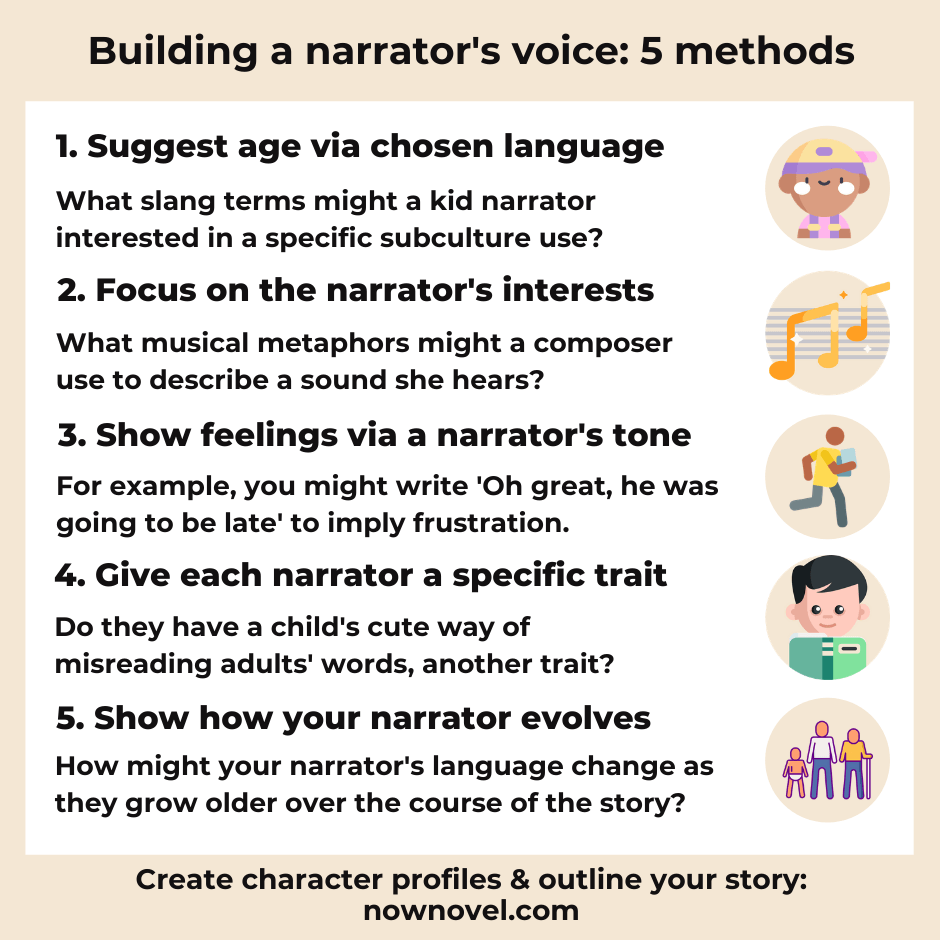
Let's break down how to assemble these ingredients into a coherent and consistent voice.
1. Ground the Voice in Character
The single most important source for your narrative voice is the character through whose perspective the story is told (whether in first or third person). Their background, personality, education, profession, and worldview will determine how they speak, what they notice, and how they interpret events.
A world-weary detective's narrative voice will be cynical and observant of detail. A young, idealistic hero's voice will be earnest and perhaps a bit naive. The voice of Harry Potter's third-person limited narration, for example, is colored by his adolescent perspective—his focus on fairness, his occasional angst, and his limited understanding of the adult world around him.
6 Steps to Create a Fantastic Narrative Voice (What I ...
Let's return to K.M. Weiland's article for a practical checklist on how to use character as the foundation for voice.
Read the steps titled "1. Choose the Right Point of View" and "2. Understand Your Character". The questions about personality, locale, financial background, and vocation are a powerful starting point for defining how your character's voice should sound.
2. Master Diction, Syntax, and Rhythm
Once you understand the character, you can translate their personality into language.
- Diction (Word Choice): Does your character use simple, direct words, or complex, formal language? Do they use slang from a specific region or subculture? Do they have a particular verbal tic or pet phrase? You can create a list of words or phrases specific to your narrator to help maintain consistency.
- Syntax and Rhythm (Sentence Structure): The flow of your sentences is a huge part of voice. A nervous, frantic character might narrate in short, choppy sentences. A thoughtful, philosophical character might use long, complex sentences with multiple clauses. Varying this rhythm is key to creating engaging prose.
- Imagery and Metaphor: The comparisons your narrator makes reveal their mind. A musician might describe a sunset in musical terms ("a final, golden crescendo"). A soldier might describe it in terms of battle ("the sky bled out over the horizon").
To develop a voice that is sophisticated and avoids being "basic average English," you must be deliberate about these choices and avoid clichés.
Voice in Writing: How to Make Your Narration Stand Out - Bibisco
This article from bibisco offers excellent advice on using language to build a unique voice.
Please read the sections "Use Specific Language and Vivid Imagery" and "Avoid Overuse of Clichés". These sections provide practical strategies for moving beyond generic descriptions to create fresh, memorable prose that defines your narrator.
3. Decide What the Narrator Notices
A character's voice is defined as much by what they don't say as what they do. What does your narrator pay attention to in a room? What do they ignore? This filtering of detail is a powerful and subtle way to build voice and is essential for mystery and suspense.
A thief entering a mansion will notice security cameras, escape routes, and valuable objects. An architect entering the same mansion will notice the vaulted ceilings, the materials used in construction, and the flow of light. Their narrative descriptions of the same space would be completely different, each revealing their unique perspective and voice.
How to Find Your Narrative Voice
This video from Diane Callahan on the Quotidian Writer channel provides a superb explanation of how voice acts as a "lens" for the story.
First, watch the segment that explains the importance of separating the author from the narrator. This reinforces the concept we began with. Then, pay close attention to the following section, which illustrates how a narrator's focus shapes the voice, using the "what they notice" principle with a great example of a character exploring a house.
Calibrating Voice for Genre and Audience
The final consideration is making your narrative voice appropriate for your story's genre and intended audience. The whimsical, conversational voice of a Young Adult fantasy novel would feel out of place in a gritty, hardboiled detective story.
The 7 Writing Styles | Which one are you?
The Reedsy channel has a helpful video breaking down several common writing styles, many of which are defined by their voice.
Watch the descriptions of three specific styles: the Conversational style, which feels spoken and intimate; the Comic style, which relies on wit and tone; and the Voice-driven style, which is deeply rooted in the character's unique psyche. As you watch, think about which styles you've seen in the books and movies you enjoy.
For the atmospheric mysteries you're interested in, you might choose a voice that is more observant, perhaps a bit formal or detached, to create a sense of unease. For an action-adventure story with a young protagonist, a more immediate, conversational voice might be more effective. The key is consistency. Once you establish the voice, you must maintain it to keep the reader immersed in the world you've created.
Practice: Channeling Emotion into Voice
Now, let's put this into practice. One of the best ways to find a character's voice is to tap into their strong emotions. Emotion colors perception and language in a powerful way.
How to Find Your Narrative Voice
Let's return to the Quotidian Writer video for a brilliant exercise. The host uses an excerpt from the classic Western novel True Grit to demonstrate how a character's anger and determination infuse their narrative voice.
First, watch the analysis of the True Grit example. Notice how the narrator, Mattie Ross, doesn't just say she's angry; her precise, factual, yet indignant choice of words shows her anger. Now, it's your turn. Following the video's prompt for the writing exercise, think of a character you have in mind. Your task: Write a single paragraph (5-10 sentences) where your character describes a person they intensely dislike or hate. The goal: Do not use words like "hate," "dislike," or "angry." Instead, let the emotion come through purely in the voice—through the specific details your character notices about the person and the particular words they use to describe them.
Take about 10 minutes to complete this exercise. It's a fantastic way to discover how a character's inner state can transform language and create a powerful, authentic voice.
Conclusion
Mastering narrative voice is a significant step toward becoming an accomplished writer. It moves your writing from simply conveying events to creating a rich, immersive experience.
Key Takeaways:
- Narrative voice is the personality of your story's narration. It is a conscious craft choice, distinct from your innate authorial voice.
- The most powerful voices are grounded in a specific character's personality, background, and worldview.
- Voice is built from the technical elements of diction, syntax, and rhythm.
- A key component of voice is what the narrator chooses to notice and what they ignore.
- The voice must be consistent and appropriate for the story's genre and audience.
In our next lesson, we will put everything from this module together. You will write a short scene from two different points of view, which will give you a chance to practice not only choosing a POV, but also controlling narrative distance and, most importantly, crafting two distinct narrative voices.