In our last lesson, we deconstructed the architecture of an engaging story, exploring the structural skeleton and psychological hooks that make a narrative like Harry Potter so compelling. You learned to see stories not just as a reader, but as an analyst. Today, we pivot from analysis to creation. This lesson is about igniting that initial spark and fanning it into a flame. We will focus on how to generate and evaluate compelling story ideas using structured brainstorming techniques, equipping you with the practical tools to move from a blank page to a promising concept.
The Origin of an Idea: The "What If?" Spark
Every novel, from epic fantasies to grounded thrillers, begins with a single, foundational idea. Often, this idea takes the form of a simple but powerful question: "What if...?" This question is the seed from which entire worlds can grow.
- What if a boy discovered he was a wizard on his eleventh birthday?
- What if dinosaurs could be cloned and brought back to life in a theme park?
- What if a team of thieves could enter people's dreams to steal their secrets?
These simple premises are the starting points for Harry Potter, Jurassic Park, and Inception. But ideas don't always arrive as a sudden flash of insight. They can be actively sought out.
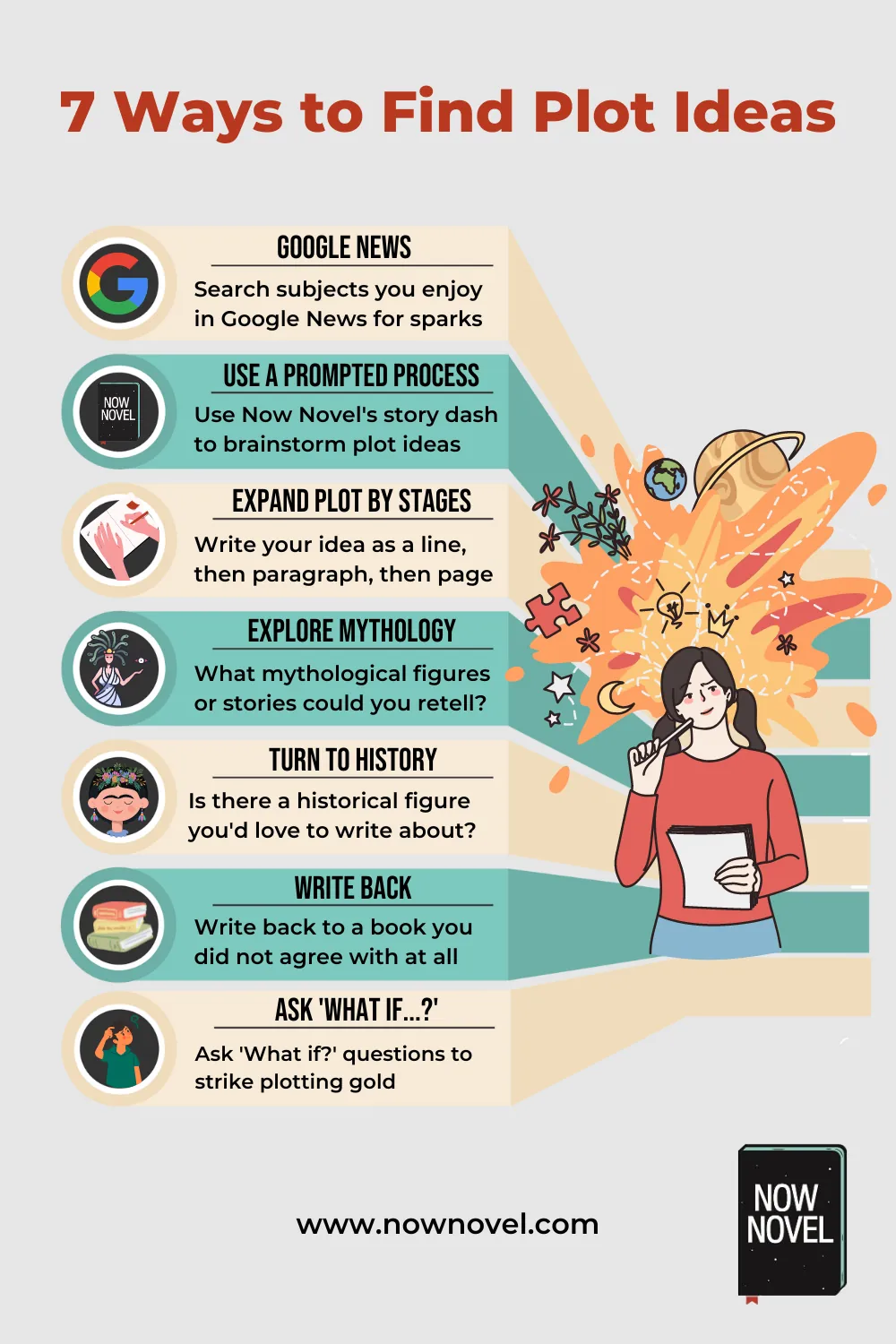
As the infographic suggests, inspiration is everywhere. It can be found in a historical event, a scientific discovery, a piece of mythology, or even a book you disagreed with. The key is to remain curious and to practice seeing the story potential in the world around you.
To begin, let's explore this foundational "What if?" concept and address a common concern for new writers: originality.
Writing a Fiction Novel (Part 1): How to Brainstorm Ideas ...
This article by Miffie Seideman provides an excellent introduction to generating and thinking about story ideas. It starts with the 'What if?' question and explains why you shouldn't worry too much about your idea being completely unprecedented.
Please read from the beginning of the article down to the start of the "Growing the Idea" section. Focus on the explanation of 'What if?' and the subsequent section, which addresses originality. Notice the examples of how the core idea of Romeo and Juliet has been retold in countless unique ways.
The key takeaway is that execution matters more than the absolute novelty of a concept. Your unique voice, characters, and plot twists are what will make a familiar idea feel fresh and exciting.
From Spark to Concept: Structured Brainstorming
Once you have a spark—a "What if?" question—the next step is to develop it into a more fleshed-out concept. This is where brainstorming comes in. The goal of brainstorming is not to find the right ideas, but to generate a quantity of ideas without judgment. You are giving yourself permission to be creative and explore possibilities.
Method 1: Mind Mapping
A mind map is a visual brainstorming tool that helps you explore the different facets of your core idea. It's a fantastic way to see how the five core elements we discussed in our first lesson (Character, Plot, Setting, Theme, Conflict) relate to each other.
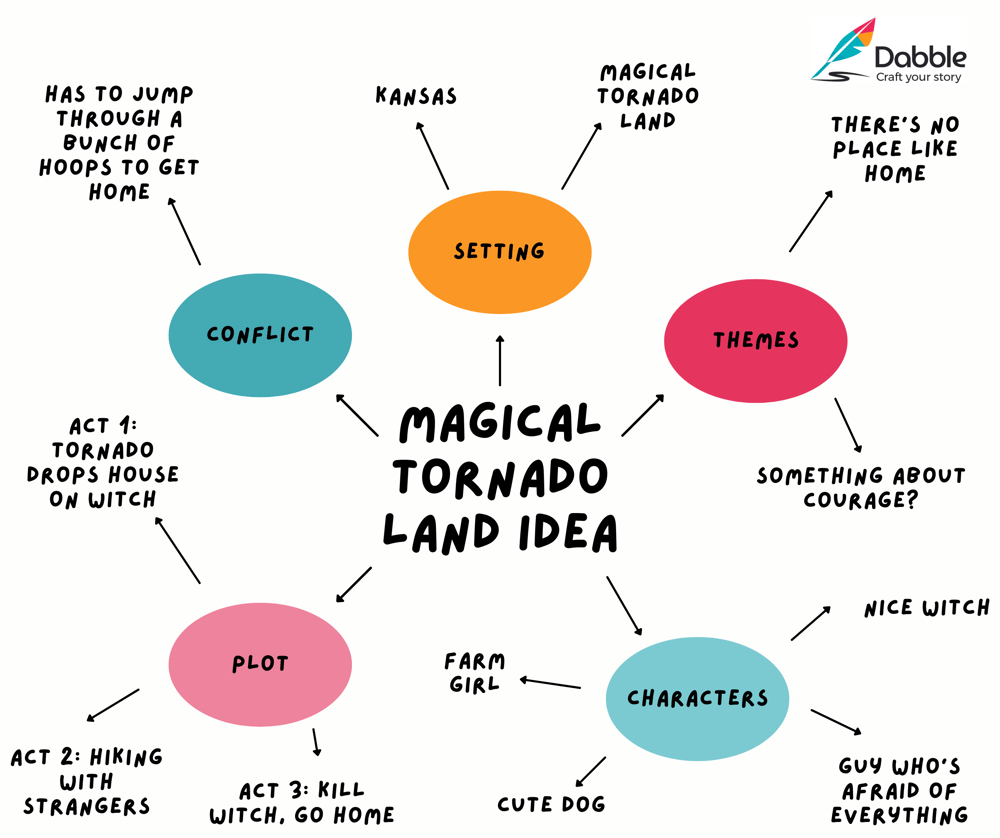
You can see how a vague idea inspired by The Wizard of Oz quickly starts to take shape. The setting is "Kansas" and a "Magical Tornado Land." The character is a "Farm Girl" with a "Cute Dog." The plot involves a tornado, a witch, and a journey. It's simple, but it's a start.
Method 2: The "One Truth and Four Questions"
This is a powerful, character-centric method for building a story from a simple observation. It's particularly useful for generating ideas that have strong internal and external conflict baked in from the start. The core principle is that all stories are about people and their reaction to change.
How to Come Up with ORIGINAL Story Ideas [Brainstorming Method]
This video from the Reedsy channel, "How to Come Up with ORIGINAL Story Ideas," details a systematic approach to brainstorming. It breaks the process down into "one truth and four questions."
Watch the video to understand this method. Pay close attention to these key segments: The "One Universal Truth": This section explains the fundamental idea that all stories are about people reacting to change. Question 1: "Why are they doing that?": Learn how to turn a simple observation into a potential character motivation. Question 2: "What does that say about them?": See how motivation helps define a core personality trait. Question 3: "What's the best or worst thing that could happen?": This is the crucial step where you introduce conflict that specifically tests the character's defining trait. Question 4: "Where else could this happen?": This demonstrates how to transplant your core character conflict into any genre or setting, which is highly relevant to your interest in writing across genres.
This four-question process—Why are they doing that? What does it say about them? What's the best/worst thing that could happen? Where else could this happen?—is a complete engine for generating robust story concepts. It moves from a simple real-world observation to a complex character-driven plot that can be adapted to fantasy, mystery, or sci-fi.
Other Brainstorming Techniques
There are many other ways to get ideas flowing. The key is to find what works for you.
9 Fiction Writing Brainstorm Techniques - Quill and Books
This article from Quill and Books offers a quick tour of several other useful techniques.
Skim the article to get a sense of the variety of methods available. Pay particular attention to: Visual Association: Since you enjoy movies and have an interest in creative visualization, using images (movie stills, concept art, photos) can be a powerful trigger. Free Writing: The simple act of writing continuously without stopping can unlock ideas you didn't know you had. The "What if...?" question is reinforced here as a central tool.
Evaluating Your Idea: Is It a Novel?
After a brainstorming session, you might have dozens of ideas. How do you know which one is worth pursuing for the length of a novel? You need a way to test the strength and viability of your concept. A great story idea usually has three essential components: a clear objective, meaningful stakes, and significant obstacles.
The ONLY Way to Plot a Novel (It's Easier Than You Think!)
In this video, "The ONLY Way to Plot a Novel," editor Alyssa Matesic breaks down the core of any compelling plot into three simple elements. This framework is perfect for evaluating your raw ideas.
Watch these sections to understand the three pillars of a strong story concept: The Protagonist's Objective: Learn why your character must want something concrete and tangible. The Stakes: Understand why the reader needs to know what the character has to gain or lose. The Obstacles: See why conflict is essential for creating tension and momentum. Finally, watch the Plot Exercise section. The sentence template provided is an incredibly effective tool for testing your idea.
The template is your litmus test:
[Character] wants [Objective] because [Stakes], but [Obstacle] is getting in their way.
If you can fill in this sentence with specific, compelling details, you likely have a strong foundation for a story.
- Weak Idea: "A man wants to be happy, but life is hard." (Objective and Obstacle are too vague; Stakes are missing).
- Stronger Idea: "A disgraced knight wants to reclaim his family's ancestral sword (Objective) because it's the only way to restore his honor and clear his name (Stakes), but his former mentor, who now leads a corrupt order of knights, has hidden it and will do anything to stop him (Obstacle)."
Your Turn: From Spark to Sentence
Now it's time to put these techniques into practice.
- Generate: Choose one brainstorming method we've discussed (Mind Mapping, the Four Questions, Visual Association, etc.). Spend 10-15 minutes generating a few story sparks. Don't self-edit; just get the ideas down.
- Evaluate: Pick the idea that intrigues you the most. Try to distill its core conflict using the sentence template: "[Character] wants [Objective] because [Stakes], but [Obstacle] is getting in their way."
- Reflect: Does the sentence feel compelling? Is the objective specific? Are the stakes meaningful? Is the obstacle formidable? If not, how could you strengthen each component?
This exercise isn't about creating a perfect plot; it's about learning to identify the essential ingredients of a story worth telling.
Conclusion
Today we've moved from the role of critic to creator. You've learned that generating ideas is a skill that can be practiced and developed with structured techniques.
Key Takeaways:
- Story ideas often start with a "What if...?" question and can be found by observing the world with a storyteller's eye.
- Structured brainstorming methods like mind mapping and the "One Truth and Four Questions" help you develop a simple spark into a full-fledged concept.
- A strong story concept can be tested by identifying its three core pillars: a clear Objective, high Stakes, and a significant Obstacle.
- Using the template "[Character] wants [Objective] because [Stakes], but [Obstacle] is in the way" is a powerful method for evaluating the core conflict of your idea.
In our next lesson, we will begin honing the craft of bringing your ideas to life on the page. Now that you have a method for generating story concepts, we will focus on practicing sensory observation exercises to sharpen your awareness for descriptive writing, the first step toward building the vivid, atmospheric worlds you're interested in creating.