Welcome to the third lesson in our journey to build your skills as a fiction writer. In our previous lessons, we identified the five core elements of a story and then explored how different genres—fantasy, adventure, and mystery—combine these elements to create distinct reader experiences. We saw how a story like Harry Potter is a masterful blend of all three.
Today, we move from what makes a story to why a story is engaging. Why do we find ourselves unable to put down certain books? What makes us care so deeply about fictional characters and their imaginary worlds? This lesson will equip you with the tools to analyze the engaging qualities of a story, using Harry Potter as our primary case study to deconstruct the architecture and psychology of a compelling narrative. By the end, you'll be able to look at your favorite stories not just as a reader, but as a writer learning the craft.
The Architecture of Engagement: Story Structure
Engaging stories are rarely accidental. They are meticulously constructed. Just as an architect designs a building to be both beautiful and structurally sound, a writer designs a story to be emotionally resonant and logically coherent. This design is its structure.
You’ve likely heard of the three-act structure, and in our previous lessons, we've touched on elements that fit within it. At its simplest, this structure can be visualized as a dramatic arc.
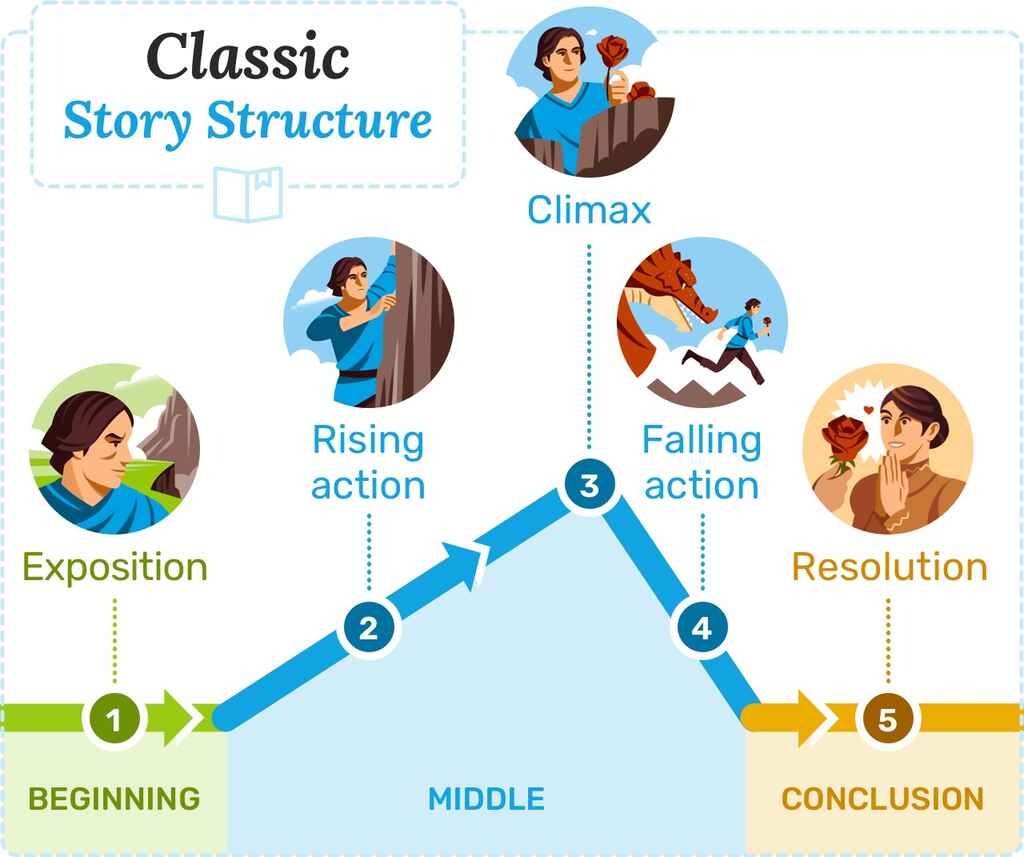
This is a great starting point, but to truly understand how engagement is built, we need a more detailed blueprint. Many successful stories, especially in the fantasy and adventure genres you enjoy, follow a pattern known as the Hero's Journey. This is just one of several proven templates for structuring a compelling narrative.
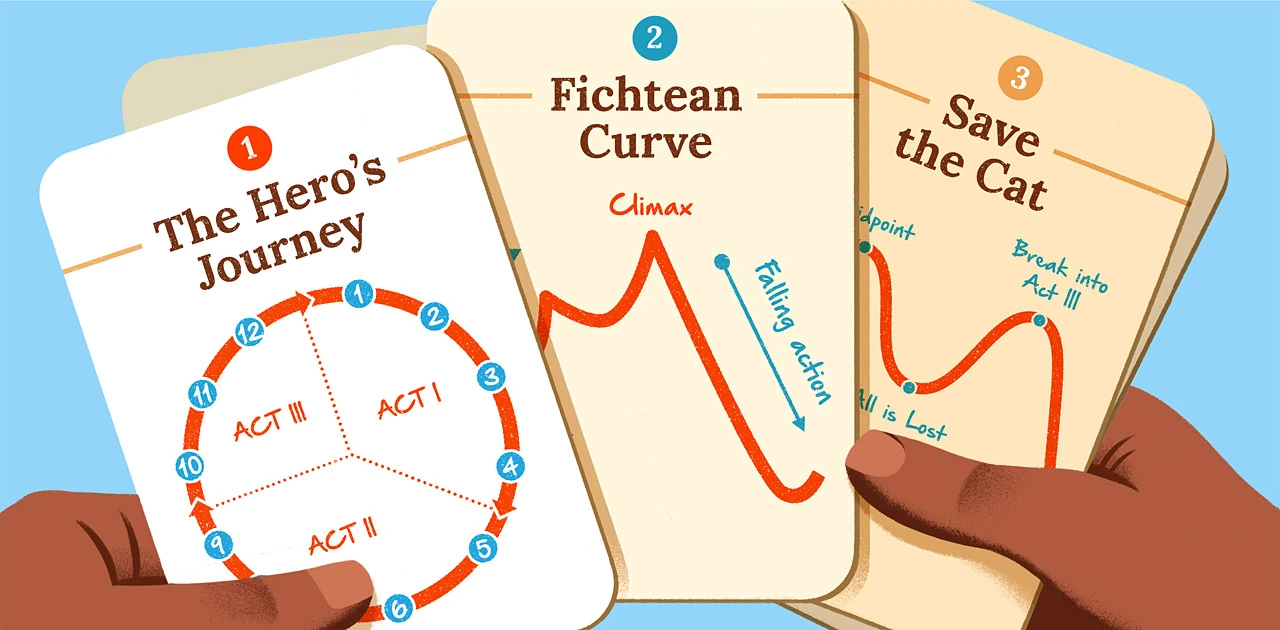
To dig deeper, we'll use a powerful analytical tool called the Story Grid, which breaks a story down into its most fundamental turning points.
Deep Dive: Harry Potter's Story Structure
This "Deep Dive: Harry Potter's Story Structure" from the Story Grid channel provides a university-level analysis of Harry Potter and the Sorcerer's Stone. We'll use it to understand the book's structural skeleton.
First, watch the section that explains the Five Commandments of Storytelling. These are the essential building blocks of any scene, act, or global story. Pay close attention to the definitions of these five terms: Inciting Incident, Progressive Complication, Crisis, Climax, and Resolution. Next, watch how the presenters apply these Five Commandments to the entire plot of Sorcerer's Stone. This will show you how the story's main conflict is built from beginning to end. Focus on the segment from the global five commandments up to the discussion of the internal story.
What this analysis reveals is that a story's engagement isn't magic—it's engineering. The global structure of Harry Potter and the Sorcerer's Stone creates a clear and compelling arc:
- Inciting Incident: Harry learns he's a wizard and Voldemort tried to kill him. (A disturbance that creates a goal).
- Progressive Complications: Harry discovers the Sorcerer's Stone, suspects Snape, and realizes Voldemort is at Hogwarts. (Obstacles and revelations that raise the stakes).
- Crisis: Should Harry go after the stone himself, or let the adults handle it? (A crucial, high-stakes decision).
- Climax: Harry confronts Quirrell/Voldemort in the final chamber. (The action taken to resolve the crisis).
- Resolution: Harry defeats Voldemort (for now) and saves the stone. (The outcome of the action).
This sequence provides a backbone that ensures the plot is constantly moving forward and the stakes are continually rising, pulling the reader along with it.
The Ingredients of Engagement: Psychological Hooks
If structure is the skeleton, what is the flesh? What are the specific elements within that structure that make it so appealing to us?
Researcher and author Dr. Jennifer Lynn Barnes argues that the most successful stories tap into deeply ingrained psychological triggers, or "pleasure buttons." By understanding these, you can see why certain themes, characters, and situations are so universally compelling.
6 Psychological Triggers That Make Books Bestsellers (Six of Crows Breakdown)
This video from Story Lab, "6 Psychological Triggers That Make Books Bestsellers," introduces this concept clearly.
Please watch the introduction to learn what these six pleasure buttons are: her research suggests.
The six triggers are: Beauty, Wealth, Power & Status, Competition, Safe Danger, and Touch. While the video uses Six of Crows as its example, these triggers are the secret sauce in Harry Potter as well.
- Beauty: The breathtaking, almost cinematic descriptions of Hogwarts castle, the wonder of Diagon Alley, the eerie beauty of the Forbidden Forest, the visual spectacle of a spell—these create an immersive, aesthetically pleasing world.
- Wealth: This isn't just about money. It's about resources and what they represent. Think of Harry's shock at seeing a vault full of gold left by his parents (security, legacy) contrasted with the Weasleys' loving but impoverished home.
- Power & Status: The entire wizarding world is built on hierarchies of power. The power of the Ministry of Magic, Dumbledore's immense magical ability, Voldemort's lust for ultimate power, and the social status conflicts between "pure-bloods," "half-bloods," and "Muggle-borns."
- Competition: This is a huge driver of engagement in Harry Potter. The constant rivalry between the Hogwarts houses, the thrilling Quidditch matches, and the formal structure of the Triwizard Tournament in a later book all tap into our love for a good contest.
- Safe Danger: This is perhaps the core appeal of the action-adventure genre. We get to face a basilisk, escape Dementors, and battle a dark lord, all from the safety of our armchair. The story provides the thrill of mortal peril without any actual risk.
- Touch: This refers to human connection in all its forms. The power of the central trio's friendship is the emotional core of the series. Harry's deep longing for the parents he can never touch, and the protective warmth of characters like Molly Weasley, provide immense emotional weight.
By consciously weaving these elements into your story, you can create a narrative that resonates with readers on a fundamental, psychological level.
The Art of Engagement: Creating Curiosity
Structure provides the path, and psychological hooks provide the motivation, but the art of engagement lies in managing the flow of information to make the reader desperate to know what happens next. This is especially relevant to your interest in writing mysteries, puzzles, and plot twists.
The key is to create curiosity, not confusion. A confused reader will put the book down. A curious reader will stay up all night to finish it.
How To Hook Your Readers' Curiosity (Without Being Vague)
This article by Savannah Gilbo masterfully explains this distinction. It provides a simple, powerful framework for managing information in your story.
Please read the first two sections of the article. Start with The Difference Between Mysterious and Vague, which gives a clear definition. Then, continue with the example from Harry Potter, which perfectly illustrates the principle in action.
The Gringotts break-in example shows the core principle: Give the reader context first, then create a question within that context. We know Harry was at Gringotts. We know Hagrid took a mysterious package. Now, we learn there was a break-in at a vault that was emptied that very day. The facts are clear, but the connection is a mystery. We aren't confused; we are intrigued.
The article goes on to provide a three-part framework for generating this kind of curiosity:
- Give Readers the Essential Context: Ground the reader in the who, what, and where so they can focus on the mystery that matters, not on trying to figure out what’s going on.
- Make the Missing Information Matter to Your Character: The mystery must be personal. The identity of the Sorcerer's Stone's creator isn't an academic puzzle; for Harry, it's the key to understanding who is trying to kill him.
- Deliver Information That Answers Questions AND Raises New Ones: Every clue should feel like progress, but it should also open up a new line of inquiry. Finding out Nicholas Flamel created the stone (an answer) immediately raises a new question: Why is it at Hogwarts, and who would want to steal it? This is the engine of a mystery plot.
Deconstructing the Magic
We've looked at J.K. Rowling's work through the lenses of structure, psychology, and information management. A final reading will help tie these concepts together, showing how they all work in concert.
How to Write Like JK Rowling: Discover Her Process
This article from Self-Publishing School provides a great overview of Rowling's techniques, which align perfectly with what we've discussed.
As you read, try to connect the points back to our lesson: Read the section on The Hero's Journey. You'll see it's a more detailed version of the classic story structure we examined. Read about Emotional Connection and Relatable protagonists. Notice how these connect directly to the psychological trigger of Touch and creating character-driven stakes. The section on meticulous world-building shows how to infuse a setting with the triggers of Beauty, Wealth, and Power. Finally, read about Foreshadowing and plot twists. This is a perfect summary of how to create the kind of Curiosity we analyzed, planting clues that pay off later.
Conclusion
Today, we've peered behind the curtain to see how literary magic is made. We've learned that the most engaging stories are not just creative accidents; they are thoughtfully crafted products of structure, psychology, and artistry.
Key Takeaways:
- Engaging stories have a strong architecture. Structures like the Five Commandments or the Hero's Journey provide a proven blueprint for taking the reader on a satisfying emotional journey.
- Compelling narratives tap into universal psychological hooks. By incorporating elements of Beauty, Wealth, Power, Competition, Safe Danger, and Human Connection, you can make your story resonate on a deeper level.
- The art of engagement is the art of creating curiosity. By strategically revealing information, you can make your reader a partner in solving the story's puzzle, keeping them hooked until the very end.
In our next lesson, we will take these principles and put them into action. Now that you have a better understanding of what makes a story work, you'll learn structured brainstorming techniques to generate and evaluate compelling story ideas of your own.