Welcome to the next step in your journey as a writer. In our previous lesson, we focused on generating the foundational concepts for your stories using structured brainstorming techniques. You learned how to take a simple "What if?" question and test its strength by defining a character's objective, stakes, and obstacles. Now that you have the tools to build the skeleton of a story, this lesson will teach you how to put flesh on those bones.
Today, we will focus on practicing sensory observation exercises to sharpen your awareness for descriptive writing. Your goal is to create immersive, atmospheric, and mysterious worlds for your readers. This lesson provides the fundamental skill to achieve that: learning to observe the world with a writer's senses and translate those observations into vivid prose that pulls your reader directly into the scene.
The Doorway to Your World: Sensory Writing
Have you ever read a book and felt like you were truly there? You could almost smell the rain-soaked earth, hear the distant city traffic, or feel the chill of a stone corridor. This feeling of immersion is not accidental; it is crafted by the author through the deliberate use of sensory details.
Writing that appeals to the five senses—sight, sound, smell, taste, and touch—is what transforms a description from a static image into a living experience. For the reader, it's the difference between watching a movie of your story and actually stepping into its world.
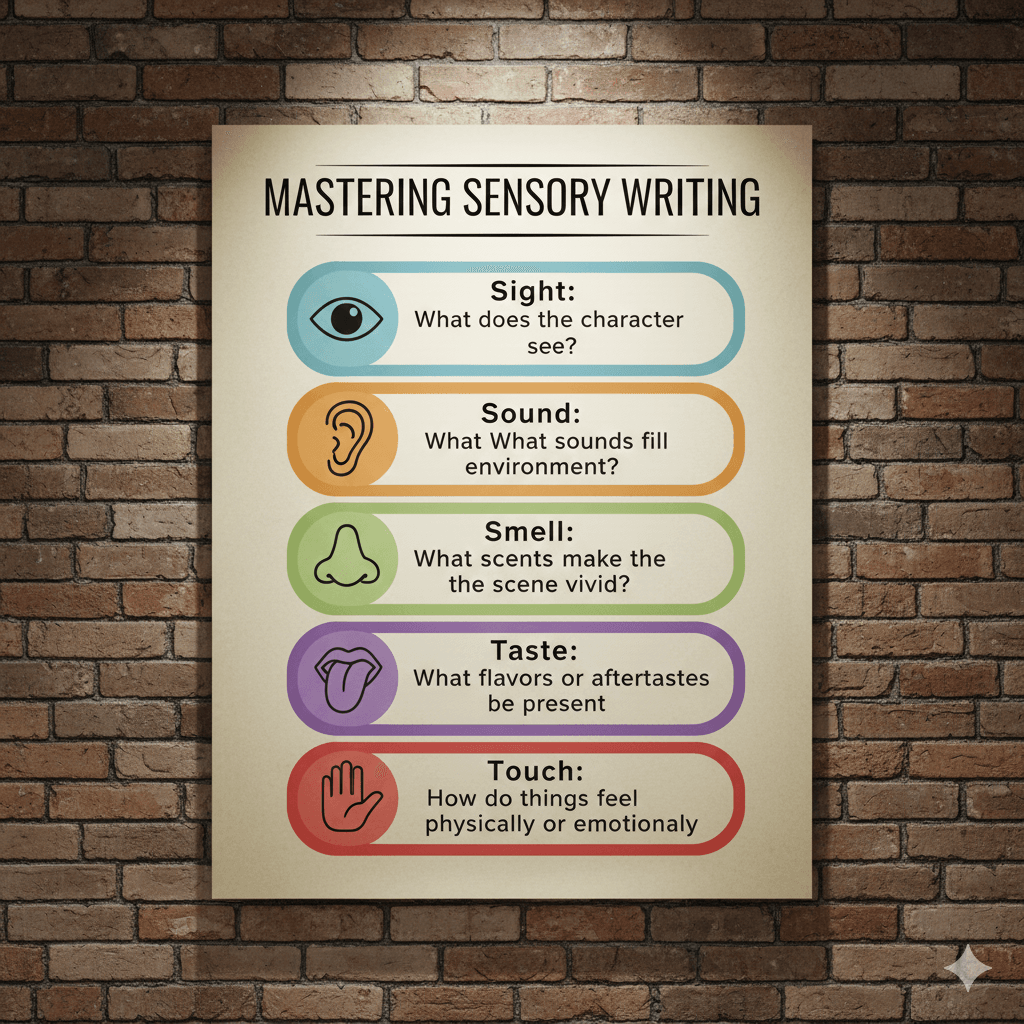
The goal is to move beyond simply stating what happens and instead evoke the experience of it. To see how this works in practice, let's look at some examples that contrast basic description with rich, sensory writing.
Descriptive writing using 5 senses ✍️ | How to write the perfect piece of descriptive writing
This short video from Learn Easy English powerfully demonstrates the 'before and after' of applying sensory details. It shows how to elevate simple sentences into engaging prose.
Please watch two key examples in the video: First, watch the segment that improves a description of a forest, from the simple version to the analysis. Notice how it moves from "I can see..." to using stronger verbs ("glow," "wave") and personification. Next, pay close attention to the example of a mysterious, gloomy scene, starting from the description and analysis. This is directly relevant to your interest in creating atmospheric settings. Note how words like "bleak," "isolation," and "crippled" and the metaphor "a blanket of fog" create a specific mood of mystery and unease.
As the video shows, the effective use of sensory language is not just about listing details; it's about choosing specific words that create a particular feeling or atmosphere.
A Framework for Observation
Before you can write a sensory-rich scene, you need to practice observing the world with a writer's focus. This means actively tuning in to the sensory information that we often filter out in our daily lives. A great way to practice this is to pause before writing a scene and consciously catalog the sensory details from your character's perspective.
The following article provides a superb example of this pre-writing exercise.
Using Setting and Description in Creative, Yet Crucial Ways
This article by Darcy Pattison demonstrates a practical method for grounding your scenes in sensory detail. It shows how to build a scene from a simple list of observations.
Read the first part of the article, from the beginning down to the heading "Sensory Details Change When The Setting Changes." Pay close attention to the cave exercise. The author first lists sensory details and then weaves them into a short, atmospheric paragraph. This is the exact process you should practice.
What makes this technique so powerful is that sensory details do more than just paint a picture; they establish mood. The choice of words can turn a neutral setting into one of dread, excitement, or tranquility.
In the article you just read, notice how the author later adjusts the sensory details of the cave scene to completely change its emotional tone.
- Dread: "cold drops plopped," "musty smell," "sinister."
- Anticipation: "merry yellow circle," "glossy moss," "cool water trickled," "torch sizzled."
By consciously selecting your sensory words, you gain precise control over the reader's emotional experience, a key component in building the mysterious or tense atmospheres you're aiming for.
Your Turn: Sensory Training Exercises
Now it's time for you to actively practice this skill. The goal of these exercises is to train your brain to think in sensory terms. We'll use a set of targeted prompts to help you focus on each sense individually, especially those that are often overlooked, like smell and touch.

Here is your main exercise for this lesson. It has two parts: observation and freewriting.
Part 1: The Sensory Audit (15 minutes)
- Choose a Place: Pick a location you can either physically be in or remember very clearly. It could be your current room, a local park, or even a setting from a favorite movie or a memory of a football match.
- Brainstorm: Using a notebook or the structure from the "Brainstorm Descriptive Words" worksheet, spend about 10-15 minutes listing as many sensory details as you can for that place. Go through each of the five senses systematically. Don't judge the details, just capture them.
- Sight: What colors, shapes, light, and shadows do you see?
- Sound: What are the loudest sounds? The quietest? Is there a rhythm?
- Smell: Are the smells pleasant or unpleasant? Sharp or faint?
- Touch: What is the temperature? The texture of surfaces? The feeling of the air on your skin?
- Taste: Is there a taste in the air? On your tongue?
Part 2: Focused Freewriting (15 minutes)
Now, we'll use some specific prompts to turn your observations into prose. The article below contains 25 excellent prompts designed to awaken each of your senses.
25 Great Creative Writing Exercises To Awaken The Senses
This article from A Writer Within offers a fantastic collection of prompts to practice sensory writing. It also provides excellent advice on how to approach these exercises.
First, read the sections "How to start:" and "Remember:". The advice to set a timer, write by hand, and suspend judgment is crucial for this kind of creative practice. Then, review the prompts for each sense to see the kinds of questions that can trigger detailed descriptions.
Using the location you chose in Part 1, select one prompt from the "Smell" section and one from the "Touch" section in the article. Spend about 5-7 minutes on each prompt, freewriting a short paragraph inspired by your brainstormed list. For example, if your setting was an old library:
- Smell Prompt: "What's the most unusual smell you’ve ever encountered?" might lead you to describe the scent of decaying paper mixed with old leather and a faint hint of floor polish.
- Touch Prompt: "Write about something you can’t pass by without touching it" might lead to a description of running your fingers over the embossed gold letters on the spine of an old book.
The purpose of focusing on smell and touch is to build strength in the senses that writers most commonly neglect, giving your prose an immediate and noticeable depth.
Advancing Your Skills
Once you are comfortable with this basic practice, you can begin to make your sensory language even more evocative. One advanced technique is to describe a sense using the language of another.
The 3 Writing Exercises That Instantly Level Up My Writing
In this video from Story Lab, the presenter discusses a few key writing exercises. He breaks down sensory writing into an "easy mode" and a "hard mode."
Watch the section on sensory writing from this point in the video. The "easy mode" is what we've just practiced: ensuring all five senses are represented. Pay attention to the "harder challenge", which involves describing a sense with unconventional words, like a "heavy" or "rough" smell. This encourages the reader to participate by interpreting what that means from their own experience.
This technique is a powerful way to move beyond "basic average English" and develop a more unique and compelling style.
Conclusion
Today, you've learned the importance of sensory details and, more importantly, have practiced the active skill of sensory observation. This is the foundation upon which you will build the atmospheric and immersive worlds your characters will inhabit.
Key Takeaways:
- Sensory writing is about immersing the reader in an experience by appealing to all five senses.
- Before writing a scene, practice a "sensory audit" by brainstorming what your character would see, hear, smell, touch, and taste.
- Your choice of sensory words is a powerful tool for establishing a specific mood or atmosphere.
- Practice focused freewriting exercises, especially for underused senses like smell and touch, to strengthen your descriptive muscles.
In our next lesson, we will build directly on this foundation. You've now practiced observing the real world for sensory details. Next, we will explore how to use guided visualization techniques to imagine story scenes in vivid detail before writing, allowing you to generate this same level of richness for worlds that exist only in your mind.