Welcome to the seventh module of our course, where we dive into the art of writing effective dialogue. In the previous module, we concluded by looking at the large-scale architecture of a novel—how scenes are arranged into chapters to control pacing and create suspense. Now, we will zoom in from that bird's-eye view to the most granular level: the punctuation that makes conversations on the page clear, professional, and immersive.
Today's lesson is dedicated to a fundamental, non-negotiable skill: applying proper dialogue formatting and punctuation conventions. While it might seem like a dry, technical topic, mastering these rules is what separates an amateur manuscript from a professional one. Just as poor sound mixing can ruin a scene in a movie, incorrect punctuation distracts the reader and shatters the illusion of the story. By learning these conventions, you build the essential framework upon which all effective dialogue is written.
Why Punctuation Matters: The Foundation of Clarity
Before diving into the specific rules, it's crucial to understand why they exist. Dialogue punctuation isn't arbitrary; it's a set of signals that guide the reader, telling them who is speaking, how they are speaking, and what actions are happening around them. When these signals are clear and consistent, the reader can forget about the mechanics and simply immerse themselves in the conversation.
The video below, from the Quotidian Writer channel, provides an excellent and thorough overview of the dialogue punctuation rules used in modern fiction, based on the Chicago Manual of Style, which is the standard for US publishing.
This video, "How to Punctuate Dialogue," is a comprehensive guide that will serve as our primary reference for this lesson. It clearly breaks down the most important rules.
Please watch the following segments: Introduction (0:07 - 1:13): This explains the importance of punctuation and establishes the style guide we'll be following. Commas with Dialogue Tags (1:20 - 3:57): This is the core of dialogue punctuation. Pay close attention to the placement of commas and capitalization rules when a tag like "he said" comes before, after, or in the middle of dialogue. Paragraph Breaks (3:57 - 4:38): This covers the single most important rule for formatting conversations.
Let's summarize and reinforce the essential rules from the video with a helpful visual guide.

The most critical takeaway is the "new speaker, new paragraph" rule. Every time the person speaking changes, you must start a new, indented paragraph. This is the primary visual cue that helps readers track a conversation without getting lost.
Dialogue Tags vs. Action Beats: A Crucial Distinction
One of the most common areas of confusion for new writers is the difference between a dialogue tag and an action beat. Punctuating them correctly is essential.
-
A Dialogue Tag uses a verb of utterance to identify the speaker (e.g., said, asked, shouted, whispered). It is part of the same sentence as the dialogue and is typically set off by a comma.
"I won't be late," she promised.
-
An Action Beat is a separate sentence that describes a character's action. It is not part of the dialogue sentence and is separated by a period. It shows what the character is doing while speaking.
"I won't be late." She grabbed her keys from the hook.
The following resource provides a crystal-clear distinction and, importantly, a list of words that are often misused as dialogue tags.
This article from Beacon Point Services is a concise and practical guide that focuses specifically on the difference between tags and beats.
Please read the entire article. Pay special attention to the section titled "These words aren’t dialogue tags." Verbs like "smiled," "sighed," or "nodded" describe actions, not speech. You cannot "smile" words, so these must be treated as action beats, requiring a period before them.
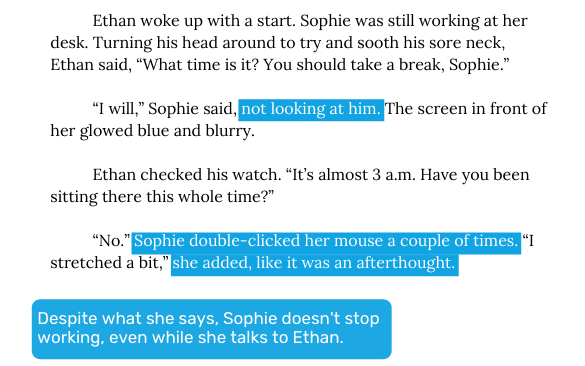
Here is an example showing how action beats function in a scene. The actions ("not looking at him," "double-clicked her mouse") reveal character and subtext, doing much more than a simple "she said."
Advanced Punctuation: Interruptions, Pauses, and Thoughts
Once you've mastered the basics, you can use more specific punctuation to create nuanced effects that mirror real-life speech patterns.
Interruptions and Abrupt Pauses: The Em Dash (—)
When a character is cut off mid-sentence—either by another speaker or a sudden event—you use an em dash. The em dash signals a sharp, sudden stop. Note that there are no spaces around the em dash.
"I never meant to—"
"To what? Hurt me?"
You can also use a pair of em dashes to set off an action that interrupts a single, continuous line of dialogue.
"And that's when I decided"—he leaned forward, lowering his voice—"to follow him myself."
Trailing Off and Hesitation: The Ellipsis (...)
When a character's speech trails off, they hesitate, or they are struggling to find the right words, you use an ellipsis. An ellipsis indicates a fading or tapering pause, which is softer than the hard stop of an em dash.
"I thought maybe we could... I don't know... just talk?"
The Kingdom Pen article provides clear examples for both em dashes and ellipses.
The Ultimate Guide to Punctuation in Dialogue | Kingdom Pen
Let's return to the Kingdom Pen article to look at these specific punctuation marks.
Read the section on Action Beats, focusing on the part that introduces the em dash for interruptions within a thought. Then, read the section on Ellipses Points to understand how to show a pause or a voice trailing off. Finally, review the section on Interruptions for more examples of using the em dash.
Internal Dialogue (Thoughts)
By convention, a character's direct, internal thoughts are formatted in italics, without quotation marks.
This is a terrible idea, he thought.
However, in modern writing, particularly with a close third-person point of view, it's common to weave thoughts directly into the narration without italics, letting the context make it clear.
He stared at the locked door. This was a terrible idea.
Choose one method and apply it consistently throughout your novel.
Practice Exercise
Now it's time to put these rules into practice. The article from Beacon Point Services that you read earlier contains a short, effective exercise.
This will test your ability to apply the rules we've just covered, especially distinguishing between tags and beats.
Go to the section titled "Practice" and rewrite the 11 sentences with the correct punctuation. Once you are done, check your work against the "Answers" provided just below the exercise. Don't worry if you make mistakes; the goal is to identify and learn from them.
Conclusion
Mastering dialogue punctuation is a crucial step in your development as a writer. It is the technical foundation that ensures your conversations are read clearly and effortlessly, allowing your characters' voices and the story's drama to shine through. While the rules may seem numerous at first, they quickly become second nature with practice.
Key Takeaways:
- Clarity is King: Proper punctuation removes ambiguity and keeps the reader immersed in the story.
- New Speaker, New Paragraph: This is the most critical formatting rule for dialogue.
- Tags vs. Beats: Dialogue tags (
he said) are joined to dialogue with a comma. Action beats (He nodded.) are separate sentences that require a period. - Em Dash vs. Ellipsis: Use an em dash (—) for abrupt interruptions and an ellipsis (...) for hesitant pauses or trailing off.
- Consistency: Whatever conventions you choose (e.g., for internal thoughts), apply them consistently throughout your novel.
In our next lesson, we will build directly on this technical foundation. Now that you know how to format dialogue, we will explore how to write dialogue that sounds natural and believable for your characters and setting. We'll move from the mechanics of punctuation to the art of voice.