Welcome back. In our last lesson, we established the technical scaffolding of dialogue—the punctuation and formatting that ensure clarity on the page. Mastering those rules was about building a solid, invisible foundation. Today, we move from the science of formatting to the art of conversation itself.
This lesson focuses on a crucial next step: writing dialogue that sounds natural and believable for your characters and setting. Think of the movies you enjoy; the best dialogue doesn't sound like a perfect, grammatically flawless script. It feels like real people talking, with all their quirks, hesitations, and hidden intentions. Our goal is to learn how to create that same illusion of authenticity in your own fiction, making your characters' conversations engaging and true to who they are.
What Does "Natural" Dialogue Mean in Fiction?
A common mistake for new writers is to assume that "natural" dialogue means transcribing real-life speech. However, real conversations are often filled with filler words ("um," "like"), mundane pleasantries, and rambling thoughts that don't serve a story's purpose.
Fictional dialogue is an artifice; it's a curated and compressed version of reality. It needs to feel real while actively doing work for the story. The key is to mimic the patterns of natural speech without getting bogged down in its unedited messiness.
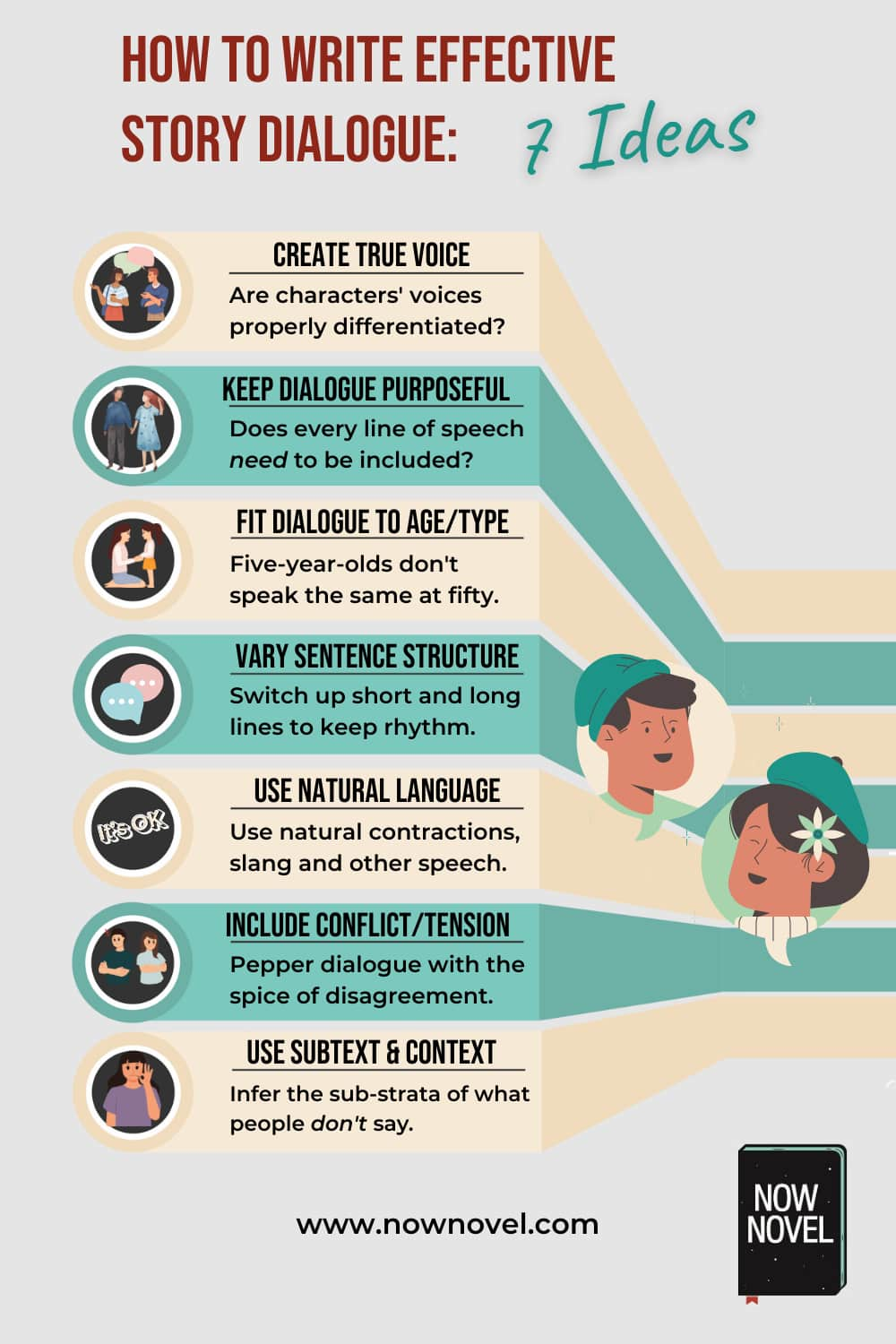
As the infographic suggests, effective dialogue uses natural language, varies its rhythm, and fits the character. Let's start with the first of these: how to mimic the sound of real speech.
A professional editor on the Reedsy blog puts it perfectly.
How to Write Fabulous Dialogue [9 Tips + Examples] - Reedsy
This article gathers advice from several book editors. We'll start with a tip about capturing the feel of real-life conversation.
In the Q&A section, find the answer from editor Sophia D. Please read her first point, about real conversation. Then, scroll down to Tip #6, "Model any talk on real life." The most important piece of advice here is to read your dialogue aloud. This is the fastest way to discover if your writing sounds stiff or unnatural.
When you read your work aloud, you'll immediately catch sentences that are too long, word choices that feel out of place, or a rhythm that sounds monotonous. Real people use contractions ("don't" instead of "do not"), speak in fragments, and interrupt each other. Embracing these "imperfections" is the first step toward authenticity.
Observing How People (Really) Talk
To write believable conversations, you must first become a dedicated observer of them. This means paying active attention not just to the words people use, but to their non-verbal cues, their hesitations, and the dynamics between them. Your interest in movies is a significant advantage here, as film is a masterclass in curated, effective dialogue.
The following video from author Abbie Emmons provides excellent, practical techniques for honing your observational skills.
In "How to Write GREAT Dialogue," Emmons shares several techniques for making dialogue shine. We'll focus on two that involve active listening.
Please watch these two segments: Listen to Real People (3:55 - 4:44): This explains the value of paying close attention to real-life conversations, including the non-verbal elements. Listen to Well-Written Film Dialogue (4:45 - 6:38): Here, she explains why film is such a useful tool for this exercise and encourages you to actively analyze why some dialogue works and some doesn't.
As you watch movies or TV shows, try to analyze the dialogue. Notice how arguments escalate, how characters talk over one another, and how they use non-sequiturs (abruptly changing the subject). A great example of this "messy realism" is explored in the video below, using the film Marriage Story as a case study.
Best and Worst Dialogue Writing Tips, RANKED
The Bookfox channel's video, "Best and Worst Dialogue Writing Tips, RANKED," analyzes several techniques with clear examples.
Watch the section on interruptions and overlaps. See how the constant interruptions and talking-over create a conversation that feels intensely real and confrontational.
The Power of What Isn't Said: Subtext
Now we arrive at one of the most powerful tools in a writer's arsenal: subtext. People rarely say exactly what they are thinking or feeling. They hide their motives, soften their criticisms, or talk about one thing when they really mean another. This gap between the literal words spoken and the actual meaning is the subtext.
Dialogue without subtext is often called "on-the-nose." It's flat, unrealistic, and treats the reader like they can't infer anything for themselves.
On-the-Nose: "I am angry with you for betraying our friendship."
With Subtext: "You know, I always thought we could trust each other. No matter what."
The second example is far more powerful because it forces the reader to interpret the character's tone and the history of their relationship. The anger is implied, not stated, making it feel more genuine.
The following article offers a masterclass in transforming on-the-nose dialogue into layered, subtext-rich exchanges through detailed before-and-after examples.
The Art of Masterful Fiction Dialogue
This article by C. S. Lakin provides some of the clearest demonstrations of revising for natural, impactful dialogue.
Please read the following three sections carefully: Start with the section titled "Subtext," which introduces the concept with a clear before-and-after example of a marital conversation. Continue with the next example, studying both the "Before Passage" and the analysis of its problems. Finally, read the "After Passage" and the detailed breakdown of the second phone call example that follows, which explains how to cut banal greetings and make the dialogue more tense and purposeful. Pay close attention to the editor's analysis of why the "after" versions are superior.
As you can see from those examples, powerful dialogue doesn't just convey information. It reveals personality, escalates conflict, and hints at the deep currents of emotion running beneath the surface of a scene.
A Few Common Pitfalls to Avoid
As you practice writing more natural dialogue, be mindful of a few common traps.
- Overusing Names: In real life, people rarely use each other's names repeatedly in conversation. Doing so on the page sounds awkward and artificial. The Bookfox video you watched earlier has a great segment on this, citing the famously awkward "Oh, hi Mark" from the movie The Room.
- Overwriting Accents Phonetically: It can be tempting to spell out a character's accent to show their origin (e.g., "Ah'm goin' teh the stoah"). A little of this goes a long way. Heavy-handed phonetic spelling can be difficult to read and can turn a character into a caricature. It's often better to suggest an accent through word choice and sentence rhythm, perhaps with only a single, consistently used colloquialism, rather than misspelling every other word.
Conclusion
Writing dialogue that feels alive is a skill that develops with practice and observation. It requires you to move beyond simply having characters exchange information and instead treat every conversation as an opportunity for character revelation and plot advancement.
Key Takeaways:
- Natural dialogue is curated reality: It mimics the patterns of real speech (fragments, contractions) but remains purposeful and concise.
- Be an observer: Actively listen to conversations in real life and analyze dialogue in well-written films to internalize its rhythms.
- Embrace subtext: The most believable conversations are often about what isn't being said. Avoid "on-the-nose" dialogue where characters state their feelings directly.
- Read your work aloud: This is the most effective way to test if your dialogue flows naturally.
Practice Exercise
Let's put these principles into practice. Below is a piece of simple, on-the-nose dialogue. Your task is to rewrite it twice.
Base Dialogue:
"Where have you been? I was worried," said Person A.
"I was just out for a walk. I lost track of time," said Person B.
"Well, you should have told me. I thought something bad happened to you," said Person A.
Rewrite 1: Imagine Person A is a controlling gang leader and Person B is a subordinate who is late for a meeting. Rewrite the exchange to reflect their power dynamic and the tension of the situation.
Rewrite 2: Now, imagine Person A and Person B are a young couple who just had their first major fight. Person B stormed out, and has just returned. Rewrite the exchange to reflect their hurt feelings and fragile attempts at reconciliation.
This exercise will help you see how the same basic information can be conveyed in vastly different ways depending on the characters and their context.
In our next lesson, we will build directly on this foundation by focusing on a crucial aspect of believable dialogue: how to revise your writing to give each character a distinct voice. We'll explore techniques to ensure your hero, your villain, your mentor, and your sidekick all sound like unique individuals.