In our last lesson, we focused on making your dialogue sound natural and believable, moving from the rigid rules of punctuation to the fluid art of conversation. We explored how fictional dialogue is a curated version of reality, using subtext and authentic speech patterns to create an illusion of realism.
Today, we'll build directly on that foundation. We will tackle one of the most powerful aspects of characterization: giving each character a distinct voice. If natural-sounding dialogue makes your characters believable, a distinct voice makes them unforgettable. This lesson will show you how to revise your writing to ensure your protagonist, antagonist, and supporting cast all sound like unique individuals, shaped by their specific personalities and backgrounds. This skill is fundamental to your goal of writing from diverse perspectives.
What Is Character Voice?
At its core, a character's voice is their personality manifesting on the page through their speech and thoughts. A simple but powerful way to think about it comes from the writing blog My Story Doctor.
Understand and Implement Voice – David Farland
This article breaks down the concept of voice into a simple, memorable formula.
Please read the first two sections, "What is Voice, Really?", which presents the core equation for understanding voice.
As the article explains, the equation is: What the Person Talks About + How They Say It = Voice.
This means voice isn't just about an accent or a favorite slang word; it's a combination of a character's interests, priorities, and worldview, and the specific way they choose to express those things.
Because you're a fan of the Harry Potter series, you've already seen this in action. Think about the main trio.
Understand and Implement Voice – David Farland
The same article provides a perfect example using characters you know well.
Now, read the section "Character Voice and The Voice Equation." Notice how the short, quoted lines for Hermione, Ron, and Harry immediately reveal who they are.
Hermione’s dialogue often centers on rules, logic, and knowledge, delivered with precision. Ron’s is frequently more informal, reactive, and humorous. Harry’s often reflects the weight of his responsibilities and his recurring role as the center of trouble. Even without dialogue tags, a reader familiar with the books could likely tell who is speaking. That is the power of a distinct voice.
The Building Blocks of Voice
A character's voice is not arbitrary. It is the natural result of who they are. To create a unique voice, you must first understand the character's core components. These infographics provide a great visual overview of the key factors.

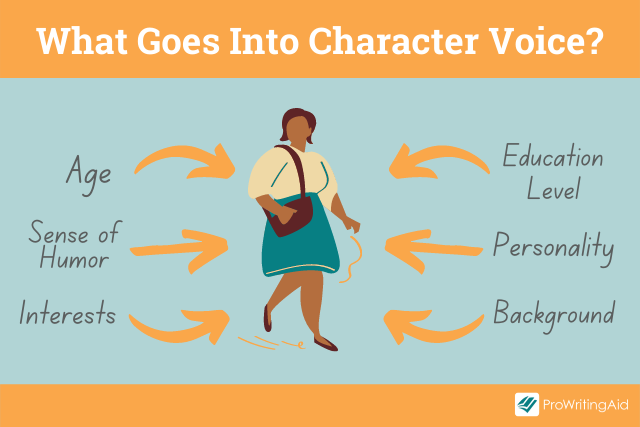
As you can see, voice is a composite of many elements. We can group these into two main categories: their internal landscape (personality, worldview) and their external context (background, education, age).
The following video provides an excellent demonstration of how two characters with different core personalities react to the exact same situation.
How to Write Character Voice *EFFORTLESSLY* and Stop Sounding Like YOU
In her video "How to Write Character Voice EFFORTLESSLY", author Abbie Emmons gives a masterclass in differentiating voices based on internal beliefs.
Watch the segment from this example where she compares two male characters, Character A (a fun-loving Enneagram 7) and Character B (an ambitious Enneagram 3), who are both running late. Pay close attention to how their internal thoughts and spoken words differ drastically, revealing their core fears and motivations.
This example clearly shows that voice begins with a deep understanding of your character's inner world. Character A sees being late as an opportunity for adventure, while Character B sees it as a professional failure. Their speech—both internal and external—reflects this fundamental difference.
A Practical Toolkit for Crafting Voice
Once you understand what shapes a character's voice, you can use specific literary tools to bring it to life on the page. This is where you move from character development to the craft of writing.
However, a quick word of caution is in order. It's easy to fall into lazy shortcuts when trying to make characters sound different.
8 Steps to Nail a Character Voice (even for people totally unlike you)
The video "8 Steps to Nail a Character Voice" from the Bookfox channel starts by outlining several common mistakes.
Before we explore the tools, please watch the introduction from the beginning of the video. It explains the traps of relying on stereotypes related to history, ethnicity, age, or gender. This is crucial advice for writing authentic, respectful characters.
With those pitfalls in mind, let's look at the actual techniques you can use. The article "Top 14 Tips and Tools for Creating Unique Character Voices" offers a fantastic, detailed breakdown.
Top 14 Tips and Tools for Creating Unique Character Voices
This article from Helping Writers Become Authors is a comprehensive guide to both the theory and practice of character voice.
First, quickly skim the "9 Considerations" section. You'll recognize many of the points from the infographics we just saw, such as personality, age, education, and profession. This reinforces the foundational elements. Next, read the second half of the article, "5 Solid Tools," more carefully. This section provides concrete techniques, using characters from the TV show Stranger Things as examples. Pay attention to: Dialogue Tics: A favored word or volume. Personalized Slang/Swears: Assigning specific words to specific characters. Metaphor Families: How a character's job or background shapes their comparisons. Catchphrases: A repeated phrase that defines character. Rhythms and Phrasings: The underlying sentence structure and cadence.
These tools give you a concrete palette to work with. For instance, a soldier might use military metaphors ("It was a surgical strike"), a chef might use culinary ones ("He needed to simmer down"), and a programmer might use technical analogies ("We need to debug this relationship").
The Bookfox video you started earlier elaborates on some of these tools, like metaphor families, and introduces a few more sophisticated ones.
8 Steps to Nail a Character Voice (even for people totally unlike you)
Let's return to the Bookfox video to explore a few more advanced techniques.
Please watch the following three segments: Metaphors and Similes (2:06 - 3:08): This expands on the idea of metaphor families, showing how a character's sensory environment shapes their comparisons. Active vs. Passive Divide (5:23 - 7:04): This fascinating point explains how a character's sentence structure can reveal their sense of responsibility or self-effacement. Character Syntax (9:54 - 11:18): This discusses how word order itself can reflect a character's logical, emotional, or inquisitive nature.
A System for Consistency: The Voice Cheat Sheet
With so many variables, how do you keep each character's voice consistent throughout a novel? A practical solution is to create a "character voice cheat sheet" for each major character. This is a document where you explicitly define the building blocks and tools for that character's voice.
Abbie Emmons, from the first video, demonstrates this technique perfectly.
How to Write Character Voice *EFFORTLESSLY* and Stop Sounding Like YOU
In this final clip, Abbie Emmons shows how to systematize this process and provides another excellent extended example.
Please watch the segment from this point. She introduces the concept of voice cheat sheets and then creates two for the characters Monica (clipped, sarcastic) and Josh (enthusiastic, chaotic). The demonstration of the same scene written from both perspectives is an invaluable look at voice in practice.
Creating a cheat sheet forces you to make conscious decisions about each character's vocabulary, sentence rhythm, humor, and worldview. It becomes an essential reference guide during your writing and revision process.
Conclusion
In this lesson, we've dissected the art and science of creating distinct character voices. We've moved from the general principle of natural dialogue to the specific task of making each character sound unique.
Key Takeaways:
- Voice Defined: Character voice is a combination of what a character talks about (their priorities and worldview) and how they talk about it (their specific language patterns).
- Built from the Inside Out: A strong voice is rooted in a character's personality, background, age, education, and beliefs.
- Crafted with a Toolkit: You can express this voice using specific tools like word choice, sentence structure (syntax), verbal tics, and character-specific metaphors.
- Avoid Stereotypes: Authentic voices are built on individual psychology, not lazy generalizations about groups.
- Stay Consistent: Use a "voice cheat sheet" to define and maintain each character's unique way of speaking throughout your story.
Practice Exercise
In the last lesson, you rewrote a simple dialogue exchange for two different scenarios. Let's revisit one of them:
Scenario: A subordinate is late for a meeting with their controlling gang leader.
Your task is to write only the subordinate's dialogue for this scene twice, creating two completely different character voices. The leader's lines can remain simple placeholders.
Subordinate 1: "The Ambitious Upstart"
This character is cocky, disrespectful, and sees the leader as an obstacle to their own rise to power. Their dialogue should be laced with thinly veiled challenges and a lack of deference.
Subordinate 2: "The Terrified Veteran"
This character has seen the leader's wrath before and is genuinely scared. Their dialogue should be full of apologies, stammers, and desperate attempts to placate the leader.
Write a short exchange (4-6 lines of dialogue from the subordinate in each version) that showcases these two vastly different voices in the same situation. This will solidify your understanding of how personality dictates every word a character speaks.
In our next lesson, we will take this one step further. Now that you know how to format dialogue, make it sound natural, and give it a unique voice, we will focus on ensuring every line serves a purpose by simultaneously revealing character, advancing the plot, and building tension.