Welcome back. In our last lesson, we focused on giving your characters distinct voices, ensuring that who they are—their personality, background, and worldview—shines through in how they speak. We've built a solid foundation, moving from the technical rules of formatting to the art of creating natural, unique dialogue.
Today, we'll put that dialogue to work. We're moving beyond making dialogue sound good to making it do good for your story. This lesson tackles one of the most vital principles of efficient, powerful writing: ensuring every line of dialogue serves multiple purposes. Our goal is to master how to use dialogue to simultaneously reveal character, advance the plot, and build tension. For the plot-heavy, mysterious, and action-driven novels you enjoy, this skill is the engine that drives the narrative forward and keeps readers turning the page.
Dialogue as Action
Great dialogue is never just small talk. As author and editor Tom Bromley notes, "Good dialogue is about propelling the story forward, pulling the reader along, and fleshing out characters and their dynamics." It’s a workhorse, not a show pony.
A powerful way to frame this comes from the author Elizabeth Bowen, who said, "Dialogue is what characters do to each other." This simple idea is transformative. It recasts dialogue not as passive conversation, but as active engagement where characters persuade, manipulate, console, attack, or deceive one another with their words.
Revealing character through dialogue - Authors A.I.
This podcast transcript from Authors A.I. explores the concept of dialogue as an active force in a story.
Please read the first part of the transcript, starting from the introduction of the quote by Elizabeth Bowen. Pay close attention to how the speakers interpret "do" as implying action, interaction, and narrative movement.
When you think of dialogue as an action, you begin to see that every line should have a purpose. In great writing, that purpose is threefold: revealing character, advancing plot, and creating tension.
The Three Functions of Hard-Working Dialogue
Let's break down these three functions. While we'll look at them separately first, the ultimate goal is to make them work in concert. The Authors A.I. transcript provides an excellent framework for this.
Revealing character through dialogue - Authors A.I.
The discussion continues by breaking down how dialogue serves these key functions, with clear examples.
Read the next section of the transcript, which covers three key points. Focus on the examples provided for each: Revealing Knowledge: How a composer's vocabulary differs from a layperson's. Revealing Personality: The two different ways a character might make a dinner reservation. Revealing Intention: The contrast between what a character says ("go, leave me") and what they do (gripping someone's shoulder).
As you can see, these functions are deeply intertwined.
-
Revealing Character: This builds directly on our last lesson. A character's word choice, sentence structure, and tone reveal their personality, education, and emotional state. A question can reveal curiosity, insecurity, or a challenge. A statement can project confidence, ignorance, or deception.
-
Advancing Plot: Dialogue should move the story forward. This can happen in several ways:
- Introducing new information (exposition): A character reveals a piece of the puzzle, a secret from the past, or a new objective.
- Making a decision: Characters debate a course of action and commit to a plan.
- Inciting action: One character's words provoke another to act, leading to the next event in the story.
The challenge, especially with exposition, is to make it feel natural. You must avoid the dreaded "info-dump."
-
Building Tension: Dialogue creates tension through conflict and subtext.
- Conflict: This is the most direct way. Arguments, threats, and interrogations create immediate friction. Power dynamics are key here; a conversation is often a subtle battle for control.
- Subtext: This is what a character means rather than what they say. A seemingly polite exchange can be filled with unspoken threats, desires, or fears, creating a powerful undercurrent of tension. This is the art of "showing, not telling" in conversation.
Putting It All Together: A Masterclass from Harry Potter
You're a fan of Harry Potter, which provides some of the best examples of dialogue that works on multiple levels. The following video analyzes the scene where Hagrid first tells Harry he is a wizard. It's a perfect case study.
How to Write Group Dialogue (Conversations with 3+ Characters)
In his video on group dialogue, writer Brandon McNulty breaks down a pivotal scene from Harry Potter and the Sorcerer's Stone.
Please watch the segment from this example. As you watch, try to identify how J.K. Rowling uses this single conversation to achieve all three goals.
Let's deconstruct that scene:
-
It Reveals Character:
- Hagrid: His booming voice, shock, and furious anger ("Hagrid thundered," "his every syllable trembled with rage") reveal his passionate nature and deep loyalty to Harry's parents and Dumbledore.
- The Dursleys: They "shrink back into the Shadows" and cower. Uncle Vernon's voice is a "whisper" and then a panicked "yell," showcasing his cowardice and desperation to maintain control.
- Harry: His confusion ("All what?"), eagerness ("said Harry eagerly"), and attempts to assert his limited knowledge ("I can you know, do math and stuff") perfectly capture the voice of an 11-year-old thrust into an unbelievable situation.
-
It Advances the Plot: This is the story's most crucial turning point. The dialogue delivers the central piece of information that sets the entire series in motion: Harry is a wizard. It also resolves the mystery of the letters and establishes the main conflict for the rest of the book: Harry must leave the Dursleys and enter the wizarding world.
-
It Builds Tension: The tension escalates brilliantly. It starts with Harry's confusion, grows with Hagrid's mounting anger at the Dursleys, and peaks with Uncle Vernon's desperate, futile attempts to forbid Hagrid from revealing the secret. The final line, "Harry — you're a wizard," is the explosive release of all that built-up tension.
This one short scene is a masterclass in efficiency. Not a single word is wasted.
The Power of Action and Context
Did you notice how much of the Harry Potter scene's power came from the descriptions woven between the lines of dialogue? Hagrid "leapt to his feet"; the Dursleys were "cowering"; Uncle Vernon "had gone very pale."
Dialogue does not exist in a vacuum. It is supported by action beats, which are descriptions of a character's gestures, expressions, and movements. These beats are critical because they often reveal the subtext—the truth beneath the words.
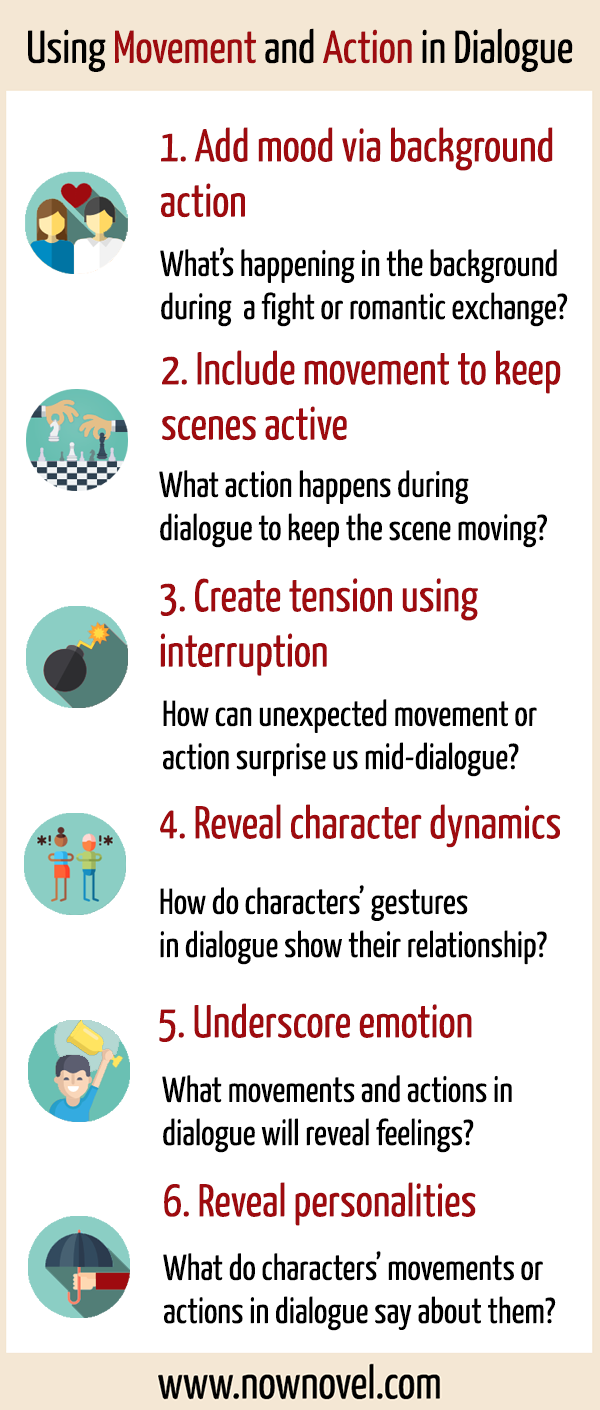
The Authors A.I. transcript provides a brilliant example of how changing only the action beats can completely transform the meaning and tension of a scene.
Revealing character through dialogue - Authors A.I.
This final section presents two versions of a scene between characters named Terry and Millie. Terry's line of dialogue is identical in both.
Please read the two versions of the scene, beginning at "Terry lifted the burger". Pay close attention to how the action beats and Millie's response change the entire dynamic from a motherly, caring one to a flirtatious, romantic one.
This example perfectly demonstrates that the same words can carry entirely different intentions and create vastly different relationships depending on the physical context. In version one, the actions establish a caretaker dynamic. In version two, the "lascivious grin" and the act of reaching across the table to touch his cheek instantly injects romantic and sexual tension into the scene.
This is the synergy you're aiming for: words, actions, and subtext working together to create a rich, layered, and purposeful scene.
Conclusion
Today, we've elevated our understanding of dialogue from simple conversation to a powerful, multi-functional narrative tool. The goal is no longer just to write dialogue that sounds real, but to write dialogue that performs a triple duty for your story.
Key Takeaways:
- Dialogue is Action: Think of dialogue as something characters do to each other—a way of enacting their desires and creating change in the story.
- The Triple Duty: Every significant exchange should strive to (1) reveal character, (2) advance the plot, and (3) build tension.
- Avoid Wasted Words: Cut conversational filler. If a line of dialogue doesn't serve at least one of these three functions, it probably doesn't belong in your novel.
- Action Beats are Your Ally: Use gestures, expressions, and movements to ground your dialogue in the physical world and reveal the subtext beneath the surface.
Practice Exercise
Let's apply these concepts to a scenario suited to your interest in spy fiction.
Scenario: A rookie operative and a cynical veteran are on a stakeout in a parked car. They are watching a target's house, waiting for a signal.
Your Task: Write a short dialogue scene (approx. 200-300 words) between these two characters. Your goal is to make the dialogue perform the triple duty:
- Reveal Character: Show the contrast between the rookie's nervous energy or by-the-book idealism and the veteran's weary professionalism or jaded outlook.
- Advance Plot: Include a piece of information that is important to their mission. Perhaps they confirm a detail about the target, or they debate the next step of the plan.
- Build Tension: Create a sense of suspense. Is there a noise outside? A false alarm? Does a disagreement between them put the mission at risk?
Remember to weave in action beats to show their body language and reactions.
In our next lesson, we will dive deeper into the most subtle and powerful of these techniques: writing subtext, where what a character means is deliberately different from what they say.