In our last session, we focused on making your dialogue a narrative workhorse, ensuring it simultaneously reveals character, advances the plot, and builds tension. We touched upon the idea of subtext as a powerful source of tension, where an undercurrent of unsaid meaning ripples beneath a conversation.
Today, we will dive deep into that undercurrent. This lesson is dedicated entirely to the art of subtext, where what a character means is deliberately different from what they say. This is one of the most sophisticated skills in a writer's toolkit, often described as the "black belt" of dialogue. Mastering it will allow you to craft the kind of subtle, mysterious, and emotionally layered scenes that are hallmarks of the spy thrillers and character-driven stories you enjoy. You'll learn how to make your characters' conversations hum with unspoken desires, threats, and secrets.
The Iceberg Theory: What Lies Beneath
The most effective way to understand subtext is through what Ernest Hemingway called the "Iceberg Theory." The words on the page—the explicit dialogue—are merely the tip of the iceberg, the part visible above the water. The true mass, the real weight and meaning of the scene, lies submerged. This includes a character's history, their hidden motives, fears, desires, and the unspoken power dynamics between them.

It is the reader's job to sense the shape of what lies unseen. Your job, as the writer, is to provide the clues. This is what makes reading an active, engaging experience rather than a passive one. It’s the difference between being told a secret and uncovering one.
To begin, let's watch a short video that introduces this concept.
How to Write Freakishly Good Dialogue
This video from the Tucker Berke channel, "How to Write Freakishly Good Dialogue," opens with a clear explanation of Hemingway's Iceberg Theory.
Watch the segment from the start of the explanation until just before the Whiplash example. Focus on how subtext provides the "substance" and "depth" that gives a story its meaning.
Subtext shouldn't be confused with context. Context provides the factual framework for the scene (the setting, the situation), while subtext provides the emotional and psychological depth.
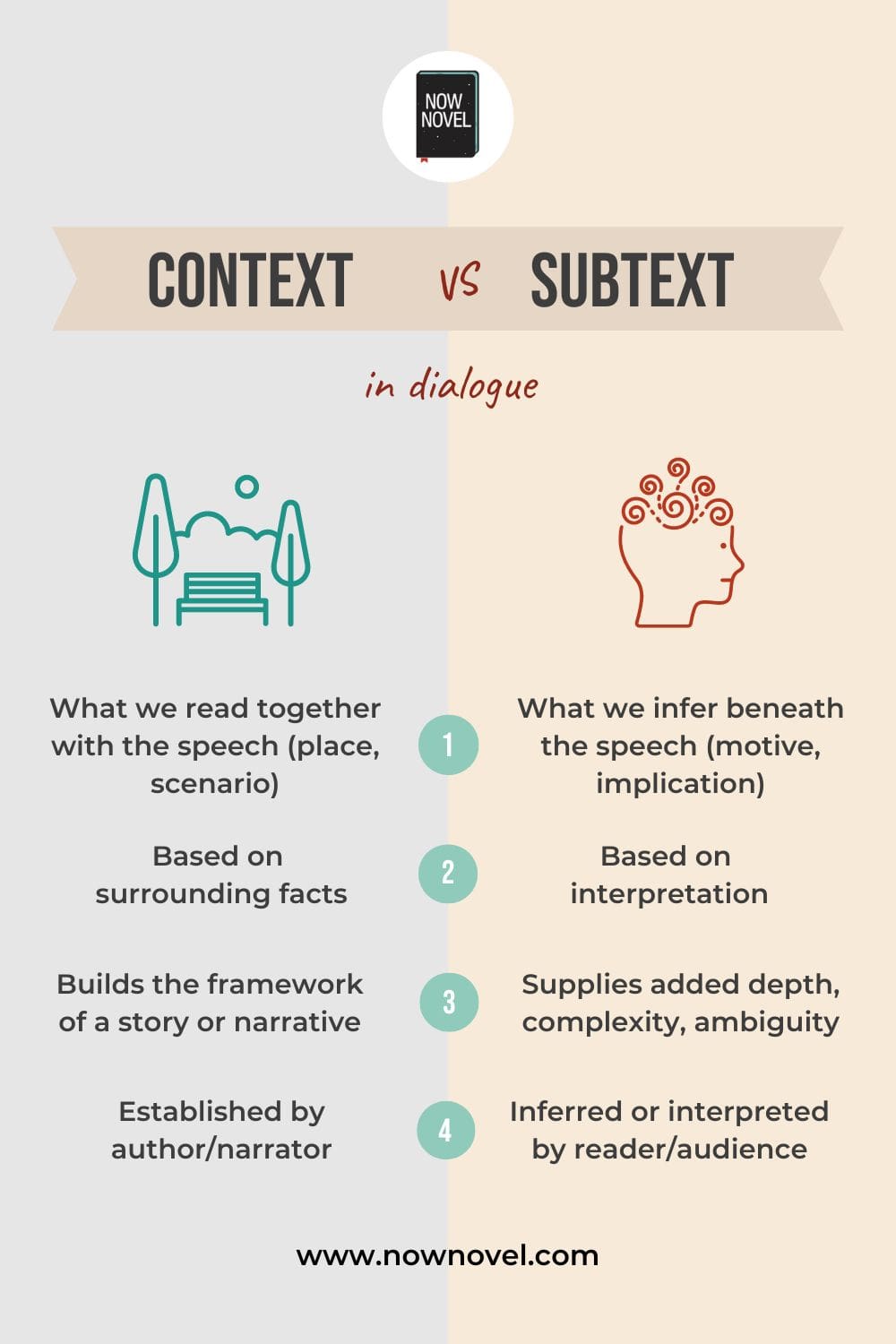
The classic literary example of subtext is Hemingway's short story "Hills Like White Elephants." The entire story is a seemingly mundane conversation between a couple waiting for a train. They discuss drinks, the scenery, and travel plans. The word "abortion" is never used, yet through their evasions, loaded statements, and tense repetition, it becomes painfully clear that this is the monumental, unspoken subject of their conversation. The story's power comes entirely from what is not said.
The Cardinal Sin: On-the-Nose Dialogue
The opposite of subtext is "on-the-nose" dialogue, where characters state their feelings and motivations with unnatural clarity. This is the number one mistake that makes dialogue feel flat, unrealistic, and robs a scene of its tension. Real people rarely say exactly what they mean, especially when emotions are high. We hedge, we deflect, we lie, we speak in code. Your characters should too.
Writer Abbie Emmons calls this error "conflict dumping," and she provides a powerful example of what it looks like—and how to fix it.
Dialogue Mistakes New Writers Make ❌ Avoid These Cringeworthy Cliches!!
In her video on common dialogue mistakes, Abbie Emmons demonstrates how to transform "cringeworthy" on-the-nose dialogue into something compelling and realistic through subtext.
Please watch the following four segments: First, watch the introduction to the concept of conflict dumping and subtext. Next, watch the "bad" dialogue example between Violet and Kent, where Kent sounds like his own therapist, explicitly stating his childhood traumas. Then, listen to her explanation of how to approach the rewrite by considering character personality and emotional response. Finally, watch the revised, subtext-heavy version of the same scene. Notice how in the final version, Kent's defensiveness, his forced laugh, and his eventual outburst about his brothers reveal his insecurities far more powerfully than his initial, blunt confession ever could.
The difference is staggering. The first version tells us Kent's problem. The second version makes us feel it. We understand his shame and his fraught relationship with his father because of what he tries to hide, not what he declares.
How to Write Subtext: A Toolkit of Techniques
So, how do you actively create subtext? It begins with a core rule: Don't say what you mean. Instead, you come at the topic sideways, you have characters say the opposite of what they feel, or you imply it through their actions.
Let's explore some specific, practical techniques you can use. The following article from The Write Practice offers an excellent list. We'll focus on a few key methods, supported by film examples that bring them to life.
Subtext Examples: 7 Simple Techniques to Supercharge ...
This article explains when to use subtext and provides a list of seven actionable techniques.
First, read the sections "When Should I Use Subtext?" and the point about reader participation. This clarifies the strategic purpose of subtext. Then, skim the list of seven techniques to get an overview. We will be focusing on a few of these in detail.
1. Hidden Agendas: Dialogue as Interrogation
This is a cornerstone of spy and mystery fiction. A conversation appears innocent on the surface, but one character is secretly mining the other for information. The tension comes from the audience knowing (or suspecting) the hidden motive. The film Whiplash has a chilling example of this.
How to Write Freakishly Good Dialogue
The Tucker Berke video continues by analyzing a scene from Whiplash.
Watch this segment from the Whiplash example. The instructor, Fletcher, asks his new student, Andrew, a series of seemingly normal "get to know you" questions. Pay attention to how this seemingly innocent information is later weaponized.
Fletcher's dialogue has a hidden agenda: to find Andrew's emotional vulnerabilities. He isn't being friendly; he's gathering ammunition. This creates a powerful subtext of manipulation and impending cruelty.
2. Saying It Without Saying It: The Mundane as a Mask
Sometimes the most emotional conversations are disguised as discussions about something completely ordinary. A character who can't say "I miss you" or "I'm lonely" might instead call their ex-partner to ask for help with a broken appliance. The topic is mundane, but the subtext is charged with longing.
How to Write Freakishly Good Dialogue
This next clip from the same video analyzes a famous scene from the movie Crazy, Stupid, Love.
Watch this segment analyzing the scene where Emily calls her ex-husband Cal about the water heater. She is clearly not in the basement, so ask yourself: what is she really calling about?
Emily isn't calling about the pilot light. She's calling because she's alone and misses the life she had with her husband. The dialogue is about a water heater, but the subtext is about a broken marriage. This technique allows you to convey deep emotion without resorting to sentimental, on-the-nose declarations.
3. Contrast Dialogue with Action
We touched on this in the last lesson, but it's a fundamental technique for creating subtext. When a character's body language or actions directly contradict their words, we instinctively believe the actions.
- Someone says, "I'm fine," while clenching their fists and avoiding eye contact.
- A character says, "I'm not scared," while their hands tremble.
- Two characters have a polite, sterile conversation while sitting as far apart as possible on a sofa.
The gap between the words and the action is where subtext lives. It forces the reader to ask, "What's really going on here?"
Conclusion
Subtext elevates dialogue from a simple exchange of information to a complex, layered performance of human emotion and intent. It respects the reader's intelligence, inviting them to participate in the story by reading between the lines. By mastering this skill, you move from being a storyteller to being a creator of immersive psychological worlds.
Key Takeaways:
- The Iceberg Theory: The most powerful meaning in a scene is often what remains unspoken beneath the surface.
- Avoid On-the-Nose Dialogue: Don't let your characters sound like their own therapists. Real people are rarely so self-aware or direct, especially under pressure.
- Dialogue is Performance: Characters use words to mask their true feelings, to manipulate others, or to test the waters. Their dialogue is a strategy, not just a statement.
- Create a Gap: Subtext emerges in the space between what is said and what is meant, what is said and what is done, or what is expected and what is delivered.
Practice Exercise
Let's put this into practice. The best way to learn subtext is to consciously convert on-the-nose dialogue into something more subtle.
Scenario: Alex suspects their partner, Jordan, is having an affair.
Your Task: Write two short versions of the scene where Alex confronts Jordan after Jordan comes home late.
-
Version 1: On-the-Nose (approx. 100 words)
Write the scene where Alex says exactly what they think. For example: "Where were you? I know you're cheating on me. I can't trust you anymore." Jordan can deny it or confess, but the dialogue should be direct and explicit. -
Version 2: Subtext (approx. 200-300 words)
Rewrite the same scene, but this time, do not use the words "cheat," "affair," or "lie." Alex cannot directly accuse Jordan. Instead, use the techniques we've discussed:- Focus on a mundane detail (e.g., "That's a new shirt, isn't it?" or "Traffic must have been terrible tonight.")
- Use contrasting body language (e.g., Alex speaks calmly but won't look at Jordan, or Jordan tries to hug Alex, who remains stiff).
- Have Alex ask questions that are seemingly innocent but carry a hidden accusation (e.g., "Did you have a good time with... whoever you were with?").
The goal is to make the reader feel Alex's suspicion and Jordan's guilt or defensiveness without ever stating it outright.
In our next lesson, we will continue to build on this by exploring how to perfectly balance dialogue, subtext, and action within the broader narrative description to create seamless, powerful, and well-paced scenes.