Welcome back. In our last lesson, we explored the art of subtext, learning how to load conversations with unspoken meaning and tension by focusing on what characters don't say. This is the invisible architecture of great dialogue.
Today, we're going to place that architecture into a living, breathing world. This lesson is about balancing dialogue with action beats and narrative description. If subtext is the internal world of a conversation, action is its external expression. We'll move beyond just who is speaking to where they are, what they are doing, and how their physical movements can reveal as much as their words. For the action-driven stories you enjoy, this skill is paramount. It’s the technique that ensures a tense conversation between spies doesn't just feel like a transcript, but a scene you can see, hear, and feel.
By the end of this lesson, you will be able to weave dialogue, character action, and description together to create scenes that are dynamic, immersive, and psychologically rich.
Grounding Your Dialogue: What Are Action Beats?
At its most basic, an action beat is a sentence of description or action attached to a line of dialogue. Its primary job is to show the reader who is speaking without endlessly repeating "he said" or "she said."
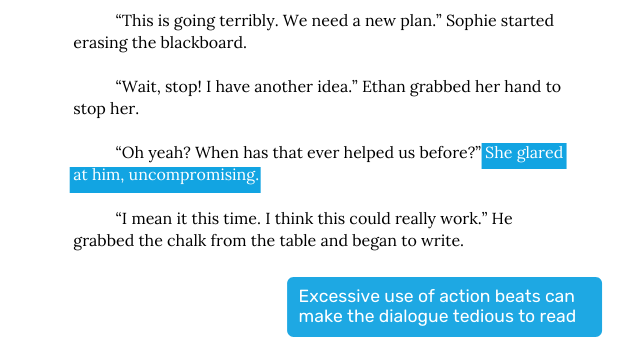
However, their function goes far beyond simple attribution. Action beats are the key to avoiding what writers call "talking heads syndrome"—scenes where characters seem to float in a white void, disembodied voices exchanging words. They ground your dialogue in the physical reality of the scene.
Let's get a formal definition and explore the flexibility of this technique.
How to Improve Our Story with Action Beats - Jami Gold
This article by Jami Gold provides a clear and practical introduction to action beats and their advantages over simple dialogue tags.
Please read the first two main sections. Start with the definition of an action beat and its primary function. Then, continue with the next section, which explains why they are more powerful and versatile than simple tags like "said" or "whispered."
As the article notes, action beats are more flexible because they aren't limited to describing the sound of the speech. They can describe anything the character is doing, thinking, or feeling, which opens up a vast toolkit for a writer.
The "Talking Heads Avoidance Device" (THAD)
Simply having your characters perform random actions isn't enough. A character can sip coffee, pace a room, or tap their fingers, but these small gestures can quickly become repetitive and meaningless. To make the interplay between dialogue and action truly powerful, the action itself should have a purpose.
Author Elizabeth George coined a brilliant term for this: the Talking Heads Avoidance Device (THAD). A THAD is a significant activity that characters are engaged in while they talk. Instead of just drinking coffee, maybe they are repairing a motorcycle, tending a garden, or trying to solve a puzzle.
A well-chosen THAD can achieve several things at once:
- It grounds the scene and makes it visually interesting.
- It can reveal character skills, passions, or personality traits.
- It can introduce tension or conflict that runs parallel to the dialogue.
- It can serve as a metaphor or symbol for the scene's underlying theme.
Let's examine an article that explains this concept and provides one of the most effective before-and-after examples you're likely to see.
Talking Heads Avoidance Device
This article from Live Write Thrive introduces the concept of the THAD and demonstrates its transformative power on a scene.
First, read the introductory section to understand the concept. Start at the beginning and read down to just before the heading "Consider Your Bigger Picture." Next, jump down to the Before and After example. Read the "Before" version first. It's a standard argument scene. Then, read the "After" version carefully. The dialogue is largely the same, but it now takes place while the characters are delivering baby goats. Pay close attention to how this single change in activity completely alters the scene's impact.
The difference is profound. In the "After" version, the raw, difficult, and miraculous process of birth becomes a powerful, painful counterpoint to the characters' dying marriage and the protagonist's own infertility. The action of handing over the slime-covered wedding ring is a moment of pure symbolic power that the dialogue alone could never achieve. This is the magic of a well-executed THAD.
A Toolkit for Balancing Dialogue and Action
Now that you understand the "why," let's focus on the "how." Integrating action should be a deliberate choice to enhance your scene.

Let's break down the process of finding the right balance. Overloading a scene with action can be just as problematic as having none at all. The key is to make every beat count.
If Your Dialogue Sounds Flat, THIS Is Why
In this video, writer Abbie Emmons demonstrates how to diagnose and fix dialogue scenes that are out of balance.
Watch the segment from mistake number four. She first presents an example that is mechanically repetitive with too many simple tags. Then, she shows a version overloaded with distracting action. Finally, she walks through the editing process, showing how to trim away "filler action" and select meaningful beats that connect to the characters' emotions and the scene's purpose.
As Abbie Emmons highlights, the goal is to find a rhythm. Sometimes, you need rapid-fire dialogue with no interruptions to build tension in an argument. At other times, a long, descriptive beat of action is perfect for creating a thoughtful pause or building suspense. Your action beats should not be random filler; they must mean something.
Here are the key functions to keep in mind, drawing from what we've learned:
-
Attribute and Ground: The most basic function. Use an action beat to clarify who is speaking and to remind the reader where they are.
"Let's get out of here." Maria grabbed her keys from the hook by the door.
-
Reveal Character: Actions often speak louder than words. Show a character's personality through their movements.
"I'm perfectly calm." He meticulously straightened the pens on his desk into a perfect line.
-
Create Subtext: This is where today's lesson meets our last one. Use an action that contradicts the dialogue to create a powerful undercurrent of unspoken truth.
"It was great to see you again," she said, taking a deliberate step backward.
-
Control Pacing: Use beats to orchestrate the tempo of the conversation.
- To speed up: Use short, punchy lines of dialogue with few or no beats.
- To slow down or create a pause: Insert a longer, more descriptive beat of action or internal thought. This can create a dramatic pause or build suspense before a critical line.
-
Advance the Plot: The action itself can move the story forward.
"I think I found it." He brushed the dust from a hidden inscription on the wall.
Conclusion
Dialogue does not exist in a vacuum. By weaving in action beats and narrative description, you transform a simple conversation into a fully realized scene. This technique grounds your readers in the story's world, reveals the deep truths of your characters, and gives you precise control over the pacing and rhythm of your narrative. A masterfully chosen activity—a THAD—can elevate a good scene into an unforgettable one.
Key Takeaways:
- Avoid "Talking Heads": Always ground your dialogue in a physical setting with characters who have bodies and interact with their environment.
- Use Action Beats Strategically: Go beyond simple attribution ("he said"). Use actions to reveal character, create subtext, and control pacing.
- Employ a THAD: For significant dialogue scenes, consider having your characters engage in a meaningful activity that can parallel or contrast with the conversation, adding layers of tension and symbolism.
- Balance is Key: Too much action can clutter the scene and slow the pace. Too little leaves your characters disembodied. Read your scenes aloud to feel the rhythm and find the right balance.
In our next and final lesson on dialogue, we will examine some common pitfalls to avoid, such as info-dumping and on-the-nose exposition, ensuring your dialogue is always sharp, purposeful, and effective.
Practice Exercise
Let's apply these concepts. You're going to write a scene where a mentor figure reveals a secret to a younger protagonist, a classic dynamic in the types of stories you enjoy.
Scenario: An old, experienced spy (the mentor) must tell their young apprentice that the apprentice's first mission was secretly a test, and not a real operation.
Your Task: Write this scene (approx. 250-350 words). The crucial element is that they must be engaged in a Talking Heads Avoidance Device (THAD) while they talk. Choose one of the following activities for them:
- A) Playing a game of chess. (The moves in the game can mirror the moves in the conversation—a sacrifice, a trap, a checkmate).
- B) Carefully cleaning and reassembling a complex firearm. (The precision and danger of the task can reflect the seriousness of the conversation).
- C) The mentor is teaching the apprentice how to pick a lock. (The process of feeling for tumblers and finding the weakness can parallel the reveal of the secret).
Focus on using the activity to add layers to the scene. How do the characters' actions—a steady hand, a dropped piece, a moment of frustration with the task—reflect their feelings about the dialogue?