In our last lesson, we focused on the specific, high-stakes task of writing an opening chapter that hooks the reader by introducing the protagonist, setting, and conflict. Now, we will broaden our perspective to see how this principle of deliberate construction applies to every chapter in your novel.
Today's lesson addresses how to arrange scenes into chapters to control narrative momentum and create smooth transitions. If a scene is a single beat in your story, a chapter is the rhythm. Mastering chaptering is what transforms a sequence of events into a page-turning experience. This is the architectural skill behind the thrilling, plot-driven stories you enjoy, where each chapter break leaves you needing to know what happens next.
Scenes vs. Chapters: The Bricks and the Building
Before we can arrange scenes, we must be absolutely clear on the difference between a scene and a chapter. They are not the same thing, and understanding their distinct roles is fundamental to structuring your novel.
A scene is a unit of story that takes place in a continuous block of time and a single location. It has a beginning, a middle, and an end, and as we've learned, it should involve a character with a goal facing conflict. You start a new scene whenever you change the point of view (POV) character, jump forward in time, or move to a new location.
A chapter, on the other hand, is a structural division of the book. It's a container that can hold a single, long scene or a collection of several related (or purposefully contrasting) scenes.
The Story Grid channel offers a fantastic explanation of this distinction, framing scenes as the objective, functional units of change for the writer, and chapters as the subjective packaging for the reader.
Scenes vs Chapters: Mastering Story Structure in Fiction Writing
This video, "Scenes vs Chapters: Mastering Story Structure," clarifies the core difference between these two story units. It's a crucial concept for any novelist.
First, watch the introduction from the beginning to 3:45, where the presenter explains the objective role of scenes versus the subjective role of chapters. Next, watch the segment from 7:15 to 8:51. Here, he uses the first chapter of Harry Potter and the Sorcerer's Stone to demonstrate how a single chapter can contain multiple, distinct scenes.
As the video explains, thinking in terms of scenes allows you to ensure something is always happening and changing. Thinking in terms of chapters is about how you present that change to the reader to create a specific emotional experience and control the pace of their reading journey.
The Purpose of Every Chapter
Just as every scene has a goal, every chapter must have a point. A chapter break shouldn't be an arbitrary stopping point you create when you run out of energy. It's a deliberate choice. You are deciding to give the reader a moment to pause, to build suspense, or to shift their focus.
An excellent article on the Kill Zone blog encourages writers to think of each chapter as a "dramatic island" with its own mini-arc.
What’s Your Point? Figuring OutWhat Goes Into Each Chapter | Killzoneblog.com
This article provides practical, hard-hitting advice on ensuring every chapter in your book serves a clear purpose.
First, read the section that explains why chapters are needed and introduces the "dramatic island" concept. Then, continue to the next section, which offers a powerful technique: defining a chapter's primary and secondary purposes before you even start writing it.
This idea of giving each chapter a primary and secondary purpose is incredibly useful. For example:
- Primary Purpose: The protagonist discovers a vital clue.
- Secondary Purpose: In the process, we reveal a painful memory from their past that explains their obsession with the case.
- Tertiary Purpose: The stormy weather during the scene establishes a gloomy, oppressive atmosphere.
By layering purposes like this, your chapters become richer and more efficient, advancing plot, character, and theme all at once.
Strategies for Arranging Scenes into Chapters
Once you have your individual scenes, how do you group them? This is where you move from being a bricklayer to an architect. Your decisions here will dictate the rhythm and flow of the entire novel.
Grouping Scenes
A chapter can be composed of:
- A Single Scene: This is effective for a long, continuous, and important event, like a final confrontation or an intense interrogation.
- Multiple, Related Scenes: You might group several short scenes that follow one character's POV as they pursue a goal. For example, a chapter could follow your young spy as he first surveils a location, then breaks in, and finally escapes.

- Multiple, Contrasting Scenes: This is a powerful technique, especially in plot-heavy thrillers. You can cut from your hero defusing a bomb (high tension) to the villain calmly watching on a monitor (revealing their cruelty and control). Weaving different POV scenes together creates a richer, more complex narrative tapestry.
Scenes vs. Chapters: How to Write Write a Chapter
The video "Scenes vs. Chapters: How to Write a Chapter" by Nonsense-Free Kristin offers a very practical, step-by-step process for organizing your story.
First, quickly watch from 2:31 to 3:07 for a clear definition of what marks a scene break. Then, pay close attention to the section from 7:12 to 8:46, which discusses when to order your scenes into chapters and, crucially, how to weave multiple POVs together to avoid clunky "POV chunks."
The Art of the Chapter Ending
The end of a chapter is your single greatest tool for controlling narrative momentum. It’s your chance to make the reader decide to read "just one more."
- The Cliffhanger: The most famous technique. You end the chapter just as the hero is about to make a choice, a discovery is made, or a threat appears. You cut away right at the moment of highest tension.
- The Question: The chapter ends not with action, but with a deep, compelling question. The character might find a mysterious object and the chapter ends with them thinking, "What is this, and who left it here?" This hooks the reader's intellect.
- The Resolution and Reveal: A good chapter often closes one door while opening another. It might resolve the immediate conflict of the scene (the hero escapes the trap) but end by revealing that their escape has led them into an even bigger problem.
What’s Your Point? Figuring OutWhat Goes Into Each Chapter | Killzoneblog.com
Let's return to the Kill Zone blog post for its excellent advice on crafting effective chapter endings.
Read the section beginning with the discussion on endings. The final sentence here is a maxim to remember: "A good chapter ending does two things — it closes one door and it opens another one."
Varying Chapter Length
The length of your chapters helps create the novel's rhythm. You can use this strategically.
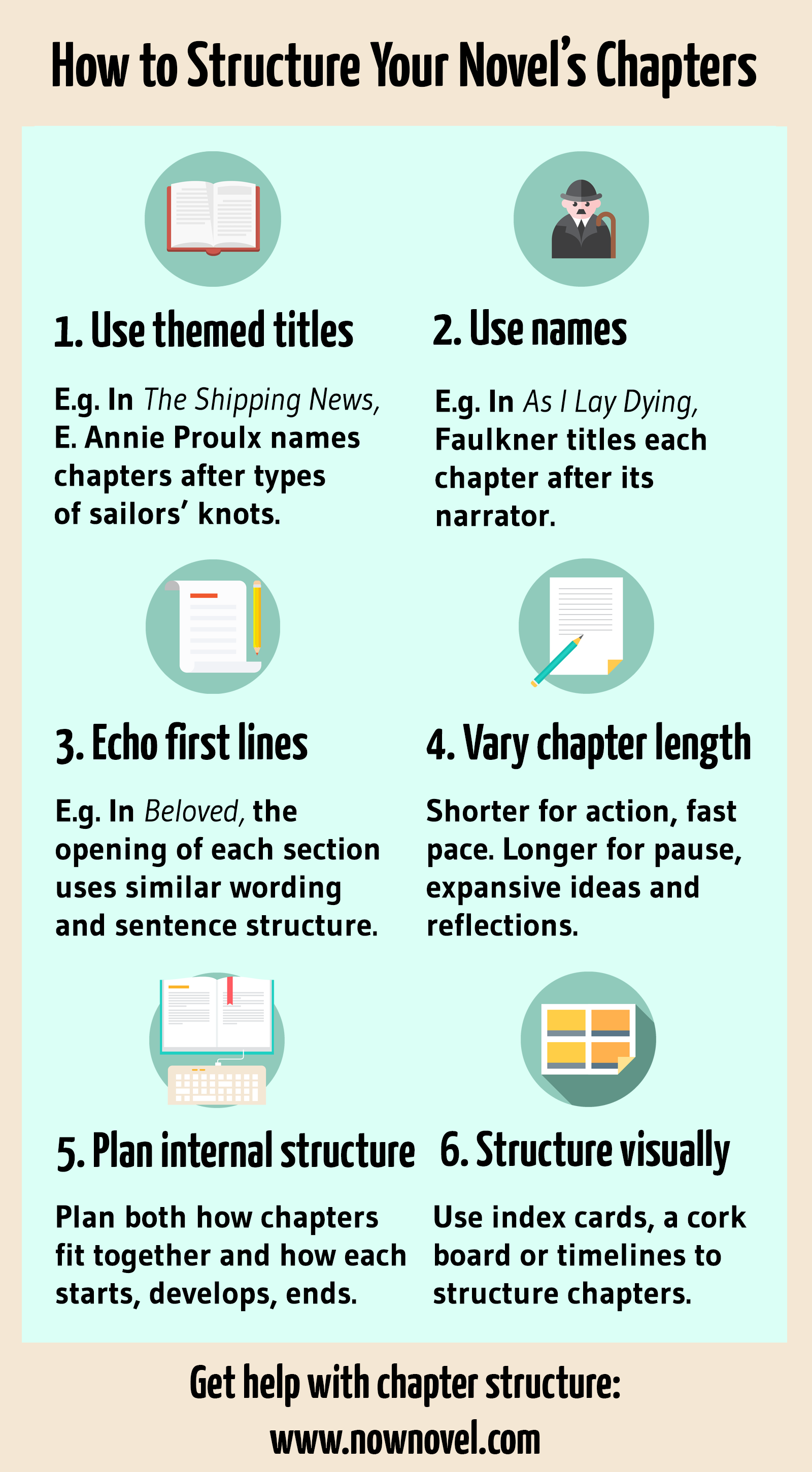
As the infographic suggests, chapter length is a pacing tool:
- Short Chapters: Create a feeling of speed, urgency, and rapid progression. A series of short, punchy chapters is perfect for a chase sequence or a frantic battle, especially if you're cutting between different characters.
- Long Chapters: Allow the reader to sink into a scene, location, or character's mindset. They are good for deep conversations, complex explorations of your world, or major set-piece events where you want to build tension slowly.
Establishing a relatively consistent chapter length can create a comfortable rhythm for the reader. Then, when you deliberately break that pattern with a very short or very long chapter, the effect is magnified.
Conclusion
Structuring chapters is an art form that balances the needs of the story with the experience of the reader. It’s about more than just finding a place to stop; it’s about making calculated decisions to manipulate pacing, tension, and emotion. By thinking of scenes as your objective building blocks and chapters as your subjective presentation, you gain a powerful new level of control over your narrative.
Key Takeaways:
- A scene is a unit of action in a specific time and place. A chapter is a container for one or more scenes, designed to manage the reader's experience.
- Every chapter should have a clear purpose, ideally advancing plot, character, and/or theme.
- Chapter endings are your most powerful tool for creating narrative momentum. Aim to resolve a small question while raising a bigger one.
- Varying chapter length is a key technique for controlling the story's pacing and rhythm.
- When using multiple POVs, weave them together across chapters rather than grouping them in large, separate chunks.
In our next lesson, we will shift our focus from the large-scale architecture of chapters to the fine details of prose. We'll begin our study of dialogue by learning how to apply proper dialogue formatting and punctuation conventions, the essential foundation for writing conversations that feel alive on the page.