Welcome back! In our last lesson, we outlined the major pathways for a character's internal transformation by exploring positive, negative, and flat character arcs. We now have a blueprint for your character's inner journey.
Today, we shift our focus from the internal blueprint to the external expression. How do you bring this complex inner world to life on the page for your reader? This lesson introduces one of the most foundational principles in all of creative writing: "show, don't tell." By the end of our session, you'll be able to apply this principle to reveal your character’s personality, emotions, and arc through their actions, dialogue, and the powerful tool of subtext. Mastering this will make your stories more immersive, turning your prose into a mental movie for the reader.
The Core Principle: "Show, Don't Tell"
At its heart, "show, don't tell" is about creating an experience for the reader rather than simply delivering a report. Telling states a fact directly, like "Sarah was angry." Showing paints a picture that allows the reader to deduce that Sarah is angry, making them an active participant in discovering the story.
Show, Don't Tell: The Definitive Guide for Writers - Jerry Jenkins
This article by author Jerry Jenkins provides a superb introduction to the concept with clear, memorable examples.
Please read the first main section, starting with "The Difference Between Showing and Telling." Pay close attention to the before-and-after examples for traits like 'tall,' 'angry,' 'cold,' and 'tired.' These demonstrate how to translate a simple label into a vivid scene.
As the article explains, showing draws the reader into the narrative. Instead of being told a character is tired, we see their slumped shoulders and puffy eyes, and we feel their exhaustion. This is the key to creating an engaging, cinematic experience.
For a quick visual breakdown of this idea, the following video offers another clear contrast between telling (which is like a summary) and showing (which brings a story to life).
Show, Don't Tell Writing Technique | EasyTeaching
This animated video from EasyTeaching effectively illustrates the core difference.
Watch the first segment, from the beginning until the first set of examples. Notice how it contrasts passive statements with active descriptions.
The STEAL Method: A Framework for Showing Character
"Show, don't tell" can feel abstract, so let's ground it in a practical framework. A popular and highly effective tool for characterization is the STEAL Method. It's a mnemonic that gives you five distinct channels through which you can show who your character is, rather than telling.
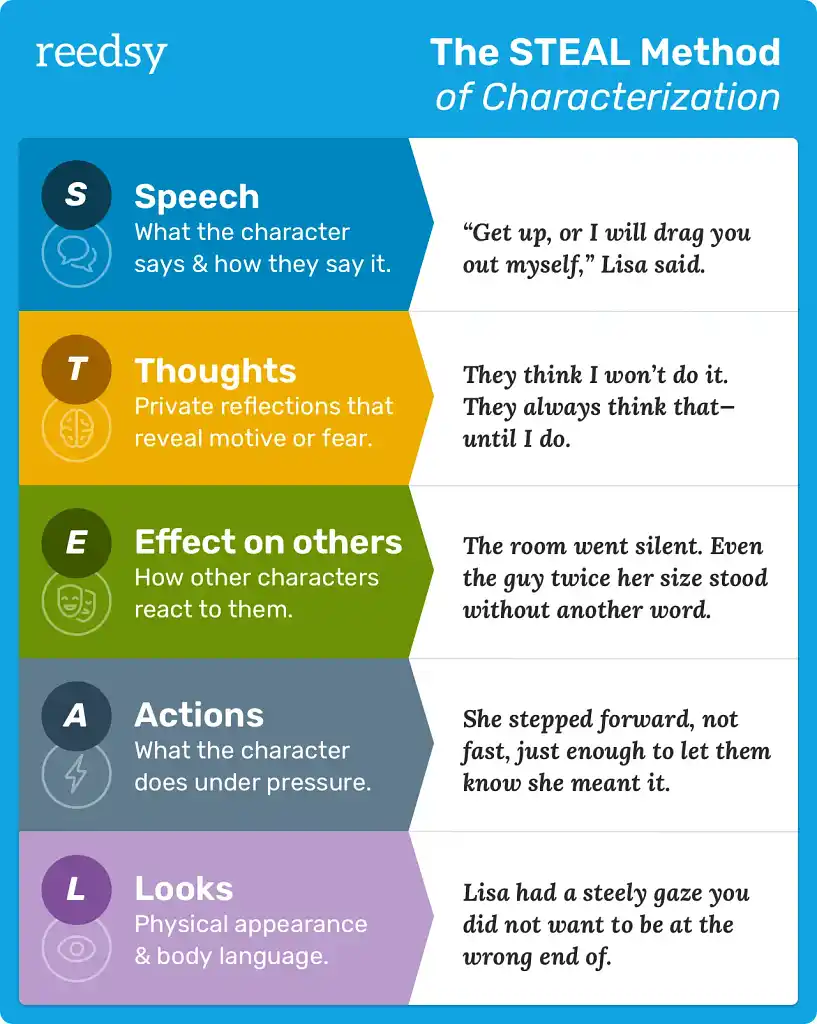
Let's use this as our guide for the rest of the lesson:
- Speech: What the character says and how they say it.
- Thoughts: Their private reflections, fears, and motivations.
- Effect on others: How other characters react to them.
- Actions: What the character does, especially under pressure.
- Looks: Their physical appearance and body language.
Revealing Character Through Action, Looks, and Effect (A, L, E)
The most direct way to show character is through their physical presence and behavior.
- Actions: A character who claims to be brave but runs from a fight reveals their true nature through action. A character who meticulously organizes their desk under stress is shown to be orderly and in need of control.
- Looks & Body Language: This is more than just hair color. Is their suit perfectly tailored or rumpled? Do they meet people's gazes or stare at the floor? These details are windows into their personality and emotional state. The "EasyTeaching" video we looked at offers excellent examples of this.
- Effect on Others: This is a powerful, indirect method. When your protagonist walks into a room, do people fall silent and step aside? Or do they flock to them eagerly? The reactions of others can define a character's power, charm, or menace more effectively than any direct description.
Think about the young protagonist-driven stories you enjoy. Harry Potter's defining moments aren't when the narrator tells us he is brave; they're when he chooses to walk into the Forbidden Forest to face Voldemort. That action shows his bravery.
Revealing Character Through Speech and Subtext (S)
Dialogue is one of your most versatile tools. It doesn't just convey plot information; it reveals the character's education, background, personality, and current emotional state.
A key to effective character dialogue is making it specific. Every character should have a unique voice.
Write better dialogue in 8 minutes.
The channel Standard Story Company offers a fantastic exercise to test the specificity of your dialogue.
Watch the segment from "Great dialogue is specific". The advice to cover the character names in a scene and see if you can still tell who is speaking is an invaluable technique for ensuring your characters sound distinct.
The Power of Subtext
The most advanced way to use dialogue is through subtext: the unspoken meaning simmering beneath the surface of the words. Real people rarely say exactly what they mean, especially in emotionally charged situations. Their true intentions are hidden in implication, irony, and what they choose not to say.
This is where you can create the puzzles, misdirection, and emotional intensity you're interested in writing. Subtext turns a simple conversation into a strategic game.
Write better dialogue in 8 minutes.
Let's return to the "Write better dialogue" video for a clear demonstration of subtext.
Watch the section on subtext from the start of the explanation. The before-and-after example of the mother and daughter's conversation is a perfect illustration of how to transform an "on-the-nose" exchange into a layered, emotionally resonant scene.
The mother isn't just asking about her daughter's day; she's saying, "I miss our connection, and I'm worried about you." The daughter isn't just stating where she's going; she's saying, "Stop treating me like a child." The real conversation happens between the lines.
To master this, let's explore a few specific techniques for crafting subtext.
How to Write Subtext in Dialogue
This article from author K.M. Weiland treats subtext as the "Black Belt" of dialogue writing and provides excellent, movie-based examples that will resonate with your interests.
First, read Rule #1, "Don't Say What You Mean." The breakdown of the bar scene in Captain America: The First Avenger brilliantly shows how a conversation between two people can really be about a third person who barely speaks. Next, read Rule #4, "Understatement and Irony." The analysis of Captain America's line, "I knocked out Adolf Hitler over 200 times," is a masterclass in how a single, ironic sentence can reveal a character's inexperience, confidence, and unique history all at once.
An Important Exception: When Telling is Okay
While "show, don't tell" is a powerful rule, it's not absolute. Sometimes, telling is more efficient and serves the story better. You don't need to spend two pages showing a character's uneventful flight from one city to another.
Show, Don't Tell: The Definitive Guide for Writers - Jerry Jenkins
Let's revisit the Jerry Jenkins article to understand the exception to the rule.
Find the section titled "When Telling is Acceptable". The key is to use telling (or narrative summary) to bridge moments of low importance, allowing you to focus your "showing" energy on the scenes that truly matter.
The goal is to be a discerning author, knowing when to direct the camera for a close-up (showing) and when to fast-forward to the next important scene (telling).
Your Turn: Practice Showing
Let's put this into practice. Take each of the following "telling" statements and rewrite them into a short paragraph (2-3 sentences) that shows the same information. Try to use different elements from the STEAL method for each one.
-
Telling: Mark was terrified of public speaking.
- Hint: Show this using Actions and Looks. What does his body do as he approaches the podium?
-
Telling: Jessica was the most powerful person in the room.
- Hint: Show this using her Effect on others. How do people behave when she enters?
-
Telling: Their first meeting after the argument was awkward.
- Hint: Show this using Speech with heavy subtext. What do they say to each other that avoids the real issue?
Take about 10-15 minutes on this. The goal isn't to write perfect prose, but to practice the mental shift from stating a fact to creating a scene.
Conclusion
Today, we've moved from your character's internal design to their external portrayal. By mastering "show, don't tell," you empower your reader to become a detective, piecing together the truth of your characters from the clues you provide.
Key Takeaways:
- Show, Don't Tell: This principle is about immersing the reader in an experience, allowing them to deduce character and emotion through sensory details, actions, and dialogue.
- The STEAL Method: A practical framework (Speech, Thoughts, Effect on others, Actions, Looks) for applying the "show, don't tell" principle to characterization.
- Action Reveals Truth: A character's actions, especially under pressure, are the ultimate indicator of their true self.
- Dialogue is Characterization: Beyond conveying information, dialogue reveals personality through word choice, rhythm, and subtext.
- Subtext Creates Depth: The meaning hidden between the lines of dialogue is where you can build tension, reveal secrets, and create complex relationships.
You now have the tools to design a character's internal arc and to reveal that arc dynamically on the page. In our next lesson, we will broaden our focus to the character's place in the story's ecosystem by exploring how to identify the distinct narrative roles that supporting characters can play.