Welcome back. In our last lesson, we focused on the crucial principle of "show, don't tell," using the STEAL method to bring characters to life through their actions, speech, and effects on others. You now have the tools to portray a character's inner world dynamically on the page.
Today, we shift from how characters are portrayed to why they exist in your story in the first place. Not every character can be the protagonist, so what is everyone else doing there? This lesson will introduce you to the distinct narrative roles that supporting characters play. By the end, you will be able to identify these functions and use them to build a purposeful cast that actively serves your plot. Understanding these roles is like knowing the positions on a football team; each player has a specific job that contributes to the overall strategy and success of the game. For the plot-heavy, twist-filled stories you're drawn to, a well-designed cast is essential machinery.
Why Every Character Needs a Job
In a tightly-crafted novel, no character is superfluous. Each one, no matter how minor, should have a function. They might be there to support the protagonist, obstruct them, reveal information, or embody a particular aspect of the story's theme. Thinking of your characters in terms of their roles helps you ensure that every person on the page is pulling their weight.
To begin, let's clarify what we mean by a character's "function" in the story.
Types of Characters in a Story - Character Functions
This video from Augmented Actor provides a clear introduction to the concept of character functions, distinguishing them from simple personality types.
Please watch the introduction, from the beginning until the discussion begins. The key idea is that we are looking at the purpose a character serves within the narrative structure.
With this framework in mind, let's explore the most common and essential roles your supporting characters can fill.
The Core Cast: Allies, Mentors, and Foils
Every protagonist needs a world populated with others who interact with them, challenge them, and help them on their journey. These core supporting roles are the most recognizable and are fundamental to most stories.
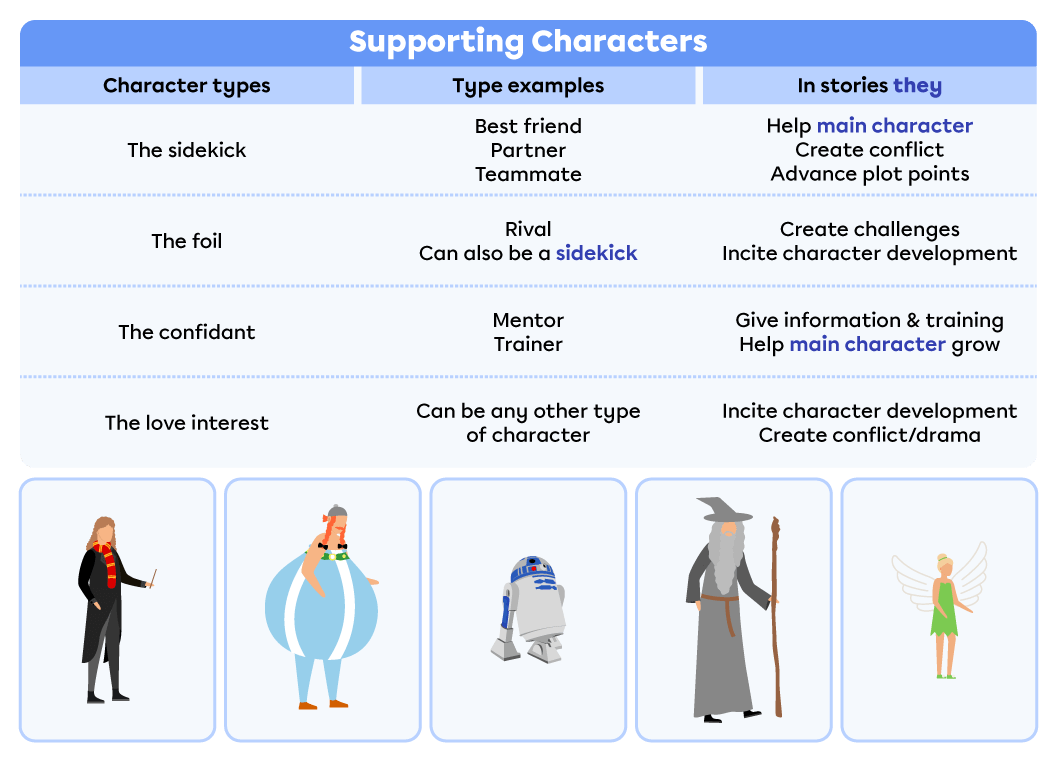
Let's break down a few of these key roles:
1. The Sidekick / Ally
This is the protagonist's loyal companion, their confidant, and their most consistent source of support. They are the Watson to Sherlock Holmes, the Samwise Gamgee to Frodo Baggins. Their function is not just to help, but also to provide a sounding board for the protagonist's ideas and to give the reader another character to connect with.
Character Roles: 10 Essential Functions for a Fiction Cast
The article "Character Roles" gives a concise definition of the sidekick.
Read the section titled "The Sidekick," noting the examples of Ron and Hermione from Harry Potter. This highlights that sidekicks are often beloved characters who can have their own significant character arcs.
Renowned story consultant Christopher Vogler refers to this role as the Ally. He points out that this character often brings balance to the hero, providing qualities the protagonist lacks, such as humor or emotional warmth.
8 Common Character Types Writers Should Know - Christopher Vogler
In this video, Christopher Vogler explains the function of the Ally archetype.
Watch the segment on the Ally. Pay attention to his analysis of Sherlock Holmes and Dr. Watson, where two different characters combine to form one "complete human being." This is a powerful technique for characterization.
2. The Mentor / Confidant
This character is the wise guide, teacher, or counselor who prepares the protagonist for the challenges ahead. They provide crucial training, information, or philosophical guidance. Think of Obi-Wan Kenobi in Star Wars or Dumbledore in Harry Potter. Their main function is to empower the hero.
Character Roles: 10 Essential Functions for a Fiction Cast
Let's return to the "Character Roles" article for definitions of these overlapping roles.
Read the sections titled "The Mentor" and "The Confidant." Notice how the mentor's role is specifically about guidance and preparation, while the confidant is a trusted listener who helps reveal the protagonist's thoughts. Often, one character can serve both functions.
3. The Foil
A foil is a character who contrasts with the protagonist to highlight the protagonist's specific traits. This character is not necessarily an enemy, but their opposing personality and values create friction and emphasize the hero's qualities.
Types of Characters in a Story - Character Functions
The "Augmented Actor" video offers an excellent explanation of the foil, using an example you'll recognize.
Watch the segment from the start of the explanation. The description of Draco Malfoy as a foil to Harry Potter is a perfect illustration. Draco's arrogance, prejudice, and cowardice serve to accentuate Harry's humility, open-mindedness, and courage.
Characters Who Drive the Plot
Other characters serve more direct, mechanical roles in moving the plot forward. They act as catalysts, gatekeepers, and sources of complication.
1. The Herald
This character or event delivers the "call to adventure." They arrive to upset the protagonist's ordinary world and present them with a challenge or quest that launches the story.
8 Common Character Types Writers Should Know - Christopher Vogler
Let's go back to Christopher Vogler's breakdown of archetypes for the Herald.
Watch his explanation of the Herald. The key function is to deliver a message that initiates the plot, like the telegraph operator in a Western warning the sheriff of danger.
2. The Threshold Guardian
These are the characters who block the hero's path. They are not usually the main antagonist, but rather obstacles that test the hero's resolve and force them to prove their worth. They can be guards, bouncers, bureaucrats, or even neutral figures who represent a challenge to be overcome.
8 Common Character Types Writers Should Know - Christopher Vogler
Vogler's take on this archetype is particularly insightful for a writer.
Watch the segment on the Threshold Guardian. Note his point that heroes must learn to get around, over, or through these obstacles. This creates opportunities for your hero to be clever and resourceful.
3. The Trickster
The trickster thrives on wit, cunning, and disruption. These characters bring comic relief, but they also challenge the status quo and can provide unexpected solutions to problems. They embody the "tricks" you enjoy in stories and can be a source of both chaos and clever plot developments.
8 Common Character Types Writers Should Know - Christopher Vogler
Vogler's discussion of the Trickster connects this archetype to a long history of folklore and mythology.
Watch the segment on the Trickster. Characters like the Road Runner or mythological figures like Loki use their intelligence to outmaneuver more powerful foes, which is a classic element of adventure and fantasy stories.
Advanced Roles: Creating Twists and Misdirection
Now we get to a category of characters that directly feeds into your goal of writing stories that keep the reader guessing. These roles are built on deception and hidden natures, making them perfect for generating plot twists.
The core idea is character misdirection: making the reader (and the protagonist) believe a character is one thing when they are, in fact, another.
Deepen Your Story With Character Misdirection
This article by K.M. Weiland is a superb introduction to using characters to create misdirection.
Please read the introduction, from the beginning of the article. It introduces the key concepts of the "False Ally" and "False Enemy."
Let's look at these two roles, and a related archetype, more closely.
-
The False Ally: This character pretends to be on the protagonist's side but is secretly working against them. They might be a mole for the antagonist or simply have their own selfish agenda. This creates dramatic irony, where the reader may suspect the betrayal long before the hero does.
-
The False Enemy: This is a character who appears to be an opponent but is actually on the protagonist's side. The conflict arises from the protagonist's mistrust. The revelation of their true allegiance can be a powerful turning point. A classic example is Severus Snape in Harry Potter.
-
The Shapeshifter: This is a broader archetype for any character whose allegiance or nature is ambiguous and seems to change. They are puzzling and untrustworthy, keeping both the hero and the reader off-balance. Love interests are often shapeshifters, forcing the hero to question, "Can I truly trust this person?"
These roles are your toolkit for building some of the most memorable twists in fiction.
Deepen Your Story With Character Misdirection
Weiland's article provides excellent, movie-based examples of these deceptive roles.
Read the first two sections under the heading "The 4 Variations of Character Misdirection": "The False Ally" and "The False Enemy." As you read, think about how the discovery of each character's true nature would dramatically turn the plot.
Conclusion
A story is an ecosystem, and every character plays a part in its health and function. By moving beyond thinking of characters as just "good guys" and "bad guys," you can begin to construct a dynamic cast where each member serves a deliberate narrative purpose.
Key Takeaways:
- Characters Have Functions: Every character should serve a purpose, whether it's to help the protagonist (Ally, Mentor), challenge them (Foil, Threshold Guardian), or drive the plot (Herald).
- A Cast Creates Balance: Supporting characters can be used to highlight a protagonist's qualities through contrast (Foil) or to compensate for their weaknesses (Ally).
- Roles are Flexible: A single character can embody multiple roles. A Mentor can also be a Herald (like Dumbledore) or even a False Ally.
- Misdirection Through Character: Roles like the False Ally, False Enemy, and Shapeshifter are powerful tools for creating the suspense, surprises, and plot twists that you aim to write.
You now have a clearer understanding of the strategic roles characters play. In our next lesson, we will build upon this by exploring how to create believable character relationships with evolving dynamics and internal conflict. After all, it is in the interactions between these different roles that a story truly comes alive.