In our previous lesson, we established the foundational concepts of marketing, defining it as a process centered on creating and exchanging value. We concluded that the first step in this strategic process is to understand the marketplace and its customers. Today, we will dive directly into that first step. This lesson will equip you with a structured approach to conduct a market situation analysis, focusing specifically on how to examine customer needs and competitor positions to identify strategic opportunities.
Your extensive experience in project management has taught you that the success of any initiative hinges on a thorough initial analysis of the environment, stakeholders, and constraints. We will apply that same disciplined mindset to marketing. By systematically analyzing the market, you can move from guesswork to data-informed strategic decisions.
Finding the Strategic Sweet Spot
Before diving into the "how," let's clarify the "why." The ultimate goal of a situation analysis is to find your organization's "strategic sweet spot." This is the space in the market where your company's capabilities align with customer needs in a way that your competitors cannot easily match.
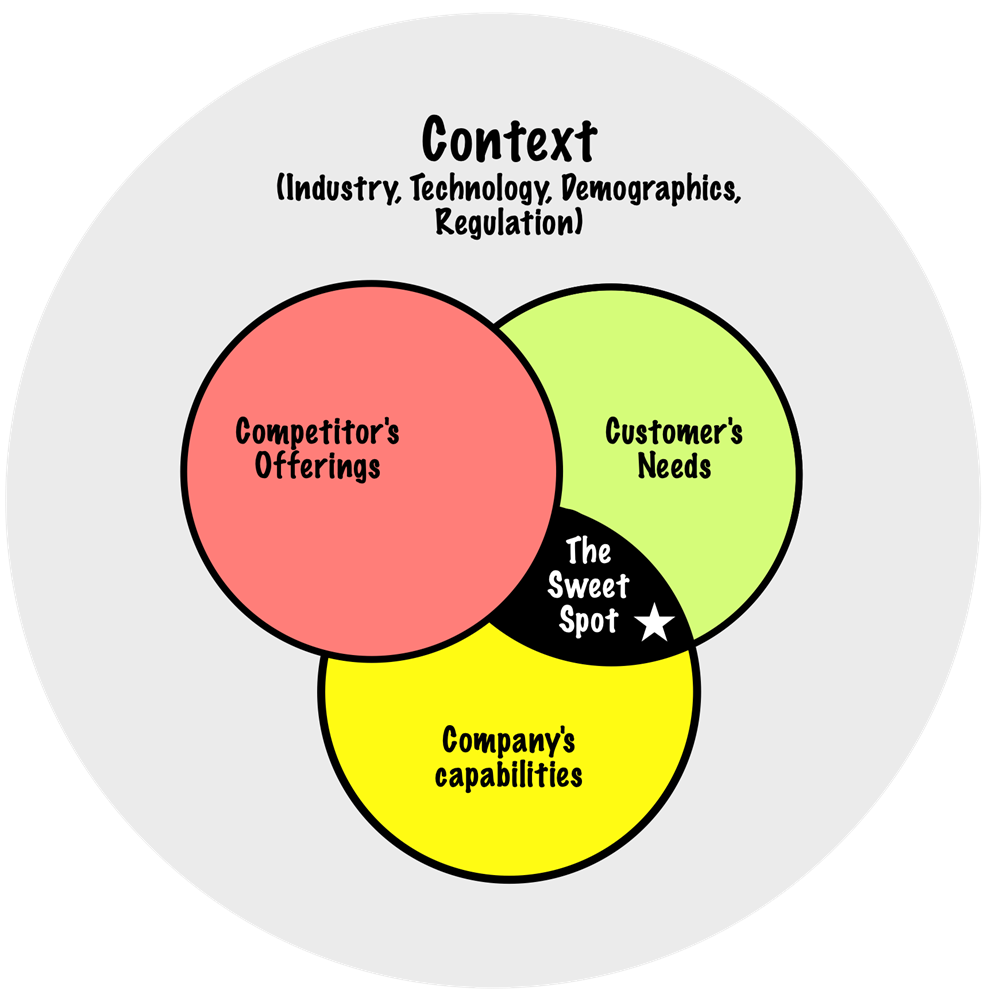
To find this sweet spot, you need a structured way to analyze these components. One of the most practical and widely used frameworks for this is the 5C Analysis.
The 5C Framework: A Structured Approach to Market Analysis
The 5C framework provides a logical structure for a situation analysis, much like a project initiation document lays out the essential parameters of a project. It ensures you consider all critical internal and external factors. The five components are:
- Company: Your internal capabilities, resources, strengths, and weaknesses.
- Customers: Their needs, motivations, and behaviors.
- Competitors: Their strengths, weaknesses, and market positions.
- Collaborators: External stakeholders like suppliers, distributors, or partners who can help or hinder you.
- Context (or Climate): Macro-environmental factors like technology trends, regulations, and economic conditions.
For a concise overview of this framework, please watch the following video.
Mastering 5C Analysis: Concept and Real-World Business Example of Apple
This video from Monish Shah provides a clear and quick introduction to the 5C analysis framework, defining each component.
Watch the initial segments that define the framework and its purpose. Pay attention to the explanation of each of the first three C's: What is 5C Analysis Company analysis Customer analysis Competitor analysis
While we will focus primarily on Customers and Competitors to meet today's learning outcome, a complete analysis requires all five. The following article from the Product Marketing Alliance provides an excellent, in-depth guide to the questions you should ask for each "C."
How to conduct a 5C marketing analysis (with examples)
This article breaks down the 5C framework by providing guiding questions for each component. This will serve as your practical toolkit for conducting an analysis.
Please read through the sections that introduce the framework and then detail the key questions for each 'C'. Focus your attention on the practical questions listed under: The introduction to the 5Cs. The "Company" section, which parallels an internal project resource assessment. The "Customer" section, which is central to our lesson today. The "Competitor" section, our other main focus. The "Climate/Context" section, which covers macro-level risks and trends.
Deep Dive: Examining Customer Needs
As we learned in the last lesson, customer-centricity is the bedrock of modern marketing. Therefore, a deep understanding of customer needs is the most critical part of your analysis. It's not enough to know who your customers are; you must understand what problems they are trying to solve.
Customer needs can be broken down into three categories. An article from Harvard Business School Online explains this well.
3 Effective Methods for Assessing Customer Needs
This reading from HBS Online provides a framework for categorizing customer needs and practical methods for uncovering them, especially those that customers themselves can't easily articulate.
First, read the section "What Are Customer Needs?" to understand the distinction between functional, social, and emotional needs. Then, read the section on the "Look, Ask, Try" framework. Focus on how each method helps you uncover different types of insights: Look: Observe customers to identify both explicit (obvious) and latent (hidden) needs. Ask: Use open-ended questions and interviews to get inside the customer's mind. Try: Immerse yourself in the customer experience to develop true empathy.
The "Look, Ask, Try" approach is a powerful, hands-on method for gathering the qualitative data that your interest in human psychology will find engaging. It transforms the analytical task into an empathetic one. Your interest in data analytics is also crucial here. The insights gathered from these methods become the raw data for identifying patterns in customer behavior and preferences, which can then be used to inform strategy—a topic explored in the "Advanced customer analysis framework" mentioned in the Product Marketing Alliance article you read earlier.
Deep Dive: Examining Competitor Positions
Understanding customer needs is half the battle. The other half is understanding who else is trying to meet those needs and how. A competitor analysis isn't about imitation; it's about identifying gaps in the market, understanding conventional industry practices, and finding opportunities for differentiation.
The following video provides a practical, step-by-step guide to conducting a thorough competitor analysis.
7 Easy Steps on How to Perform a Competitor Analysis
This video from LYFE Marketing breaks down competitor analysis into seven actionable steps, showing you what to look for and where to find it.
Watch these key segments to build your process for analyzing competitors: Why perform a competitor analysis? Understand the strategic purpose. Find your competitors. Learn how to identify who you're up against. Outline what competitors provide. Look at their core offerings. Describe how competitors sell. Analyze their sales process from a customer's perspective. Analyze their pricing and product presentation. This is key to understanding their positioning. Read customer feedback. This is a crucial step that connects your competitor analysis back to customer needs, revealing where competitors are failing to deliver value.
Notice how the final step—reading customer reviews of your competitors—brilliantly links the two main parts of our analysis. It allows you to use your competitors' customer base as a source of insight into unmet needs and market gaps. This is where you can find powerful clues for locating the "strategic sweet spot."
Bringing It All Together: An Example
Once you've gathered information on the 5Cs, the final task is to synthesize it to inform your strategy. The Product Marketing Alliance article provides a concise example of a 5C analysis for Walmart, showing how raw analysis points can be translated into strategic actions.
How to conduct a 5C marketing analysis (with examples)
This section provides a concrete example of a completed 5C analysis, demonstrating how the framework is applied in practice.
Please review the full Walmart example. For each of the five components, pay attention to the "Analysis" (the findings) and the corresponding "Action" (the strategic implication). This illustrates how the situation analysis directly leads to decision-making.
Conclusion
In this lesson, we have established a structured methodology for the first and most critical step of the marketing process: understanding the marketplace.
- The goal of a situation analysis is to identify the "strategic sweet spot" where your capabilities meet customer needs in a way competitors can't.
- The 5C Analysis (Company, Customers, Competitors, Collaborators, Context) provides a comprehensive framework to guide your investigation.
- Examining customer needs goes beyond demographics; it involves understanding their functional, social, and emotional problems using methods like "Look, Ask, Try" to uncover both stated and latent needs.
- Examining competitor positions involves a systematic review of their offerings, sales processes, and pricing, with a focus on using their customer feedback to find service gaps and opportunities.
You are now equipped with the foundational tools to analyze a market situation. This analytical groundwork is the essential prerequisite for developing a focused marketing strategy.
In our next lesson, we will build directly on this foundation. Once you understand the landscape of customer needs and competitor offerings, the next logical question is: "Which group of customers should we focus on?" This will lead us into the STP Framework, where we will learn how to Segment the market, Target a specific group, and Position our offering effectively for them.