Welcome to your first lesson in Marketing Management. Over the next few sessions, we'll build a strong foundation in the core principles that drive successful marketing, equipping you with the strategic mindset needed for your postgraduate studies and beyond.
Today, we're starting with one of the most fundamental concepts in modern marketing: the Segmentation, Targeting, and Positioning (STP) framework. This three-step process is the bedrock of customer-centric strategy. In this lesson, we will focus on the first, critical step: Segmentation. We'll also begin to explore the second step, Targeting. You'll learn how to break down a large, diverse market into smaller, manageable groups and then how to evaluate those groups to identify the most promising ones for your business. This methodical approach of analyzing, evaluating, and selecting is a cornerstone of strategic decision-making, not unlike the structured processes you've mastered in project management.
By the end of this lesson, you will be able to apply different segmentation variables to a market and use clear criteria to select a viable target segment.
1. The Strategic Importance of Market Segmentation
Before we dive into the "how," let's establish the "why." Why can't a company simply decide to sell its product to everyone? The reality is that markets are not uniform; they are made up of countless individuals and organizations with different needs, desires, resources, and priorities. This is known as market heterogeneity.
Attempting a one-size-fits-all approach is inefficient and often ineffective. It leads to wasted resources, diluted messaging, and a failure to connect meaningfully with any particular customer group. Effective marketing begins with the recognition that you cannot be all things to all people. Market segmentation is the strategic response to this reality. It is the process of dividing a broad market into smaller, more homogeneous groups of consumers.
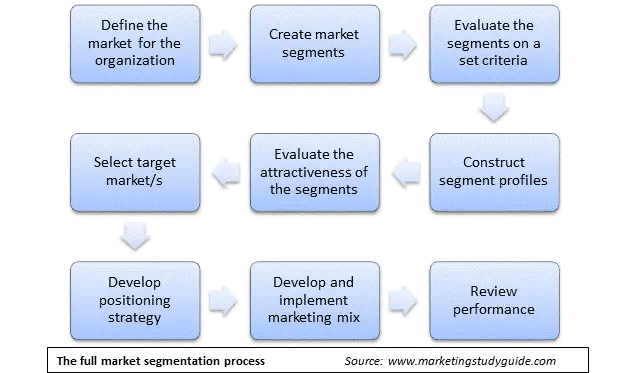
This structured approach provides a clear roadmap for your marketing efforts, much like a project plan guides project execution. To visualize where segmentation fits into the grander scheme, take a look at the following flowchart. It illustrates the complete marketing strategy process, starting with defining the market and moving through segmentation, targeting, positioning, and implementation. Our focus today is on the "Create market segments" and "Evaluate the segments" steps.
2. How to Segment a Market: The Four Key Bases
Now that you understand why segmentation is crucial, let's explore how it's done. Marketers use "segmentation variables" or "bases" to divide the market. These are characteristics that help distinguish one group of consumers from another. There are four primary types.
The table below provides a concise summary of these four main bases of segmentation. It's a useful reference for understanding the different lenses through which you can view a market.

To see these concepts explained with clear examples, the following video offers an excellent overview.
Market Segmentation in 12 minutes
This video from Leaders Talk, "Market Segmentation in 12 minutes," provides a clear and concise explanation of the four main types of segmentation.
Please watch the section that details the four main types. As you watch, pay attention to the real-world examples used for each type, such as H&M for demographic segmentation and McDonald's for geographic.
Let's briefly break down each of these four key bases:
-
Demographic Segmentation: This is often the most straightforward method. It involves grouping people based on objective, measurable population characteristics.
- Examples: Age, gender, income, education level, family size, occupation.
- Why it's useful: Demographic data is often readily available (e.g., through census data) and can be a simple starting point for identifying consumer needs. For instance, the needs of a 22-year-old university student are demonstrably different from those of a 45-year-old executive with children.
-
Geographic Segmentation: This involves dividing the market based on physical location.
- Examples: Country, region, city size, climate, urban vs. rural.
- Why it's useful: Consumer needs and purchasing habits can vary significantly by location. A company selling snow blowers would naturally focus on regions with cold, snowy winters.
-
Psychographic Segmentation: This method goes deeper into the consumer's mindset, grouping people based on their internal characteristics.
- Examples: Lifestyle (e.g., health-conscious, adventurous), personality traits, values, interests, and opinions.
- Why it's useful: Psychographics explain the "why" behind a purchase. Two people with identical demographic profiles might have vastly different lifestyles and values, leading them to choose different products. For example, one might buy an electric car due to environmental values, while another prefers a luxury sports car as a status symbol.
-
Behavioral Segmentation: This approach segments the market based on consumers' actual, observable behaviors related to a product or service.
- Examples: Purchasing habits, brand loyalty, usage rate (heavy vs. light user), benefits sought, readiness to buy.
- Why it's useful: This is arguably the most powerful basis for segmentation because it is directly linked to how people interact with your offerings. Grouping customers by the specific benefits they seek from a product is a particularly effective strategy. For example, in the toothpaste market, some consumers seek whitening (a cosmetic benefit), others seek cavity protection (a health benefit), and some prioritize low price (an economic benefit).
In practice, marketers rarely use just one type of segmentation. The most robust and insightful segments are often created by combining several variables—for instance, combining demographics with psychographics to create a rich "persona" of a target customer.
3. From Segmentation to Selection: Evaluating Target Segments
Once you have divided the market into distinct segments, the next step is to evaluate them and decide which one(s) to target. Not all segments are created equal, and a company must wisely allocate its finite resources to the segments that offer the most potential.
This evaluation is a two-part process. First, you must ensure that any segment you consider is viable. Second, you must assess how attractive it is from a business perspective.
Foundational Criteria for a Viable Segment
Before you even consider a segment's profitability, it must meet four basic conditions. A segment is only useful if it is:
- Measurable: Can you actually measure the size, purchasing power, and key characteristics of the segment? If you can't quantify it, you can't effectively target it.
- Accessible: Can you effectively reach and serve the segment with your marketing and distribution channels? A segment is useless if you have no way to communicate with it or get your product to it.
- Substantial: Is the segment large and/or profitable enough to be worth serving? It must be a large enough group to justify the costs of a tailored marketing strategy.
- Actionable: Do you have the resources and capabilities to develop effective programs for attracting and serving the segment? If you can't design a distinct marketing mix for it, it doesn't function as a separate segment.
These four conditions are the essential go/no-go gates for segment selection. A segment that fails any of these tests should be discarded.
Criteria for Evaluating Segment Attractiveness
Once you have a list of viable segments, you need to determine which are the most attractive to pursue. This is a critical strategic decision. The following reading from a Wharton School publication provides a detailed, manager-focused framework for this evaluation. It goes beyond simple metrics and introduces a portfolio-based way of thinking that will be familiar from your project management background.
[PDF] Market segmentation - Wharton Faculty Platform
This section of the paper, titled "Selecting target segments," details the criteria and process for choosing which market segments to pursue. It provides a robust checklist for making this strategic decision.
Please read the entire section, which begins with the heading "Selecting target segments." Pay close attention to the four conditions we just discussed. Then, focus on the list of questions that guide the evaluation of segment attractiveness, starting with these questions. Notice how the text mentions the Analytic Hierarchy Process (AHP). This is a structured technique for complex decision-making, similar to methods used in project portfolio management to prioritize initiatives based on multiple criteria like cost, benefit, and risk.
As the reading highlights, evaluating segment attractiveness involves analyzing factors such as:
- Segment Size and Growth: How large is the segment now, and how fast is it expected to grow?
- Profitability and Responsiveness: How much are customers in this segment willing to pay? How will they respond to your offering?
- Competitive Landscape: How many competitors are already focused on this segment? How strong are they? Is there an opportunity to establish a unique position?
- Company Fit: Do you have the competencies and resources to serve this segment effectively and better than competitors?
4. Application: A Case Study in Segmentation
Theory is best understood through application. The following case study demonstrates how a business-to-business (B2B) services company could use segmentation to refine its marketing strategy. It provides concrete examples of applying benefit, geographic, and psychographic variables to identify profitable customer groups.
Segmentation Marketing: A Case Study on Performance Solutions Group, LLC.
This document provides a case study for Performance Solutions Group, LLC (PSG). The "Recommendations" section shows how segmentation principles can be translated into actionable business strategy.
Please read the "Recommendations" section of the document. It starts on page 14. Focus on how it applies three different segmentation approaches to PSG's business: Benefit Segmentation: Notice how it identifies the primary benefit for two different products (time-saving for Telenotes, customization for the Leadership Program) and suggests targeting distinct segments for each. Geographic Segmentation: Observe how it uses geography not just to control costs but also to tailor the marketing message to the different work paces of large cities versus smaller towns. Psychographic Segmentation: See how it targets a specific "busy salesperson" lifestyle, positioning its products as solutions that fit into that demanding work life.
This case illustrates the ultimate goal of segmentation: to move from broad assumptions about the market to a nuanced understanding of specific customer groups, allowing you to tailor your products and messages for maximum impact.
Conclusion
In this lesson, we have unpacked the first essential component of the STP framework. You've learned that market segmentation is a disciplined process for managing market heterogeneity and allocating resources effectively.
Here are the key takeaways:
- Why Segment? Markets are diverse. Segmentation allows you to focus your efforts, becoming more efficient and effective by targeting groups of customers with shared characteristics and needs.
- How to Segment: You can divide a market using four main bases: demographic (who they are), geographic (where they are), psychographic (what they think), and behavioral (what they do). Often, a combination of these is most powerful.
- How to Select: The selection process is twofold. First, ensure a segment is viable by checking if it is measurable, accessible, substantial, and actionable. Second, evaluate the attractiveness of viable segments based on criteria like size, growth, profitability, competition, and fit with your company's capabilities.
You now have the foundational knowledge to break down a market and identify its most promising segments. In our next lesson, we will build directly on this foundation. Having chosen who to target, we will explore how to win their minds by developing a compelling Positioning strategy. We'll learn how to craft a unique identity for your brand that resonates with your chosen target segment and differentiates you from the competition.