Welcome to the next step in our rapid exploration of marketing management. In our previous session, we focused on the first two parts of the STP framework: segmenting the broader market and selecting a viable target segment. You now have a process for answering the crucial question, "Who are our most valuable potential customers?"
Today, we complete the STP framework by tackling the 'P': Positioning. Having chosen our target audience, we must now decide how we want them to see us. This lesson will show you how to strategically carve out a distinct and valuable space in the minds of your target customers. Much like a project charter defines a project's unique value and objectives to guide the team, a positioning strategy serves as the "North Star" for all your marketing efforts, ensuring every action builds towards a single, coherent brand perception.
By the end of this lesson, you will be able to develop a positioning strategy for a target segment and articulate it using two key tools: a positioning statement and a perceptual map.
1. What is Positioning? Winning the Battle for the Mind
Positioning isn't about what you do to a product; it's about what you do to the mind of the prospect. It's the art of designing your company's offering and image to occupy a unique and valued place in the target customer's consciousness, relative to your competitors. A strong position answers the customer's question: "Why should I choose this brand over all the others?"
To build a strong position, you need to manage two critical types of brand associations:
- Points of Parity (POPs): These are the "must-have" attributes or benefits that make your brand a legitimate and credible player within a specific category. They are not reasons to choose your brand, but they are reasons why your brand is not rejected. Think of them as the cost of entry. For a bank, POPs would include security, access to funds, and reliable online services.
- Points of Difference (PODs): These are the strong, favorable, and unique associations that customers have with your brand. These are the compelling reasons why customers should choose you over the competition. A bank's POD might be exceptional, personalized financial advice, a seamless mobile app experience, or a commitment to ethical investments.
The following video provides an excellent lecture on these core concepts. It uses the classic case of Miller Lite to demonstrate how a brand can successfully communicate both its POPs and PODs to win over a skeptical market.
Kotler and Keller, Chapter 10: Crafting the Brand Positioning
This video, based on Kotler and Keller's seminal marketing textbook, explains the foundational concepts of positioning, including Points of Parity (POPs) and Points of Difference (PODs).
Please watch the following segments: Start with the definition of brand positioning and the customer-focused value proposition. Next, learn about Points of Parity, which establish category membership. Then, understand what makes a brand unique by watching the section on Points of Difference. Finally, see these concepts in action in the detailed case study of the Miller Lite campaign. Note how they established a POP ("Tastes Great") and a POD ("Less Filling") to completely reshape the low-calorie beer market.
The key insight here is that a successful positioning strategy requires a delicate balance. You must first establish your POPs to be considered, and then use your PODs to be chosen.
2. Visualizing the Battlefield: The Perceptual Map
Before you can decide where you want to be in the customer's mind, you need to understand where you—and your competitors—currently are. A perceptual map is a powerful analytical tool for this purpose. It's a visual representation of the perceptions of customers about different brands in a market.
Typically, a map is a two-dimensional chart where the axes represent key attributes that drive customer choice in the category. For example, in the car market, these attributes might be "Price" (from Economic to Premium) and "Functionality" (from Family-oriented to Sporty). By plotting where customers perceive each brand on these axes, you can instantly see:
- Who your closest competitors are.
- What attributes are associated with which brands.
- Potential "gaps" in the market where an unmet need might exist.
The following short, animated video provides a clear, practical walkthrough of how a company might use perceptual mapping to solve a business problem.
This video from Choice Based Market Insights explains the concept of perceptual mapping through a simple case study of a cruise line named Ocean Blue.
Watch from the introduction of Sally, the marketing executive, to the end. Pay close attention to how she uses survey data to build the map, how she interprets the positions of different cruise lines, and most importantly, how the map reveals an unoccupied space in the market that becomes her company's new strategic direction.
To see what a finished perceptual map looks like, consider this example for the motorcycle industry.
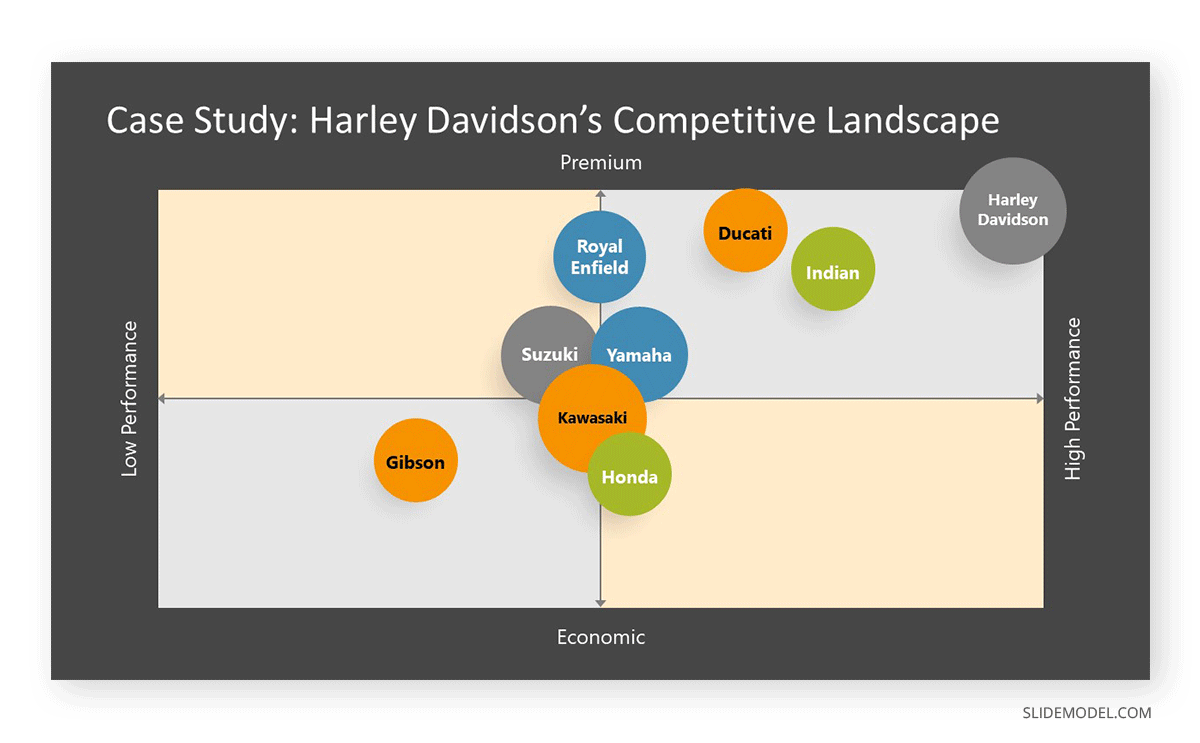
Looking at this map, you can immediately grasp Harley Davidson's position: it's perceived as a high-performance, premium brand, occupying a space distinct from more economical brands like Honda or high-performance competitors like Ducati. This visual clarity is what makes perceptual mapping an invaluable tool for strategic analysis.
For a deeper dive into the methodology, the following article provides a step-by-step guide.
How to Use Perceptual Mapping to Assess Your Competition
This article from HBS Online provides a practical guide on creating and interpreting perceptual maps to inform strategy.
Please read the section "How to Make a Perceptual Map." Focus on the four key steps described: Identify Key Attributes: This is the crucial first step of choosing the axes for your map. Assess the Competition: Understand how the map reveals direct and indirect competitors. Map Your Brand: Learn how to plot positions based on customer data. Turn Findings into Growth: See how to use the finished map to find opportunities and avoid becoming a commodity.
3. Codifying Your Strategy: The Positioning Statement
After using tools like perceptual mapping to decide on your desired position, you need to articulate it clearly. The positioning statement is the internal document that does this. It is a concise, formal declaration of your positioning strategy. It is not a public-facing slogan or tagline; rather, it's the strategic foundation upon which all marketing communications (advertising, content, messaging) are built.
A good positioning statement has several key components, as shown in this simple template.

While that infographic provides a good overview, a more robust and widely used template in business practice is the following:
For [Target Market], [Brand Name] is the only brand among all [Competitive Set] that [Unique Value Claim / Point of Difference] because [Reasons to Believe].
Let's break this down:
- Target Market: The specific segment you identified in the previous step of the STP process.
- Brand Name: Your product or service.
- Competitive Set: The frame of reference. What are the customers' alternatives?
- Unique Value Claim / Point of Difference (POD): The single most compelling and unique benefit you offer that the competition cannot match.
- Reasons to Believe (RTBs): The proof points that make your unique claim credible and believable. This could be a specific feature, a proprietary process, or a performance attribute.
The following article from Harvard Business School Online provides a superb explanation of how to construct this statement, with excellent real-world examples.
How to Craft the Perfect Brand Positioning Statement
This article provides a clear framework and template for writing an effective brand positioning statement.
Please read the sections titled "Craft Your Brand Positioning Statement" and "Inform Your Thinking with Real-World Examples." First, focus on the positioning statement template. Analyze its structure and how it incorporates the target market, competitive set, and your unique differentiation. Next, carefully study the three examples for bottled water (Voss, Perrier, and Ethos). Notice how three brands selling essentially the same physical product (water) can use positioning to create three completely different brand identities and value propositions for three different target segments.
The bottled water examples perfectly illustrate the power of positioning. The physical product is a commodity, but through strategic positioning, each brand has created unique meaning and value in the minds of its target customers. This is the essence of modern branding.
Conclusion
In this lesson, we've completed our journey through the strategic marketing framework of Segmentation, Targeting, and Positioning. You've learned how to choose your battlefield (Segmentation), select your target (Targeting), and formulate your plan of attack (Positioning).
Here are the key takeaways from today's session:
- Positioning is about perception: It's the process of creating a distinct and valued identity for your brand in the customer's mind, relative to competitors.
- Balance POPs and PODs: To succeed, a brand must meet the basic requirements of its category (Points of Parity) while offering a compelling reason to be chosen (Points of Difference).
- Visualize with Perceptual Maps: This tool is essential for understanding the competitive landscape, customer perceptions, and identifying strategic opportunities.
- Articulate with a Positioning Statement: This internal document codifies your strategy and acts as the guiding "North Star" for all your tactical marketing decisions, using the "For [target], [brand] is the only [competitor] that [POD] because [RTB]" template.
With your STP strategy now defined, you have a solid strategic foundation. The next logical question is: "How do we execute this strategy?" In our next lesson, we will begin to answer that by exploring the Marketing Mix, often called the 7Ps of Services Marketing. These are the tactical levers—Product, Price, Place, Promotion, People, Process, and Physical Evidence—that you will use to bring your positioning strategy to life in the marketplace.