Introduction
In our last lesson, we focused on adding vertical rigidity to the bra band by incorporating boning, a crucial step in preventing the band from rolling and collapsing during movement. We've essentially built a stable frame. However, many iconic Bollywood designs rely on fabrics chosen for their beauty and drama—delicate lace, ethereal chiffon, shimmering satins—which possess little to no inherent structural strength.
This lesson addresses that very challenge. We will explore how to engineer support at the fabric level itself, allowing you to use these visually stunning but mechanically weak materials in high-impact performance contexts. You will learn to draft and apply power mesh linings, creating a hidden structural chassis that stabilizes delicate fashion fabrics. This technique empowers you to achieve the delicate aesthetic demanded by the camera while ensuring the garment can withstand the rigors of vigorous choreography.
The Designer's Dilemma: Aesthetics vs. Performance
In costume design, especially for film, a frequent conflict arises between the visual requirements of the director and the functional needs of the performer. A director may envision a romantic scene with an actress in a seemingly fragile lace bra, but that same garment must later endure a high-tempo dance number without stretching, sagging, or failing.
Delicate fabrics like lace or chiffon often have poor "recovery"—they stretch but don't snap back into shape. Under the stress of movement, heat, and moisture (like a classic rain sequence), they can deform, lose their supportive qualities, and create a wardrobe malfunction. Your task is to solve this engineering problem: how to maintain the illusion of delicacy while providing robust, hidden support.
The solution lies in creating a composite material system, where a strong, stable lining acts as an invisible workhorse for the delicate "show" fabric.
Power Mesh: Your Structural Secret Weapon
The hero of this system is a fabric called power mesh or powernet. While it falls under the general category of "mesh," its properties are distinctly suited for support.

As the infographic illustrates, power mesh is engineered for gentle compression and excellent shape recovery. Unlike decorative stretch mesh, which is soft and drapey, or rigid athletic mesh, power mesh provides a firm but flexible hold.
To better understand its specific characteristics, we can turn to a technical breakdown.
Fabric for Stadium Seat Covers: Best Stretch & Mesh Options – Spandexbyyard
This article, though titled for a different application, provides an excellent technical overview of performance meshes that is directly relevant to our needs.
First, read the section What is breathable fabric? to understand how Power mesh / PowerNet is distinguished from lighter, less supportive meshes. Next, review the Key Performance Characteristics. Pay close attention to "Stretch and Recovery" and "Fabric Weight (GSM)." Your background in experimental design will give you an appreciation for the standardized tests (like ASTM) used to quantify these properties. A fabric's ability to return to its original shape after being stressed is paramount for a performance garment. Finally, look at the Best Uses and Applications. Note the specific suggestion for "Bust/upper torso support panels (inside or layered)," which is exactly our intended use case.
In essence, power mesh allows you to build a "fabric system," where each layer has a specific job. The outer fashion fabric provides the visual aesthetic, while the power mesh lining provides the structural integrity.
The Technique: Fusing Fabric Layers
The application of a power mesh lining is straightforward in concept. You will cut the same pattern piece from your fashion fabric (e.g., lace) and the power mesh. These two layers are then placed together and treated as a single piece of fabric during construction.
The video below demonstrates this principle of interlining for support, though it uses the term "power net" for a shelf bra. The technique is identical.
UNSEEN tricks: NO BOUNCE shelf bra. 2 Cami tanks (GreenStyle). Possible???
This video from Lifting Pins and Needles shows the construction of a supportive shelf bra, demonstrating the exact technique of interlining a main fabric with power net for stability.
Watch from this section where the creator lays the power net on the wrong side of the main fabric and explains that she will baste them together to be treated as one piece. This is the core technique. A "basting" stitch is a temporary long stitch used to hold layers together before the final construction seam is sewn.
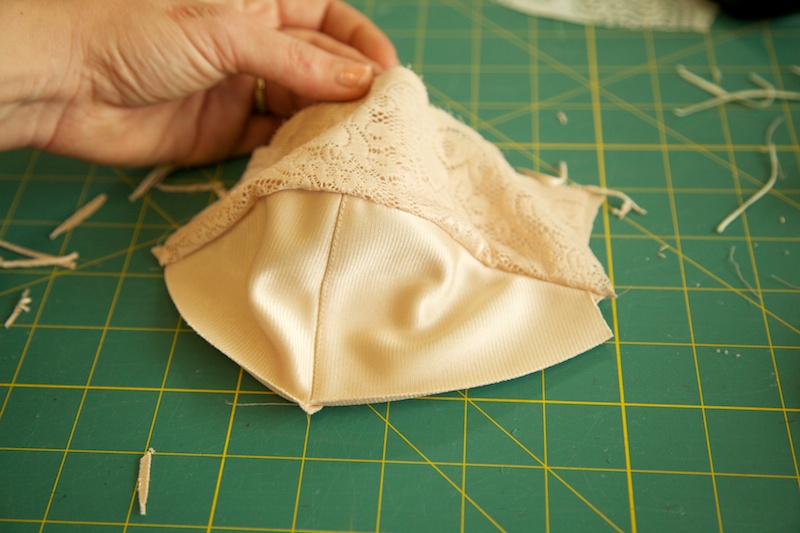
This method effectively gives your delicate lace the supportive, high-recovery properties of the power mesh it's fused to.
Why Power Mesh and Not a Stable Lining?
It's important to distinguish this technique from using a completely stable (non-stretch) lining. Fabrics like bra tulle or sheer cup lining are also used for support, but they are designed to eliminate stretch and create rigidity.
Everything You Wanted to Know About Bra Tulle & Sheer Cup Lining | Emerald Erin
This video by Emerald Erin Sews provides a fantastic comparison between two common stable lining fabrics. Watching this will clarify when you would choose a rigid lining versus a stretch-stabilizing lining like power mesh.
Watch the comparison between Bra Tulle (from 0:29) and Sheer Cup Lining (from 3:31). Notice the key difference: these fabrics are described as "rigid" and are used to prevent stretch entirely, particularly in the bra bridge. Power mesh, by contrast, is used to control stretch and add recovery to a fabric that already has stretch.
Your choice depends on the goal:
- To eliminate stretch entirely (e.g., in the center bridge, or for a fully rigid cup): Use a stable lining like sheer cup lining (marquisette).
- To support a delicate stretch fabric and add recovery: Use power mesh.
Case Study: The "Rainfall Sequence" Lace Bra
Scenario: An actress is filming a pivotal romantic scene in artificial rain. The director wants the iconic look of a wet, clinging lace bra that appears delicate and unlined. The garment must endure multiple, hour-long takes under heavy "rain" without sagging, stretching out, or failing, all while providing consistent support and shape for the camera.
The Engineering Problem: Wet lace has zero recovery and significant weight when saturated. It will immediately stretch and sag, offering no support and ruining the aesthetic. A standard beige T-shirt bra would be visible and destroy the illusion of delicacy.
The Solution using Power Mesh Lining:
-
Fabric Selection:
- Fashion Fabric: A high-quality, water-resistant decorative lace.
- Lining Fabric: A skin-toned power mesh with a high GSM (grams per square meter) and high spandex content for maximum recovery. The skin tone is crucial for making the lining "disappear" on camera, especially when wet.
-
Pattern Drafting & Cutting:
- The bra cup, frame, and band patterns are cut from both the fashion lace and the skin-toned power mesh. You will have a complete set of bra pieces in each fabric.
-
Grainline Orientation (A Critical Variable):
- This is where your experimental mindset comes into play. Power mesh has a "direction of greatest stretch" (DOGS). You will manipulate this variable to optimize support.
- For the Band: The DOGS must run horizontally, around the torso, to allow the band to stretch and anchor correctly.
- For the Cups: The DOGS is typically oriented vertically to minimize vertical stretch and control bounce. The lesser stretch direction runs horizontally across the cup, providing firm shaping.
-
Construction:
- Each lace piece is placed on its corresponding power mesh piece (wrong side of lace to right side of mesh).
- The two layers are basted together around the entire perimeter, just inside the seam allowance.
- From this point forward, each "lace + mesh" unit is treated as a single piece of fabric. The bra is constructed as usual, but you are sewing through both layers.
The Result: The power mesh acts as an invisible, high-performance chassis. It bears the load, shrugs off the weight of the water, and snaps back to shape take after take. The lace is simply along for the ride, providing the visual effect the director wants. The bra appears delicate and fragile, but is, in fact, an engineered, highly resilient performance garment.
Conclusion
You have now learned how to bridge the gap between aesthetic demands and performance requirements. By using power mesh as a structural lining, you can confidently build beautiful, seemingly delicate bras and tops from materials like lace and chiffon that are strong enough for the most demanding Bollywood dance numbers. This technique of creating a composite fabric system is a cornerstone of professional costume and lingerie construction.
Key Takeaways:
- Delicate fashion fabrics can be used for performance garments by lining them with a structural fabric.
- Power mesh is the ideal lining when you need to stabilize a stretch fashion fabric, adding strength and recovery while allowing for controlled movement.
- The technique involves cutting both fabrics from the same pattern and basting them together to be treated as a single layer.
- The orientation of the power mesh's stretch direction is a critical design variable used to control support and shape.
Next Lesson Preview
We have successfully stabilized our fabric. Now, we must ensure the most critical piece of hardware—the underwire—is housed securely. An underwire that breaks through its casing is not only a costume failure but a safety hazard for the performer. In our next lesson, we will engineer secure underwire casings designed to prevent breakthrough during extreme movement, tackling one of the most common points of failure in bra construction.