Introduction
In our last lesson, we focused on creating a stable and reliable fabric foundation by lining delicate materials with power mesh, ensuring they could withstand the demands of performance. Now, we turn our attention to another critical point of potential failure: the underwire. While essential for providing shape and support, an underwire that breaks through its casing is one of the most common and dangerous wardrobe malfunctions. It can halt a production, ruin a take, and pose a genuine safety risk to the performer.
This lesson is dedicated to engineering a solution to this problem. We will analyze the forces that lead to underwire breakthrough and design a robust, multi-layered system to prevent it. By the end of this lesson, you will be able to design a secure underwire casing that can withstand the extreme movement and torsional stresses of high-impact Bollywood choreography, ensuring your creations are not only beautiful but also impeccably reliable and safe.
The Anatomy of a Wardrobe Malfunction
During a live performance or a multi-take film shoot, garments are subjected to immense stress. A failure in a key structural component can lead to a wardrobe malfunction, a situation every designer strives to prevent.

The most insidious type of failure is often the one that happens gradually. Underwire "poke-through," or breakthrough, is a classic example of a failure caused by material fatigue and stress concentration. It doesn't usually happen because of a single catastrophic event, but rather from the accumulation of stress over time.
To understand how to prevent it, let's first analyze the problem in detail.
[PDF] Bra Underwire Customization With 3-D Printing: - SciSpace
This research paper, while focused on 3D printing, contains an excellent summary of common underwire-related problems.
In section 2.3.2, "Discomfort and health-relevant issues," read the paragraph describing the problem of the underwire poking out. Pay close attention to the identified causes: rough laundering and the breakdown of the channeling fabric. While laundering is one cause, in a performance context, the "rough shuffling" is analogous to the intense, repetitive motion of dance.
As the text highlights, the core issue is the breakdown of the "channeling" (or casing) fabric, allowing the wire tip to escape. This happens for a few key reasons in a performance setting:
- Stress Concentration: The entire supportive force of the wire is transmitted to the bra structure, but at the very ends, this force is concentrated on a tiny point—the tip of the wire. Your background in statistics and force vector analysis gives you a good framework for understanding how a distributed load can become a highly destructive point load.
- Abrasion: During vigorous movement—twisting, jumping, bending—the wire flexes and moves slightly within its casing. The wire tip continuously rubs against the fabric of the casing, slowly abrading and weakening the fibers until they break.
- Torsional Force: When a dancer twists her torso, the bra twists with her. This puts a rotational or torsional force on the wire, causing the tip to press and turn against the casing end in a corkscrew-like manner, which is highly effective at burrowing through fabric.
The Components of the System
To engineer a solution, we must consider the two main components involved: the underwire and its casing.
The Underwire
The underwire's primary job is to define the shape and provide support by tracing the root of the breast. As a structural element, its proper function is critical.
Optimising the design of sports bras: Part I - WTIN
This article on sports bra design has a relevant section on the function and challenges of underwires.
Read section 2.6. Wires. The text explains that the wire is "intended to trace the breast root" and highlights what happens when it's in the wrong position: it can come onto the breast tissue or dig in painfully. This emphasizes how crucial it is to keep the wire perfectly seated in its intended channel.
The ends of the wire are the culprits in a breakthrough. They are typically coated in a smooth plastic or nylon dip to reduce sharpness. However, this tip is still a point of concentrated force. Advanced solutions, like the patented spring-loaded tip mentioned in the "Bra Underwire Customization" paper, show how seriously the industry takes this single point of failure.
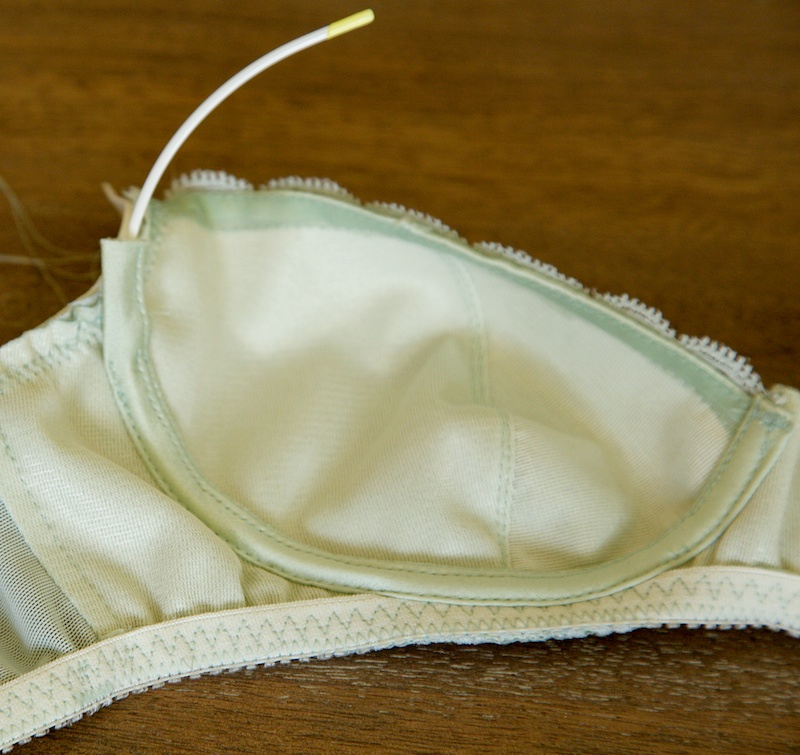
The Casing (Channeling)
The underwire casing is the fabric tube that holds the wire. Standard casing is typically a woven polyester tube with one plush side for comfort against the skin. While suitable for everyday wear, high-impact performance demands a more robust approach. The casing itself is the first line of defense, and if it fails, the entire system fails.
Engineering a Breakthrough-Proof Casing
Preventing underwire breakthrough requires a multi-layered defense strategy. You cannot rely on a single feature; instead, you build a system where each component reinforces the others.
1. Material Selection & Preparation
- Casing: Always use high-quality, densely woven underwire casing. For extreme-impact garments, you can even find casings reinforced with extra stitching. Avoid trying to make your own casing from a folded piece of fashion fabric, as it will lack the durability and plushness of purpose-made channeling.
- Wire Tips: Before insertion, feel the tips of your underwires. Occasionally, the plastic coating can have a sharp burr or imperfection from the manufacturing process. You can gently file this smooth with a fine-grit nail file to remove the primary abrasive point.
2. Secure Attachment to a Stable Foundation
A casing sewn onto a flimsy, single layer of fabric is easily compromised. The stress needs to be distributed.
- In our previous lesson, we stabilized the fashion fabric with a power mesh lining. This is the structural foundation to which the casing must be anchored.
- The casing should be stitched along the wire line through all layers: the fashion fabric, any interfacing, and the power mesh lining. This ensures that the force from the underwire is distributed across the strong, stable chassis of the bra, not just a weak decorative layer.
3. The Ultimate Failsafe: The Bartack
This is the most critical step and the mark of a professionally engineered performance garment. After the wire is inserted into the casing, you must create an impenetrable physical barrier at both ends. This is done with a bartack.
A bartack is a sequence of very tight, dense zig-zag stitches used in areas of high stress (like the top of jean pockets or belt loops) to provide reinforcement. In bra making, it creates a solid wall of thread that the underwire cannot penetrate.
Application:
- Location: The bartack is stitched directly on top of the casing, perpendicular to the wire. It should be placed just outside the tip of the wire, ensuring the wire is snug but not under tension.
- Placement: You will apply one bartack at the center-front (gore) end of the casing and another at the underarm end of the casing for each cup.
- Execution: This requires a sewing machine. You will use a short stitch length and a medium-width zig-zag stitch. You sew back and forth over the same spot (typically 1-1.5 cm) until you have a thick, dense block of stitches.
This single technique is the most effective way to mechanically block the wire and prevent breakthrough.
Case Study: The Acrobatic Item Number
Scenario: An A-list actress is performing a physically demanding item number for a blockbuster film. The choreography includes high-energy Fosse-style dance, floor-work involving backbends, and a sequence where she is lifted and spun by backup dancers. She is wearing a custom-designed, heavily beaded plunge bra. A wire breakthrough is not an option—it would halt the multi-million dollar shoot and could injure the star.
The Design Challenge: Engineer the underwire casing to be "breakthrough-proof" under extreme flexion, torsion, and potential impact.
The Engineered Solution:
-
Component Selection:
- Wire: A high-quality, rigid steel plunge underwire is selected. The tips are inspected and confirmed to be perfectly smooth.
- Casing: A premium, densely woven plush polyester casing is used.
-
Structural Assembly:
- The bra pattern, made of a fashion fabric stabilized with a power mesh lining (as per our last lesson), is assembled.
- The underwire casing is pinned along the wire line of the bra frame. The plush side faces the body.
- The casing is attached with two parallel lines of precise straight stitching, creating a clean and strong channel. This stitching goes through all layers, anchoring the casing to the structural power mesh.
-
Securing the Wire (The Critical Steps):
- The underwire is inserted into the finished casing.
- Reinforcement Patch: Before bartacking, a small (2cm x 2cm) square of highly stable, non-stretch fabric (like sheer cup lining or even a tiny piece of twill tape) is placed over the casing end, right where the wire tip rests. This acts as a final layer of puncture resistance.
- Bartacking: Using an industrial sewing machine, a dense bartack (1.5cm wide) is sewn over the reinforcement patch and through all layers of the bra. This is done at all four casing ends (two at the center gore, two at the underarms).
The Result: The underwire is now housed in a system engineered for failure prevention. The wire's tip is smooth. The casing is durable and anchored to a stable foundation. A reinforcement patch provides extra puncture resistance. And finally, a solid, immovable wall of thread—the bartack—physically prevents the wire from ever reaching the end of the channel. The garment is now safe for even the most extreme performance demands.
Conclusion
You have now moved beyond simple construction and into the realm of true garment engineering. Preventing underwire breakthrough is a perfect example of how a deep understanding of forces and materials allows a designer to create garments that are not only beautiful but also robust and safe under pressure.
Key Takeaways:
- Underwire breakthrough is caused by a combination of stress concentration, abrasion, and torsional force, primarily at the wire tips.
- A preventative strategy involves a multi-layered system: selecting quality components, smoothing wire tips, and attaching the casing to a stable structural layer.
- The most crucial technique for preventing breakthrough is applying a dense bartack at both ends of the casing to create a physical barrier.
- Reinforcing the bartack area with a patch of stable fabric adds an extra layer of security for extreme-impact designs.
Next Lesson Preview
We have now secured the bra's fabric foundation and its most critical hardware component, the underwire. The final piece of the primary support structure is the strap system. In our next lesson, we will focus on how to engineer strap attachment points to distribute weight effectively, prevent slippage during intense movement, and integrate seamlessly with the overall design.