Introduction
In our last lesson, we examined the critical role of hardware, treating hooks, rings, and clasps as the mechanical joints of a performance garment. We established that for the high-stakes environment of a film set, every component must be engineered for durability and efficiency. Today, we move from the joints to the very skeleton of the bra: the underwire.
This lesson will equip you to evaluate different underwire types (plunge, demi, full) and materials (metal vs. plastic). The underwire is arguably the most important structural element for shaping and support, and choosing the correct one is fundamental to achieving a specific design goal, whether it's creating the dramatic cleavage for an item number or providing invisible support under a heavy historical costume.
Drawing on your background in statistical analysis, we will go beyond a simple catalog of shapes. We will delve into the material science of underwires, exploring concepts like stress, strain, and fatigue. This engineering-led approach will allow you to make informed decisions based not just on aesthetics, but on the predictable performance of materials under the extreme demands of Bollywood choreography.
The Underwire: An Engineered Foundation
Before we compare types, it's essential to understand the underwire's fundamental purpose. It is not merely a piece of metal inserted into a bra; it is an engineered component that creates an artificial, regularized version of the breast root (the line where the breast tissue joins the chest wall).
To understand this concept more deeply, let's turn to an excellent guide by lingerie designer Lyzzy Beswick.
Bra Underwires 101: A Basic Guide
This article from The Lingerie Addict introduces the core function of an underwire and the materials used.
Begin by reading the section "What are underwires?". Pay attention to the idea that the underwire forms an "idealised, regularised form of the breast root." The image of the breast root trace is particularly insightful. Continue to the next untitled section, reading from "Most women have one breast...". This explains the primary function: to contain the breast volume and push it into a desired shape, much like a mold. Finally, read the brief paragraph on materials: "Underwires can be...". This introduces the fundamental material choice we will explore throughout this lesson.
As the article notes, the underwire works in tandem with the fabric components of the bra (the cup and cradle) to form a cantilever system that lifts and supports the breast. The shape of that wire is the primary determinant of the final silhouette.
A Taxonomy of Underwire Shapes
While there are countless subtle variations, underwires can be grouped into a few key families, each designed to produce a different effect. The images below show some of the most common shapes you will encounter.
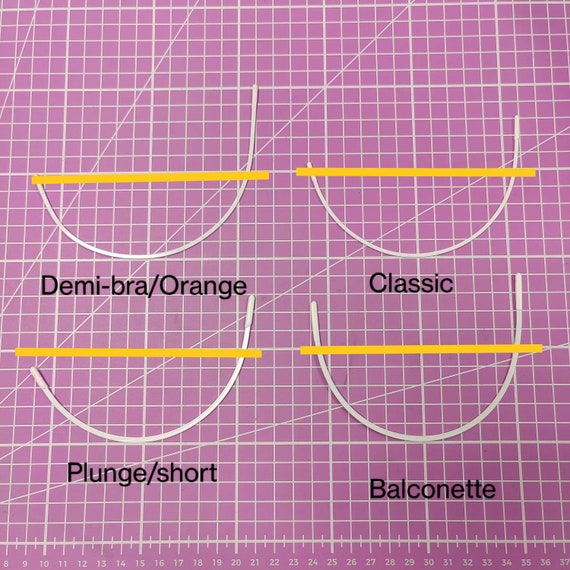
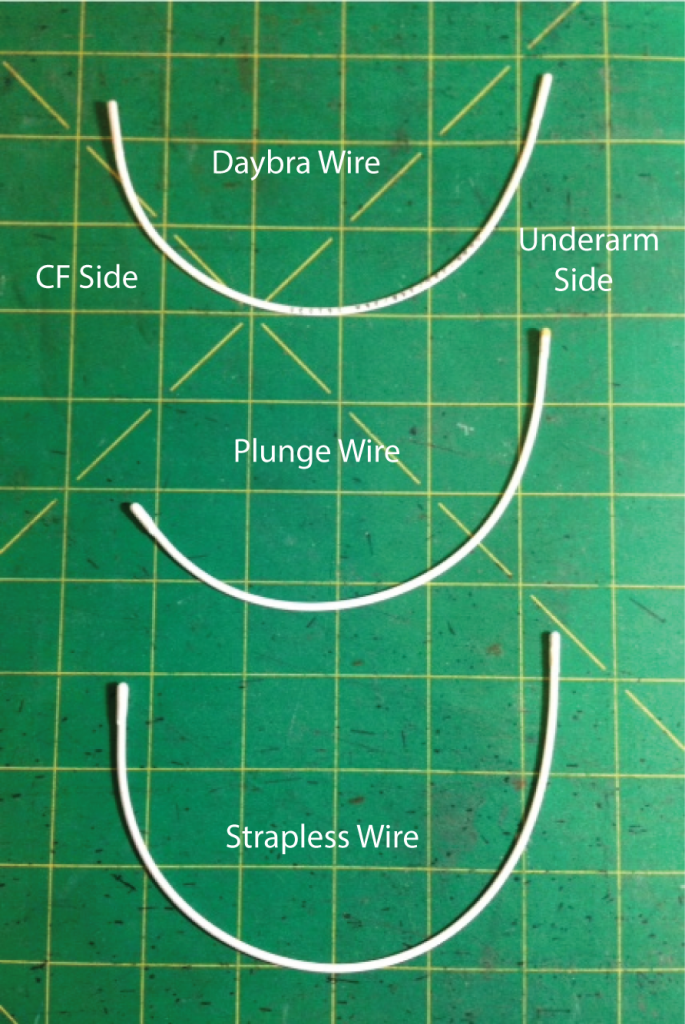
Let's break down the function of these primary types, using the "Bra Underwires 101" guide as our reference.
Bra Underwires 101: A Basic Guide
This section details the three main underwire categories and the shapes they create.
Please read the section titled "The 3 Main Types of Underwires". Focus on understanding the distinct geometry and purpose of the Balconette/Day bra, Plunge, and Strapless wires.
To summarize and consolidate this information for design purposes:
- Balconette / Daybra / Classic: This J-shaped wire is the all-rounder. It provides moderate coverage and good lift, creating a rounded, natural shape. Its versatility makes it the foundation for many everyday bras and fuller-cup styles. The arms are of medium, often unequal height, with the taller arm sitting at the underarm.
- Plunge: This wire is more open and angled, resembling a banana or a checkmark. It is designed specifically for low-cut necklines. The center front ends are very low, and the wire is inserted at an angle to push the breasts upwards and towards the center, creating dramatic cleavage.
- Strapless: This is a deep, symmetrical U-shaped wire. Both arms are high and of nearly equal length. The goal is to fully contain the breast tissue from below and the sides, providing robust support without the aid of straps. It projects the bust forward rather than pushing it up or together.
- Demi: This is typically a shorter, more open version of a balconette wire, designed for lower-coverage cups that reveal the top of the bust.
Material Science: The Engineering of Resilience
Choosing the wire shape determines the silhouette. Choosing the material determines its survival. As the guide noted, wires are either plastic or metal.
- Plastic Wires: These are lightweight and rust-proof, making them a common choice for inexpensive mass-market bras and some swimwear. However, they are prone to snapping under stress and can lose their shape over time. For the demands of performance, they are almost always an unacceptable compromise.
- Metal Wires: The professional standard is nylon-coated carbon steel. This material provides the rigidity, strength, and resilience necessary to withstand high-impact movement and support heavy, embellished garments.
To truly understand why steel is superior, we need to look at its mechanical properties. Your background in quantitative analysis will be useful here as we explore the concepts of stress and strain.
A blog post from "Hugs for Your Jugs" offers a remarkably clear, engineering-focused explanation.
Should you worry about bending your wires? (A response to Bare Essentials)
This article provides an excellent primer on the material science concepts that govern underwire behavior.
Read the section What is a Stress-Strain Curve?. Focus on understanding the definitions of stress (\sigma) and strain (\epsilon), and the difference between the elastic region (where material returns to its original shape) and the plastic region (where it permanently deforms).
The key takeaway is that for a given stress (force applied), the wire experiences a predictable amount of strain (deformation). As long as the stress stays within the wire's elastic region, it will spring back to its original shape. This is what happens during normal wear. If you apply force beyond its yield strength, you enter the plastic region, and the wire bends permanently.
Work Hardening: A Counter-Intuitive Strength
This leads to a fascinating and crucial concept for custom design: work hardening. You might assume that permanently bending a wire weakens it. The opposite is often true.
Should you worry about bending your wires? (A response to Bare Essentials)
This part of the article explains what really happens when you bend a wire.
First, read Does bending your wires cause them to break easily? to understand the common misconception. Now, read the section on Work Hardening and Wire Snapping. The graphs here are key. They illustrate that after a wire is strain-hardened (bent), its elastic region actually increases.
This means that when you carefully bend a wire to better fit an actress's ribcage, you are not necessarily weakening it. You are performing a process of work hardening (or strain hardening), which can make the wire more resilient to deforming during wear. It can now withstand a higher level of stress before it begins to deform plastically again.
Fatigue and Creep: The Real Adversaries
So if bending isn't the main enemy, what is? The true causes of wire failure over time, especially in a high-impact context, are fatigue and creep.
Should you worry about bending your wires? (A response to Bare Essentials)
This final section identifies the true culprits behind wire failure.
Read the sections Fatigue and Creep and Why Do Wires Break. This explains how repeated cycles of stress (even within the elastic limit) and poor fit are the primary causes of breakage.
- Fatigue: Like bending a paperclip back and forth, repeated cycles of loading and unloading (i.e., dancing) create microscopic cracks that eventually lead to failure. A heavier gauge (thicker) wire will be more resistant to fatigue.
- Creep: This is the slow, permanent deformation of a material under constant stress over a long period. This is why an old, well-worn bra may have wires that seem warped, even if they never broke.
- Poor Fit: If a wire doesn't fit the body correctly (e.g., it sits on breast tissue or is subjected to excessive strain from a too-tight band), it will experience concentrated stress points, accelerating fatigue dramatically.
Case Studies: Selecting Wires for Bollywood Scenarios
Let's apply this knowledge to practical design choices.
Case Study 1: The Item Number Plunge Bra
- Scenario: A star performer needs a bra for a high-energy "item number" dance. The costume is a minimal choli with a deep, plunging neckline designed for maximum visual impact.
- Design Goal: Extreme cleavage, security during athletic choreography.
- Wire Selection:
- Shape: A Plunge wire is the only choice. Its low center front and angled shape are engineered specifically for this effect.
- Material: A heavy-gauge, nylon-coated steel wire. The dynamic forces of the dance will subject the wire to high, repetitive stress. A plastic wire would be at high risk of snapping, causing a catastrophic costume failure on set. The wire's ability to remain in its elastic region under this stress is paramount.
Case Study 2: The Strapless Blouse for a Sangeet
- Scenario: An actress is wearing a heavy, off-the-shoulder lehenga blouse for a wedding sangeet scene that involves extended periods of dancing.
- Design Goal: Complete, reliable support with no straps. The garment must not slip or shift.
- Wire Selection:
- Shape: A Strapless wire. Its deep, high-armed 'U' shape is essential to contain the breast tissue from below and provide a stable foundation.
- Material: A rigid, strong steel wire. In a strapless design, the wire and the band do 100% of the support work. There is no room for material compromise. A thicker gauge wire would resist creep and fatigue, ensuring the bra provides consistent support take after take.
Case Study 3: The Structured Bikini for a "Rain Song"
- Scenario: A romantic song sequence takes place in a simulated monsoon. The actress wears a structured, underwired bikini top.
- Design Goal: Maintain shape and support when saturated with water, while resisting corrosion.
- Wire Selection:
- Shape: Depends on the neckline, but let's assume a classic balconette shape for good coverage and lift.
- Material: This presents a classic trade-off. Plastic is rust-proof but lacks strength. The professional choice is a high-quality nylon-coated steel wire. The nylon provides a robust barrier against water. While prolonged exposure could eventually lead to rust if the coating is compromised, the structural integrity and support offered by steel are non-negotiable for a filmed performance. The risk of a plastic wire snapping during movement is far greater than the risk of a coated steel wire rusting during the course of a shoot.
Conclusion
You now understand that selecting an underwire is a sophisticated design decision, blending aesthetics with material engineering. You are no longer just choosing a shape; you are specifying a structural component based on its predictable performance under stress.
Key Takeaways:
- Underwire shapes (Plunge, Balconette, Strapless) are chosen to create a specific silhouette and accommodate different necklines.
- Nylon-coated steel is the professional standard for underwires due to its superior strength, rigidity, and resilience compared to plastic.
- The concepts of stress, strain, elasticity, and plasticity govern how a wire behaves. Understanding them allows you to predict and control performance.
- Work hardening demonstrates that manually shaping a wire to fit can actually increase its resilience, while fatigue and poor fit are the primary causes of wire failure in performance garments.
- Your selection must always be guided by the specific context: the choreography's intensity, the garment's weight, and the on-set environment.
In our previous lessons, we've assembled our material toolkit: the fabric, the hardware, and now the internal skeleton. In our next lesson, we will learn how to bring these elements together by creating the architectural blueprint. We will define the essential components of a bra pattern: the frame, bridge, cup, and band, laying the groundwork for drafting our first custom bra.