Introduction
In our last lesson, we focused on the engineering principles behind fabric selection, learning to calculate and apply stretch ratios to ensure a garment can withstand the immense weight of embellishments while maintaining a perfect fit. We treated the fabric not as a mere covering, but as a technical material with predictable properties. Today, we continue building our performance garment by turning our attention from the soft structure of fabric to the hard points of connection and control: the hardware.
This lesson addresses the selection of appropriate hooks, sliders, rings, and closures. These components are often overlooked, but in the high-stakes environment of a Bollywood production, they are critical points of failure or success. A clasp that breaks during a dance take or a hook that takes too long to fasten can derail a multi-million-dollar production day. We will analyze the material science and mechanical design of this hardware, focusing on the dual requirements of absolute durability under stress and the efficiency needed for rapid, on-set costume changes.
We will ground our discussion in a practical case study: analyzing the hardware choices for a high-intensity song sequence that involves a "quick change," a backstage maneuver that is a performance in itself.
The Anatomy of a Quick Change
Before we can select the right hardware, we must first understand the environment it will be used in. In film and theatre, a "quick change" refers to the process of an actor switching costumes in an extremely short amount of time, often in less than a minute, in a cramped, dimly lit backstage area. This is not a leisurely change of clothes; it's a high-pressure, choreographed procedure executed by a team of professional dressers.
To get a sense of the precision and pressure involved, watch this short video from the National Theatre, which breaks down the process.
How to do a Costume Quick Change
This video provides a behind-the-scenes look at the world of professional dressers and the "choreographed moment" of a quick change.
Pay attention to the initial setup from the explanation of the process, where dressers plan the change and note the typical time constraint is under a minute. Watch the breakdown of the Constanza change. Notice how multiple dressers work in unison, and the commentary specifically mentions the "hooks and bars" being undone as the first step. This highlights that the closure type is central to the entire process. Finally, listen to the dressers describe the experience from the feeling of the change. Their description of it as a "choreographed moment" where they step back "as a unit" emphasizes that the hardware must be designed for flawless, repeatable, and rapid operation by a third party.
This need for speed and reliability means that costume design for performance cannot prioritize aesthetics at the expense of function. The design must be "quick-rigged" from the very beginning.
Mastering Costume Quick Changes - Dramatics Magazine
This article from Dramatics Magazine explains how the need for a quick change is integrated into the costume's design from day one.
Read the section titled "Planning for a Costume Quick Change." The key takeaway is that for a quick change, garments are engineered with different components than their "real-life" counterparts. The author notes that fragile invisible zippers are replaced with durable ones, and buttons are often replaced with Velcro or snaps. The core principle is that the "inner structures and closures in particular are often made simpler."
This principle of simplification and reinforcement is our guiding light for selecting hardware. We must choose components not for how they look on a hanger, but for how they perform under pressure.
A Taxonomy of Performance Hardware
Hardware choice is a series of engineering trade-offs: strength vs. weight, durability vs. cost, and security vs. speed of release. Your background in Operations Research will find a parallel here in optimizing a system based on competing constraints. Let's break down the primary components.
The "Complete Guide to Swimwear Notions" is an excellent resource here. While its focus is swimwear, the materials it discusses—corrosion-resistant metals and durable plastics—are precisely what's needed for performance garments that must withstand sweat, rain sequences, and intense physical stress.
The Complete Guide to Swimwear Notions
This guide provides a systematic overview of different hardware types, comparing the pros and cons of metal versus plastic for each.
Start with Swimsuit Hooks. Note the clear verdict: metal hooks are the superior choice for durability and maintaining tension. Plastic is cheaper but prone to breaking. This is a crucial first principle. Next, read about O-Rings, both plastic and metal. These can be functional connectors or decorative elements. The choice depends on whether the ring is a load-bearing part of the structure. Then, review Clasps and Fasteners. Again, the guide highlights that metal clasps are more reliable for holding straps "under tension" and convey a sense of quality. Finally, read about Sliders and Rings. This section explains their function for strap adjustment and reinforces the metal-versus-plastic trade-off. Metal is sturdy; plastic is cheaper but can fail under stress.
Let's synthesize this information into a clear framework for Bollywood design.
1. Closures: The Primary Load Point
This is typically the hook-and-eye on a bra band or a clasp on a bikini top. It bears the constant tension of the band.
- Hook & Eye: This is the standard for a reason. It's secure and allows for minor fit adjustments. For performance bras, especially those supporting heavy embellishments, you should always opt for a 3- or 4-row wide band with high-quality, coated metal hooks. The wider band distributes pressure more effectively, and multiple hooks provide redundancy.
- G-Hooks & Metal Clasps: These are common for front closures or as the primary closure on bikini tops. Their main advantage is speed—a single, decisive action to close. For quick changes, a large, robust G-hook is far superior to a fiddly hook-and-eye. The key is to select one made from a strong zinc alloy that won't deform under the panic-pull of a dresser.
- Plastic Clasps: Avoid these for any load-bearing application in a performance costume. They are a point of failure waiting to happen. Their only acceptable use is on decorative elements that bear no weight or tension.
2. Connectors & Adjusters: Rings and Sliders
Rings and sliders work as a team to allow for strap adjustment, ensuring the garment can be customized to the performer's body.
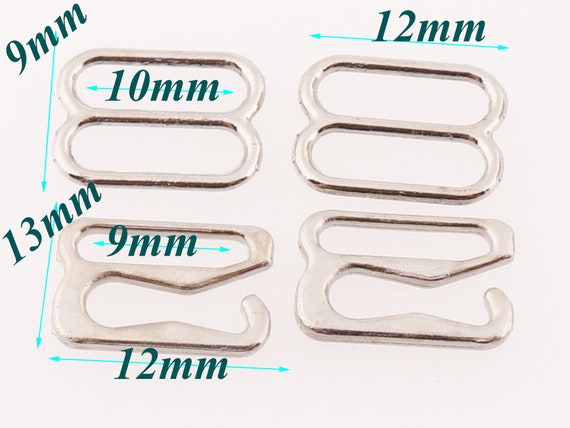
- Sliders (Tri-glides): These allow the strap length to be changed.
- Rings: These act as the junction point, connecting straps to the bra band or cups. A circular O-ring is common, but square or D-rings can also be used depending on the design.
For both sliders and rings, metal is the professional standard. The forces acting on a strap during a high-impact dance routine are significant. A plastic slider can snap, instantly compromising the garment's support. Nylon-coated metal hardware offers the durability of metal with the benefit of being dyeable to match any fabric color.

Case Study: Hardware for a "Rain Dance" Quick Change
Scenario: An actress is in a lavishly decorated, choli-style bra for the first half of a song. A sudden downpour is simulated, and she has 30 seconds to change backstage into a visually similar bikini top that is safe and durable for the water sequence.
Analysis of Costume 1 (Dry, Embellished Bra):
- Primary Closure: This garment is heavy and must withstand vigorous dancing. The ideal choice is a wide, 4-row hook-and-eye closure made of stainless steel. However, this is slow for a quick change.
- Quick-Change Rigging: The solution is to fake it. The visible back of the bra might have a decorative (non-functional) hook-and-eye panel. The actual closure, hidden from the camera, would be two or three oversized, industrial-strength snaps or even a strip of heavy-duty Velcro. This allows a dresser to rip the garment open in a single motion.
- Strap Hardware: Metal rings and sliders. The straps may also bear some embellishment, adding to the load. Plastic is not an option. The straps are pre-adjusted for the actress, so no adjustment is needed during the change.
Analysis of Costume 2 (Wet, Bikini Top):
- Primary Closure: Speed and security in a wet environment are key. The best choice is a large, corrosion-resistant metal clasp, like a zamak G-hook or an interlocking buckle. It can be fastened with one hand by feel alone and will not slip or come undone when wet. A traditional tie-back bikini is too slow and can become insecure when the fabric is soaked.
- Strap Hardware: All hardware must be corrosion-resistant. Nylon-coated metal sliders and rings would be ideal. Any decorative metal elements (like the O-ring in the image above) must also be made of a material like zinc alloy or stainless steel that won't rust and stain the fabric after one take. Plastic rings might become brittle or snap if the actress has to perform a fall or a dive as part of the choreography.
In both scenarios, the hardware selection is driven entirely by the specific performance requirements, prioritizing durability and speed over all else.
Conclusion
You have now moved beyond the fabric and into the critical mechanical components of the garment. The selection of hardware is an exercise in risk analysis and engineering efficiency. The right choices create a garment that is not only beautiful but also robust and reliable, capable of withstanding the rigors of performance and the controlled chaos of a backstage quick change.
Key Takeaways:
- Hardware for performance wear is a structural component, not a mere accessory.
- For load-bearing parts like closures and strap adjusters, metal is almost always the correct choice over plastic due to its superior strength and durability.
- Costumes for quick changes are often "quick-rigged" with simplified, robust closures like large snaps, Velcro, or G-hooks, prioritizing speed and reliability.
- The material of the hardware (e.g., zinc alloy, stainless steel, nylon coating) must be chosen based on the environment, especially considering corrosion resistance for scenes involving water or sweat.
- Hardware selection is a process of optimizing for durability, speed, and security, balancing the trade-offs to prevent on-set failures.
In our next lesson, we will delve deeper into the internal structure of the bra. Having addressed the fabric "skin" and the hardware "joints," we will now examine the "skeleton": the underwire. We will learn how to evaluate different underwire types (plunge, demi, full) and materials (metal vs. plastic) for specific design goals and necklines, adding the crucial element of rigid shaping to our design toolkit.