Welcome back. The previous lesson separated the work of HHS, NIH, CDC, and CMS. This lesson adds a second distinction: an institution can announce a goal, begin work on it, or make it legally binding—and those are different statuses.
You will use dated records to describe what has happened to a MAHA proposal without treating a speech, a company pledge, a bill, and an enacted policy as interchangeable. That skill matters especially for food policy, where federal agencies, Congress, companies, and states may all act on similar ideas.
Status is a dated claim, not a label for an entire agenda
Consider the statement “MAHA is removing synthetic food dyes.” It might refer to companies promising to reformulate products, a state restricting dyes in school meals, or a federal agency changing a regulation. Each could be real while the others remain unfinished. A reliable status description therefore identifies the specific measure, the actor, the jurisdiction, and the date.
For this lesson, use a status note with four parts:
- Measure: What precise requirement or commitment is at issue?
- Actor and scope: Who is acting, and whom would the action affect?
- Dated evidence: What does a record dated or updated at a specified time show?
- Limit: What does that record not establish?
The form of the record matters. An announcement establishes what officials say they intend to do. A voluntary pledge establishes a stated commitment by its participants, not a general legal duty. A proposed rule gives notice of a possible regulatory change and ordinarily invites comment; it does not make the proposed requirement effective. A final rule may create a binding requirement under an agency’s authority, but its effective date, any later compliance date, and any legal challenge still matter. A bill introduced in Congress is not an enacted statute. A state law can bind within that state without creating a nationwide rule.
The previous lesson’s institutional map helps here: identify the responsible body before interpreting the action. FDA rulemaking, USDA administration of a nutrition program, and a state legislature’s school-meal law leave different documentary trails. A dated agency page can help locate an action, but the relevant rule, congressional tracker, or state legislative record is usually the stronger evidence for its legal status.
A dye announcement is not the same as a dye mandate
In this recorded food-dye announcement, officials describe cooperation with manufacturers. Watch for the point at which an interviewer presses them on whether that cooperation is formally binding.
FULL SPEECH: RFK Jr. announces plans to ban commonly used food dyes
Watch the relevant passages from WFAA’s “FULL SPEECH: RFK Jr. announces plans to ban commonly used food dyes.” The recording is useful evidence of what officials said about their approach, rather than proof that a nationwide legal ban took effect.
In state leverage, listen for how differing state restrictions feature in the discussion with manufacturers. Then watch the clarification: an interviewer asks whether there is a binding agreement, and the speakers describe an understanding and a preference for cooperation without legislative or administrative mandates.
That exchange supports a narrow conclusion: at the time of those remarks, the speakers described the industry arrangement as voluntary rather than as a formal binding agreement. It does not prove that every manufacturer made the same pledge, met it, or will continue to do so. Nor does it rule out separate, binding state restrictions or a later federal action.
The mechanism is worth understanding. State restrictions may encourage a manufacturer to change products sold nationally rather than maintain different versions for different markets. If that happens, shoppers outside the regulating state might also see a reformulated product. But the company’s business decision is still distinct from the legal reach of the state law. A product change nationwide is not necessarily a nationwide legal mandate.
This distinction also keeps a scientific claim in its place. Whether a dye causes a particular health outcome requires evidence of exposure and health effects, as earlier lessons discussed. The fact that a company pledges to remove it establishes neither that claim nor its opposite.
A proposed FDA rule has a different status again
The generally recognized as safe, or GRAS, pathway offers an agency example. FDA officials have discussed changing its notification system so that the agency receives information about more GRAS determinations. The key status distinction is between describing such a change and making a new requirement effective.
RFK Jr touts MAJOR policy actions to advance MAHA agenda
Watch the FDA official’s portion of the Fox Business video “RFK Jr touts MAJOR policy actions to advance MAHA agenda.” Focus on the official’s description of the regulatory stage; treat predictions about the reform’s impact as claims, not as evidence that the proposed requirement already binds companies.
In the proposed change, the speaker contrasts voluntary notification with a proposed mandatory approach, then says the proposal is being presented for public scrutiny. In the authority limit, listen for the distinction between action under existing agency authority and possible legislation from Congress.
The operative words are “proposed rule.” The speaker describes what the requirement would do if adopted; that wording should not be silently converted into “companies must now notify FDA under the new rule.” Existing food law and regulations do not disappear while a change is proposed. Likewise, calling the proposal an important regulatory action does not identify its effective date.
For a status note about an FDA regulation, a speech is a starting clue. A dated Federal Register record would be needed to establish whether FDA published a proposal or a final rule and what text it contains. If a final rule exists, the note must also check when it takes effect and when regulated parties must comply. This lesson’s video supplies the officials’ description of a proposed GRAS change; it does not, by itself, establish a later final-rule status.
Agency action and congressional legislation may also proceed on separate tracks. An agency can propose a regulation within authority Congress has already granted. Congress could consider changing the underlying statute. Saying that legislators should act is not evidence that they have passed a law.
Read the tracker before reading a bill as law
Congress.gov shows why the wording of a bill and its legislative status must be read together. The Make America Healthy Again Act of 2025 proposes to give an executive order establishing the MAHA Commission the “force and effect of law.” That is the bill’s proposed effect, not evidence that the bill already achieved it.
Text - H.R.5404 - 119th Congress (2025-2026): Make America Healthy Again Act of 2025
Read the Congress.gov bill page to compare what H.R. 5404 proposes with what its recorded legislative actions show. This is an official congressional record for the bill, rather than a description of it in a speech.
First use the “Bill” overview: find the “Latest Action” row and the tracker, reading from its status statement through the listed stages. Then go to “Shown Here: Introduced in House (09/16/2025)” and Section 2, “Codification of Executive Order 14212.” Read the bill text through Section 2. Focus on the gap between what the introduced text says would happen and the stage the tracker records.
The displayed overview records introduction and referral to a House committee on September 16, 2025; its tracker labels the bill Introduced. Section 2 says that Executive Order 14212 “shall have the force and effect of law.” In legislative text, that provision expresses what would happen if the bill were enacted. The displayed tracker does not show enactment.
There is a second distinction here. The bill’s failure to appear as enacted in that displayed record does not mean the Commission itself cannot exist. The bill proposes to codify an existing executive order. Executive action and an enacted congressional statute are different sources of authority. The defensible status note is therefore about H.R. 5404, not a sweeping claim that “nothing about the MAHA Commission has been implemented.”
Because legislative status can change, attach the conclusion to the record consulted: the page’s displayed latest action is dated September 16, 2025. To make a claim about a later date, check the then-current actions tracker rather than repeating an old status as if it were permanent.
State action requires its own jurisdiction and timeline
The map below offers a quick view of how far state school-food-additive bills had advanced as of October 10, 2025. Its colors distinguish introduction, passage through a chamber, and enactment. It is a dated, nonofficial summary—not a substitute for the text and history of a particular state bill.
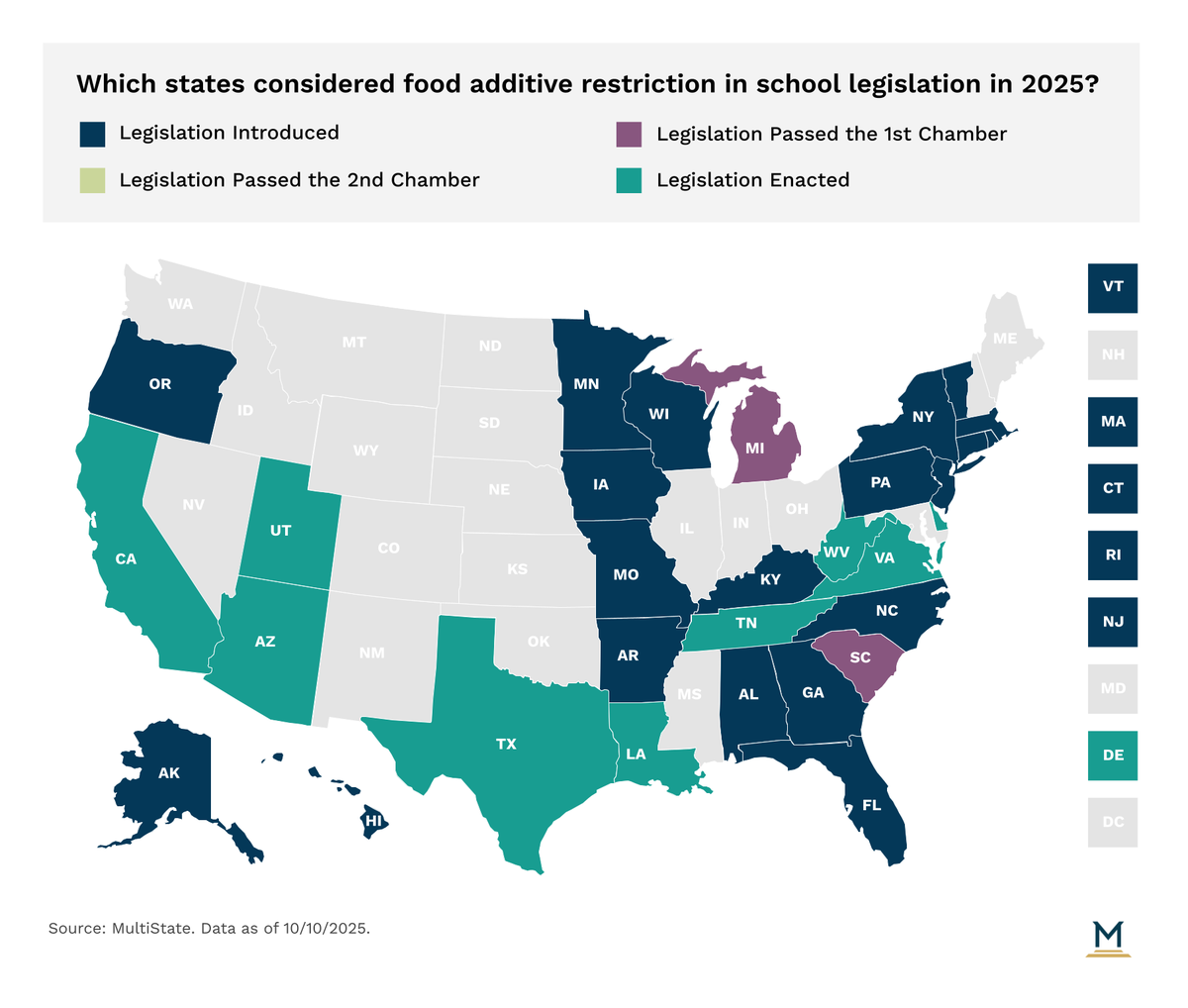
Notice two limits before drawing conclusions from it. First, “passed the first chamber” and “passed the second chamber” describe progress through a legislature, not necessarily an enacted, effective law. Second, the map is specifically about food-additive restrictions in school legislation. It cannot establish the status of every MAHA-related nutrition, SNAP, or physical-activity proposal in a state.
An HHS MAHA page supplies a useful comparison from later-dated entries. Read its state descriptions as a directory of reported actions, keeping its dates separate from the map’s 2025 snapshot.
Make America Healthy Again (MAHA) | HHS.gov
Read selected entries on HHS’s MAHA page to see how one agency roundup describes state laws and industry commitments. The page reports different kinds of progress together, so concentrate on the wording and dates of each entry rather than treating the page as one nationwide legal-status report.
Under “State and Topic Filter,” find “HF 2676 - Iowa Make America Healthy Again” and read the Iowa description. Then find “HB 3195 - Minimum Daily Recess” and read the South Carolina description, noting both its effective-date wording and its later full-implementation deadline. Under “MAHA in Action,” find “Industry Commitments” and read the commitment description. These named entries are the stopping points; the surrounding news and promotional summaries are not needed.
The Iowa entry reports a bill signed on May 20, 2026 that includes school-meal additive restrictions among several measures. That supports a claim about state legislation reported as signed, not a claim that FDA adopted a national school-meal rule. Its SNAP provision likewise should not be conflated with a separate USDA waiver or assumed to operate identically to one.
The South Carolina entry sharpens a further distinction: it describes a bill signed on May 18, 2026, says it takes effect upon approval, and gives schools until July 1, 2028, to implement it fully. Enacted, effective, and fully implemented are not synonyms. The HHS entry identifies those dates; the state’s own bill and legislative history would be the decisive records for a detailed legal account.
Finally, the same HHS page explicitly calls industry commitments voluntary. Placing them alongside signed state bills under a shared MAHA heading does not turn those commitments into statutes. Nor can a May 2026 entry be read back into a map dated October 2025: the sources describe different measures at different times.
Putting the status note together
A short, careful account of a proposal can now be written without overstating it. For example:
Measure: H.R. 5404 would codify the executive order establishing the MAHA Commission. Actor and scope: Congress is considering a federal bill. Dated evidence: The Congress.gov record displayed here lists introduction and committee referral on September 16, 2025, and labels the bill “Introduced.” Limit: Its proposed codification has not been shown by that record to be enacted; that conclusion does not determine whether the executive order itself is operative.
Compare that with a description of the dye announcement: the recorded officials described an industry understanding rather than a formal agreement. A status note could report that stated voluntary approach at the time of the recording, while leaving later company performance, state-law requirements, and any subsequent federal rule to be established separately. Precision is not a refusal to acknowledge progress; it specifies which progress the evidence demonstrates.
The same discipline applies to scientific claims. An enacted restriction demonstrates a policy decision in a jurisdiction. A voluntary reformulation demonstrates a company’s commitment or conduct. Neither, on its own, measures the restriction’s health benefit or proves the causal claim offered in its support.
Key takeaways
To determine implementation status, identify the specific measure and actor, use a dated record appropriate to that actor, and state the record’s limits. Announcements, voluntary pledges, proposed rules, final effective rules, introduced bills, and signed state laws are different kinds of action. Enactment, effective dates, and full compliance may differ as well.
The final lesson will use this status discipline alongside the earlier evidence framework to produce a brief judgment on one MAHA proposal: what the policy does, how strong its scientific justification is, and what new evidence would strengthen or weaken that justification.