Welcome to the final module, where the focus shifts from MAHA’s proposals to the federal institutions that could act on them. A proposal to reduce chronic disease can involve several kinds of work: coordinating a strategy, investigating a suspected cause, tracking a health trend, or changing how care is paid for. Those jobs are related, but they do not belong to the same agency.
In this lesson, you will distinguish four roles within the Department of Health and Human Services (HHS): HHS coordination, National Institutes of Health (NIH) research, Centers for Disease Control and Prevention (CDC) surveillance and recommendations, and Centers for Medicare & Medicaid Services (CMS) coverage and payment policy. The distinction helps answer a practical question whenever a MAHA proposal is announced: Which institution could actually do what?
One department, different kinds of authority
HHS is a department, not a single office that conducts every study, issues every recommendation, and pays every health bill. Its Secretary and departmental offices can set priorities and coordinate work among HHS divisions. Those divisions have different missions and operate under different legal authorities.
Read the department’s own account of its structure before examining the four roles.
Read “HHS Divisions” on HHS.gov to establish which offices coordinate departmental policy and how CDC, CMS, and NIH fit within the department.
In the opening paragraph under “HHS Divisions,” read the overview. Under “Immediate Office of the Secretary (IOS),” read its sentence about overseeing and coordinating the Secretary’s work. Under “Assistant Secretary for Planning and Evaluation (ASPE),” read the role description. Then, under the individual headings “Centers for Disease Control and Prevention (CDC),” “Centers for Medicare & Medicaid Services (CMS),” and “National Institutes of Health (NIH),” read CDC’s description, CMS’s description, and NIH’s description. Focus on how their stated purposes differ rather than reading every division’s entry.
HHS coordination means, for example, convening divisions around a chronic-disease priority, aligning departmental plans, requesting analyses, or communicating priorities across the department. An office such as ASPE can contribute policy analysis and evaluation. Coordination matters when a proposal touches research, public-health guidance, and health coverage at once.
But coordination is not a substitute for an agency’s authority or process. A Secretary’s statement about healthier diets does not itself establish that a dietary hypothesis is true, change a Medicare payment rule, or impose a food standard. An interagency MAHA commission can recommend and coordinate a strategy; it is not, merely by announcing one, conducting a clinical trial or making a binding rule. Some proposals also reach beyond HHS: school meals chiefly involve the Department of Agriculture, while pesticide regulation involves the Environmental Protection Agency.
A useful way to read a federal announcement is to separate its objective from its instrument. “Reduce childhood diabetes” names an objective. A funded study, a public-health recommendation, and a change to Medicaid payment are different instruments, each requiring its own responsible institution and steps.
NIH: investigate the claim
Suppose a MAHA proposal rests on the claim that a particular dietary pattern contributes to chronic disease. NIH’s characteristic role is to generate and support medical research that can test parts of that claim. It can fund investigators and conduct research, including studies of mechanisms, clinical outcomes, and interventions. It can also choose to prioritize research where evidence is incomplete.
Read NIH’s description of its mission and one stated nutrition priority.
Advancing NIH’s Mission Through a Unified Strategy
This NIH statement shows the difference between the agency’s research mission and its choice of research priorities. Read it for what NIH says it intends to investigate, not as proof of a dietary cause.
Near the director’s sign-off, find “About the National Institutes of Health (NIH)” and read the mission description. Then go to “Priorities” and its “Nutrition” subsection. Read the nutrition priority. Notice the verbs describing investigation and long-term studies: they identify questions for research, not findings already established.
For instance, NIH-supported researchers might compare diets under controlled conditions, investigate how diet affects metabolism, or follow participants over time to study health outcomes. Each design answers a different question. A short feeding study may reveal changes in intake or blood markers; it cannot by itself establish decades-long disease risk. A long observational study can examine those outcomes but must contend with differences between people who eat differently. A decision to fund research signals that a question matters; it does not certify the proposed answer.
NIH’s principal implementation lever is therefore its research activity and funding priorities, not direct control over what every clinician recommends or what an insurer pays. Other agencies can conduct or support research too; these are distinctions in primary roles, not impermeable boundaries.
CDC: observe population health and issue recommendations
A health proposal needs to know not only whether an intervention can work, but also whom a problem affects and whether its frequency is changing. Surveillance is the systematic collection, analysis, and reporting of population-health data. CDC’s work can include tracking disease prevalence, risk factors, and differences across populations and time. Such information helps identify where prevention efforts may be needed and whether a reported trend warrants closer investigation.
Consider a claim that childhood obesity has increased. A CDC surveillance series could help establish whether measured prevalence rose, which age groups were affected, and how estimates were produced. That is not the same as proving why it rose. Changes in measurement, reporting, or the population studied may affect a trend; even a well-established trend does not isolate diet, activity, stress, or any other single cause. Surveillance describes a pattern that research must then help explain.
CDC also produces public-health guidance and recommendations, drawing on evidence about prevention and risk. In a chronic-disease context, that might mean guidance for health departments, clinicians, or communities. Recommendations can influence practice, but a CDC recommendation is not automatically a binding rule for every state, school, insurer, or person. Whether it has a legal or coverage consequence depends on the applicable law and on subsequent decisions by the bodies responsible.
The distinction between CDC and NIH is easiest to see through the question each is asked to lead:
- NIH research: Does a suspected exposure contribute to a disease, or does an intervention improve outcomes?
- CDC surveillance: How common is the condition, among whom, and how is that pattern changing?
- CDC recommendations: Given the available evidence, what public-health action should be advised?
These questions interact. Surveillance can reveal a problem worth studying; research can improve recommendations; continued surveillance can help monitor what happens afterward. None of those steps should be mistaken for the others.
CMS: use coverage and payment authorities
A proven or promising health intervention still has to reach people. CMS administers major federal health-coverage programs and can affect care through coverage rules, payment policies, quality measures, and program arrangements, subject to the law governing each program. Its programs include Medicare, Medicaid, and the Children’s Health Insurance Program (CHIP). Medicaid and CHIP involve important federal–state roles, so CMS does not simply dictate every local detail.
Imagine that evidence supports a preventive service for people at high risk of diabetes. CMS’s relevant question is not primarily “What caused diabetes nationwide?” but “Under the applicable program authority, will this service be covered, for whom, and how will participating providers be paid?” Payment design can change incentives to offer and deliver care. It cannot, on its own, establish that the service works.
The image below shows why CMS is more than a check-writing office: its activities connect coverage and payment with quality reporting and improvement.
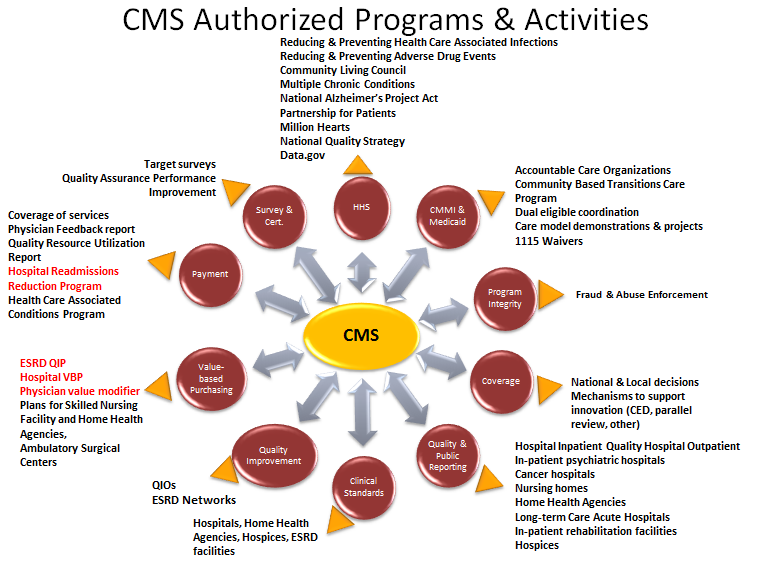
The image is a map of functions, not a live list of MAHA actions. In particular, a diagram containing “value-based purchasing” does not mean CMS has adopted a new payment policy for any specific diet or chronic-disease proposal. CMS must have an applicable authority and take the relevant program-specific steps. Nor would a Medicare payment change, which concerns that program’s eligible population, automatically change food purchases for everyone in the country.
Following one proposal across the institutions
Consider this hypothetical MAHA objective: reduce childhood metabolic disease by improving diet and access to effective prevention. Each institution could contribute, but each would produce a different kind of output.
| Institution | Plausible contribution | What that contribution would not establish |
|---|---|---|
| HHS leadership and coordinating offices | Bring HHS divisions together, set departmental priorities, and assess policy options. | That a proposed cause has been proven or a binding policy has taken effect. |
| NIH | Support studies of diet, metabolic outcomes, and preventive interventions. | That a research priority is already a confirmed finding. |
| CDC | Track population trends and develop evidence-informed public-health recommendations. | That a trend, by itself, identifies its cause; or that guidance automatically binds states and insurers. |
| CMS | Examine coverage or payment approaches for eligible people within its programs, under applicable authority. | That the intervention works, or that the policy applies outside those programs. |
The roles also expose two common mistakes in interpreting a proposal. First, evidence is not implementation: even a persuasive trial result does not itself create coverage, a payment rate, or a nationwide requirement. Second, implementation is not evidence: an agency’s decision to prioritize, recommend, or pay for something is not a substitute for evaluating the scientific claim behind it. Policies can be adopted amid uncertainty; their justification should say what is known, what remains uncertain, and what trade-offs the decision makes.
This framework will help with announcements that mention several agencies at once. Identify the precise action being described—research funding, surveillance, guidance, coverage, or payment—before deciding how far the announcement reaches.
Key takeaways
HHS can coordinate a health strategy across its divisions. NIH primarily conducts and supports research to investigate health claims. CDC tracks population health and develops public-health recommendations. CMS uses coverage and payment authorities within the programs it administers. Their work can reinforce one another, but an announcement by one does not automatically become an action by the others.
The next lesson applies this institutional map to implementation status: how to use dated official records to tell an announcement or voluntary pledge from a binding agency action, legislation, or state-level policy.