The previous lesson showed how to describe a proposal’s implementation status without confusing a strategy, a voluntary action, and a binding rule. This final lesson adds a different judgment: whether the scientific case for a proposal is strong, limited, or still untested. A proposal can be worth pursuing without every claim made on its behalf being established.
We will use one concrete MAHA proposal throughout: developing a government-wide definition of ultra-processed food. By the end, you will have a model brief judgment that states what the evidence supports, what it does not, and what findings would change the assessment.
Begin with the proposal actually on the page
The September 2025 MAHA Strategy says that USDA, HHS, and FDA will continue work on a shared definition of “ultra-processed food” to support potential future research and policy activity. That is narrower than a nationwide ban on such foods. It is also narrower than a demonstrated reduction in chronic disease.
Read the White House MAHA Strategy as a statement of proposed government action, not as proof that the action has been completed or that its scientific rationale is correct.
In “Realigning Incentives and Systems to Drive Health Outcomes,” under “Policy Reforms” (printed p. 9), begin with the paragraph opening “Implement policy reforms, deregulation, and structural improvements.” Read through the proposal, stopping at the end of the “Ultra-Processed Foods” item. Notice that the nearby food-dye and food-chemical items describe different actions; the ultra-processed-food item proposes a definition for possible later use.
Why might a definition matter? Researchers and agencies need to know whether they are classifying the same foods in the same way. A rule based on an ambiguous category could treat a packaged whole-grain bread and a confectionery product alike merely because both meet a processing-based criterion, even if their nutritional profiles differ. Conversely, a definition too narrow to identify foods of concern would be of little use. A workable definition must be clear enough to apply consistently and informative enough for its intended purpose.
Keep three claims separate. The administrative claim is that agencies can develop a common definition. The scientific claim is that the resulting category will help explain or predict relevant health outcomes. The policy claim—not yet specified by this proposal—is that some later use of the definition would improve health at acceptable cost and with acceptable effects on access and choice. Evidence for one does not automatically establish the others.
The status discipline from the previous lesson still applies. The September 2025 strategy documents an intention to continue work. That document alone does not establish that a final definition has since been adopted or that any restriction based on it is in force. A later status claim would require later, dated agency records.
Put the evidence beside the claim, not in place of it
One important reason to investigate ultra-processed foods is an NIH feeding experiment. Its design tells us more about short-term eating behavior than an ordinary comparison of people who choose different diets.
Eating highly processed foods linked to weight gain | National Institutes of Health (NIH)
Read NIH’s account of a controlled feeding study to see both the strength and the boundary of the evidence.
On the page “Eating highly processed foods linked to weight gain,” pass “At a Glance” and begin the study description at “To investigate the impact of eating ultra-processed foods on weight.” Read the study account through the final researcher quotation about a reformulated diet. Track who participated, how long each diet lasted, what the meals were matched for, and what remained uncertain about the reason people ate more.
Twenty adults stayed at a research center and ate each diet for two weeks. The meals offered were matched for several nutritional features, including calories, sugar, fiber, fat, and carbohydrates, but participants could eat as much or as little as they wished. They consumed about 500 more calories per day on the ultra-processed diet and gained about two pounds on average during that period; on the minimally processed diet, they lost about the same amount.
Because the diets were assigned and eating was closely observed, this is meaningful evidence that the particular ultra-processed diet tested increased short-term intake and weight relative to the particular minimally processed diet tested. The careful wording matters. Twenty adults studied over weeks cannot establish the size of any long-term effect in children. Nor does the experiment identify which feature of the meals caused the difference. The researcher’s proposed next step—a study using reformulated ultra-processed foods—targets precisely that uncertainty.
Observational evidence addresses a different timescale. The BMJ visual abstract below summarizes an umbrella review of meta-analyses, including associations with several adverse health outcomes. Spend a moment reading its two axes: evidence credibility and evidence quality are not interchangeable.
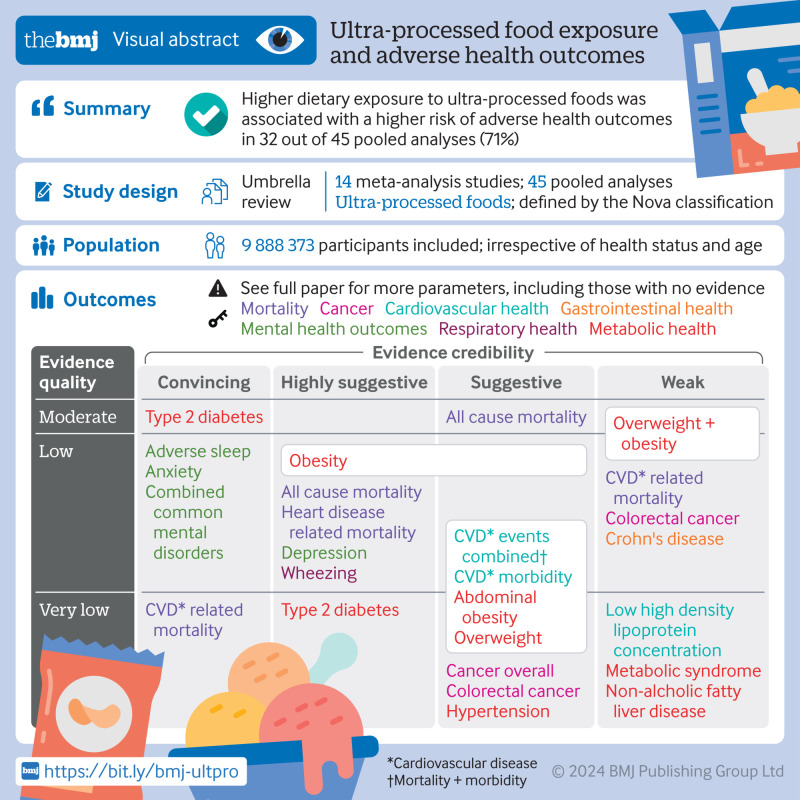
The abstract reports adverse associations in 32 of 45 pooled analyses. That count is not a finding that ultra-processed food causes 32 diseases, or that a person’s risk rises by 71%. The display also shows why a confident-sounding credibility label should not be read without its evidence-quality row. Observational associations may reflect the foods themselves, but they may also be affected by differences in overall diet, income, smoking, physical activity, or how accurately foods and diagnoses were recorded. The feeding experiment strengthens the case for a short-term effect on intake; the observational syntheses broaden the range of outcomes worth investigating. Neither supplies a ready-made justification for treating every food in a broad processing category as equally harmful.
Decide what new findings would actually change the assessment
An expert discussion of the MAHA report raises a practical problem: an ultra-processed-food category used in research may be too broad to use uncritically in policy. It also distinguishes defining the category from setting measurable targets for action.
RFK Jr. Has Issued a New MAHA Report. What Does It Mean for Americans? | Amanpour and Company
Watch Amanpour and Company’s “RFK Jr. Has Issued a New MAHA Report. What Does It Mean for Americans?” for an expert perspective on the gap between a research category and an effective policy. Treat the interviewee’s proposals as analysis, not as evidence that an agency has adopted them.
In the definition discussion, focus on why a broad category may include foods with different nutritional implications. Then watch possible alternatives, where the interviewee distinguishes defining ultra-processed foods from acting on specific nutritional features. Finish with measurable targets, which explains what a strategy would need to show progress.
For this proposal, stronger evidence would have two forms. First, independent researchers using the proposed definition should be able to classify the same products consistently, including borderline cases. Second, studies should show whether that category predicts health-relevant outcomes beyond what can already be learned from measurable nutritional features such as sodium, added sugar, and saturated fat. Longer randomized studies could compare feasible diets while measuring actual intake, weight, metabolic outcomes, cost, and sustained adherence. Carefully conducted observational studies could examine longer-term disease outcomes, with credible exposure measurement and attention to confounding.
Weaker evidence would also be informative. If researchers regularly disagreed about which foods qualified, the definition would be a poor common tool. If well-designed studies found that a broad processing label added little useful information once nutritional quality was measured—or grouped potentially beneficial and harmful foods indiscriminately—that would weaken the case for using the label as a basis for blanket restrictions. It would not show that poor-quality diets are harmless.
A definition could succeed as a research tool yet still fail as the basis for a particular policy. Before endorsing restrictions in a nutrition program, evidence would also need to address substitutions and real-world consequences: what foods people obtain instead, whether healthier options are affordable and available, and whether the measure improves health without creating disproportionate burdens. Access and choice are partly policy values; measuring their consequences is an empirical task.
A brief evidence-based judgment
Here is a finished judgment. It names one proposal, uses the strongest directly relevant findings, confines the conclusion to what they support, and gives evidence that could move it in either direction:
I support developing a common federal definition of ultra-processed food for research, but not treating the definition itself as a finding that every food it includes is harmful. The September 2025 MAHA Strategy proposes continued work on a definition for potential future research and policy; it does not, by itself, establish a binding restriction. In a small NIH feeding experiment, adults ate about 500 more calories per day and gained weight during two weeks on the ultra-processed diet tested. Observational syntheses also report adverse associations across several outcomes, but they cannot by themselves establish causation for the whole category. My support for the definition would strengthen if independent teams applied it consistently and longer studies showed that it predicts important health outcomes beyond established nutritional measures. It would weaken if classification proved unreliable or the category added little useful information once food quality was accounted for. Any later restriction would need separate evidence that it improves health without making nutritious food less accessible or affordable.
Notice the conditional structure. The judgment does not wait for perfect certainty before supporting a useful research step. It also does not let the NIH trial or the umbrella review silently prove a broader claim than either tested. Most importantly, it specifies findings that could strengthen or weaken its conclusion. That makes the scientific part of the judgment open to revision, while leaving room to debate policy trade-offs openly.
Key takeaways
An evidence-based MAHA judgment starts with the exact proposal, its dated status, and the scientific claim needed to justify it. It then matches each source to the conclusion that source can support: a short feeding trial informs short-term intake and weight; observational syntheses identify longer-term associations but leave causal uncertainty. Finally, it states both what would strengthen the case and what would weaken it.
That distinction—between a goal, a testable claim, the evidence available now, and the values involved in acting on it—is the framework for independently assessing proposals beyond this course.