Bonjour!
In our last lesson, you did a fantastic job learning how to navigate a French restaurant, from ordering your meal to paying the bill. Now that you can confidently order un steak-frites, how do you find the restaurant in the first place?
Today, we'll tackle that exact problem. This lesson focuses on one of the most practical skills you'll need: how to ask for and understand simple directions to a location. Mastering this will give you the freedom and confidence to explore any French-speaking city, a crucial step toward your goal of fluency in everyday situations. We will cover the essential vocabulary, how to ask questions politely, and—most importantly—how to understand the answers you receive.
1. The Building Blocks: Essential Vocabulary
Before you can ask for or understand directions, you need the basic vocabulary of movement and location. Let's start with a video that clearly introduces these fundamental terms.
How to give and ask Directions in French [Increase your Vocabulary]
The video 'How to give and ask Directions in French' from the Learn French with escargot channel provides a great foundation. We'll focus on the core words first.
Watch the video from the beginning until 08:30. Pay close attention to the pronunciation of key terms like 'gauche' (left), 'droite' (right), 'tout droit' (straight ahead), and prepositions like 'devant' (in front of) and 'à côté de' (next to).
To summarize and expand on the video, here is a list of the most important vocabulary you'll need:
| French | English |
|---|---|
| Basic Movements | |
à droite |
to the right |
à gauche |
to the left |
tout droit |
straight ahead |
traversez |
cross (e.g., the street) |
continuez |
continue / keep going |
tournez |
turn |
prenez |
take (e.g., the first street) |
| Key Locations & Landmarks | |
la rue |
the street |
le feu (rouge) |
the traffic light |
le rond-point |
the roundabout |
le pont |
the bridge |
l'intersection / le carrefour |
the intersection |
| Prepositions of Place | |
jusqu'à |
until / up to |
sur / sous |
on / under |
devant / derrière |
in front of / behind |
à côté de |
next to |
en face de |
opposite / across from |
près de / loin de |
near / far from |
au coin de |
at the corner of |
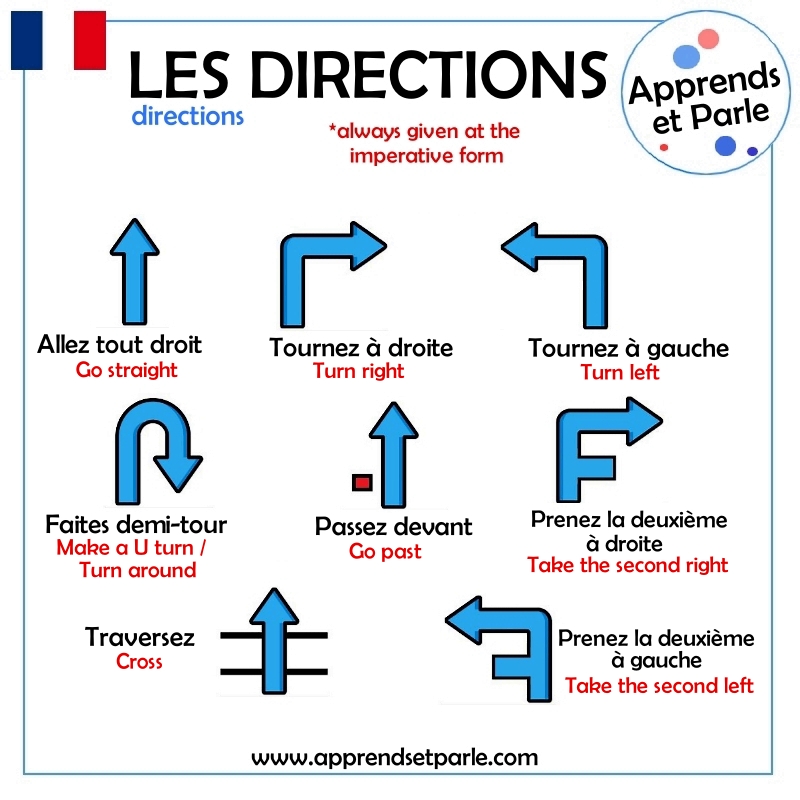
This image is a great visual summary of the core command phrases you will hear.
2. How to Ask for Directions Politely
In France, politeness is key. You can't just shout "Where is the station?". Starting the interaction correctly makes a huge difference.
The following article provides excellent phrases for asking questions politely and effectively.
How to Ask for Directions in French—and Understand ...
Let's read the article 'How to Ask for Directions in French' from Polyglottist Language Academy. It breaks down the process perfectly.
Please read 'Part 1 – The Polite Way to Start' and 'Part 2 – Key Phrases to Ask for Directions'. Focus on the different ways to formulate your question, from the simple 'Où est...?' to 'Je cherche...'.
As the article highlights, always begin with Bonjour, excusez-moi....
Here are the most useful ways to ask for a location:
Où est [la gare], s'il vous plaît ?(Where is [the train station], please?) - Simple and direct.Je cherche [la rue Victor Hugo], s'il vous plaît.(I'm looking for [Victor Hugo street], please.) - Very common and natural.Pour aller [au musée], s'il vous plaît ?(To go [to the museum], please?) - A short, conversational way to ask.Savez-vous où est [la pharmacie] ?(Do you know where [the pharmacy] is?) - A slightly more formal way.
This infographic provides more great examples.

Test your understanding!
You just left your hotel and are looking for the nearest bakery (boulangerie). How could you politely ask a passerby for directions using the phrase "Je cherche..."?
Show answer
You could say: "Bonjour, excusez-moi. Je cherche une boulangerie près d'ici, s'il vous plaît." (Hello, excuse me. I'm looking for a bakery near here, please.)
3. Understanding the Response
Asking the question is the easy part. Understanding the stream of rapid French that follows can be a challenge. The key is not to panic, but to listen for the keywords you learned in the first section.
Let's watch some real-life examples to train your ear.
French for Beginners: Asking & Giving Directions | Super Easy French 147
The 'Easy French' channel has a great video with authentic street interviews. Listen carefully to the directions people give. Don't worry if you don't understand every word; just try to catch the main ideas.
Watch the two short dialogues from 00:35 to 03:24. Listen for keywords like 'à droite', 'à gauche', and 'tout droit'.
Let's break down the first dialogue from the video:
- Question:
Je cherche une pharmacie.(I'm looking for a pharmacy.) - Response:
Prenez la prochaine à droite, marchez 100 mètres et la pharmacie est là, juste à côté de la station de métro.(Take the next right, walk 100 meters and the pharmacy is there, right next to the metro station.) - Clarification:
La prochaine à droite, puis tout droit, c'est ça ?(The next one on the right, then straight, is that it?)
Notice how the person asking for directions repeats back a simplified version to confirm. This is an excellent strategy!
What to Do When You Don't Understand
Even with practice, you'll encounter people who speak very quickly. Here are some life-saving phrases, also covered in the Polyglottist article you read earlier.
Pouvez-vous répéter, s'il vous plaît ?(Can you repeat, please?)Plus lentement, s'il vous plaît.(Slower, please.)Donc, je vais tout droit et puis je tourne à gauche ?(So, I go straight and then I turn left?) - Repeating back what you think you heard.
Conclusion
Très bien! You've now covered all the essential skills for navigating a French-speaking city. You have the vocabulary to describe directions, the phrases to ask politely, and the strategies to understand the response. This is a huge confidence booster and a very practical skill for your professional and social goals.
Key Takeaways:
- Always start with
Bonjour, excusez-moi.... - Master the core vocabulary:
à droite,à gauche,tout droit,continuez,traversez. - Use simple, clear questions like
Où est...?orJe cherche.... - Listen for keywords in the response. Don't try to understand every single word.
- Don't be afraid to ask someone to speak slower (
plus lentement) or to repeat (répéter).
Next Lesson Preview:
You can now find your way to the shops. In our next lesson, we will go inside and learn how to make purchases and handle transactions, another critical skill for everyday life in France.
À bientôt