Bonjour!
In our last lesson, you mastered je voudrais, the essential phrase for making polite requests. You now have the key to unlock countless interactions in French.
Today, we'll put that key to use in one of the most common and enjoyable situations: ordering food and drinks at a restaurant or café. This lesson will walk you through the entire process, from arriving to paying the bill. Mastering this scenario is a significant step toward your goal of feeling confident and fluent in everyday social conversations.
1. The Full Experience: A Restaurant Dialogue
To start, we'll watch a video that simulates a complete restaurant experience. It provides a clear, step-by-step example of the language and cultural norms you'll encounter. We'll break it down into parts.
First, let's see what happens when you arrive, get your menu, and order a drink.
Ordering at a Restaurant • Everyday Conversations in French
This video from Rosetta Stone, 'Ordering at a Restaurant', provides a great overview. Let's watch the first part, which covers being greeted, receiving the menu, and ordering a drink.
Watch the video from the beginning until 02:52. Pay close attention to the phrases used to ask for the menu and to order water.
Two crucial phrases from this section are:
Le menu, s'il vous plaît.- The menu, please. (Though the waiter often brings it automatically).Une carafe d'eau, s'il vous plaît.- A pitcher of (tap) water, please.
This second phrase is incredibly important. In France, tap water is free and safe to drink. If you just ask for "water" (de l'eau), you might be brought expensive bottled water. Asking for une carafe d'eau ensures you get free tap water.
2. Ordering Your Meal
Now that you have your drinks, it's time for the main event. The waiter will come back and ask if you're ready to order.
Let's continue with the video to see how to ask for recommendations and place your order.
Ordering at a Restaurant • Everyday Conversations in French
Let's watch the next part of the dialogue, where the customer decides what to eat and orders his main course and wine.
Watch from 02:52 to 04:54. Listen for how the waiter asks if the customer is ready and how the customer asks for a recommendation before ordering.
Here's a breakdown of the key interaction:
- The Waiter's Question: The waiter might ask
Vous avez choisi?("Have you chosen?"), which means "Are you ready to order?" - Asking for Advice: If you're undecided, you can ask
Qu'est-ce que vous recommandez?("What do you recommend?"). - Placing Your Order: In the video, the customer uses
Je vais prendre...("I'm going to take..." or "I'll have..."). This is a very common alternative to theJe voudrais...you learned in the last lesson. Both are perfectly polite and interchangeable.
You will typically order from la carte (the menu), which is often structured with these sections:
L'entrée- The appetizer / starterLe plat principal- The main courseLe dessert- The dessert
Many restaurants also offer a plat du jour (special of the day) or a formule / menu (a set menu at a fixed price, e.g., starter + main).
Here's how you can order using the phrases you know:
Je voudrais **le plat du jour**, s'il vous plaît.(I would like the special of the day, please.)Je vais prendre **le steak-frites**, s'il vous plaît.(I'll have the steak and fries, please.)
Test your understanding!
You are at a restaurant and want to order the onion soup (la soupe à l'oignon) as a starter and the roast chicken (le poulet rôti) as a main. How would you tell the waiter this using je voudrais for the starter and je vais prendre for the main?
Show answer
You could say: "Comme entrée, je voudrais la soupe à l'oignon. Et comme plat principal, je vais prendre le poulet rôti, s'il vous plaît." (As a starter, I would like the onion soup. And as a main course, I'll have the roast chicken, please.)
3. A Special Focus: Ordering Coffee
Ordering coffee in a French café is a cultural experience in itself. The default "coffee" is not what you might expect. This next video shows real interactions in a Parisian café and explains the different types of coffee you can order.
How to Order Coffee in a French Café | Super Easy French 75
The 'Easy French' video 'How to Order Coffee in a French Café' is perfect for understanding the specific vocabulary and culture around coffee.
First, watch from 02:25 to 03:13 to learn about the most common types of coffee. Then, watch from 01:13 to 02:25 to see various examples of people ordering.
Here is your essential coffee vocabulary:
Un café(orun express): A single, small, strong shot of espresso. This is the default if you just ask for "a coffee."Un café allongé: An espresso with extra hot water, making it more like an Americano.Un café crème: An espresso with steamed milk, similar to a cappuccino or latte.Un café noisette: An espresso with just a tiny drop of milk (the color of a hazelnut, ornoisette).
4. Finishing the Meal and Paying the Bill
The meal is over, and you've enjoyed your coffee. How do you get the waiter's attention and pay? Let's watch the final part of our first video.
Ordering at a Restaurant • Everyday Conversations in French
This last clip from the Rosetta Stone video shows how to politely get the waiter's attention, signal you're finished, and ask for the bill.
Watch from 05:08 to 07:13. Focus on the phrases for getting attention and asking for the bill.
Here are the final key steps:
- Getting Attention: A simple, polite
Excusez-moi?while trying to make eye contact is perfect. Avoid shoutingGarçon!—it's very old-fashioned and can be seen as rude. - Asking for the Bill: The phrase is
L'addition, s'il vous plaît.("The bill, please."). - Paying: The waiter may ask if you are paying by card or cash:
Vous payez par carte ou en espèces? - Tipping: As the video notes, tipping is not required. The price on the menu is what you pay because the service charge is already included (
service compris). If you had excellent service, it's common to leave a few coins, but it is not obligatory.
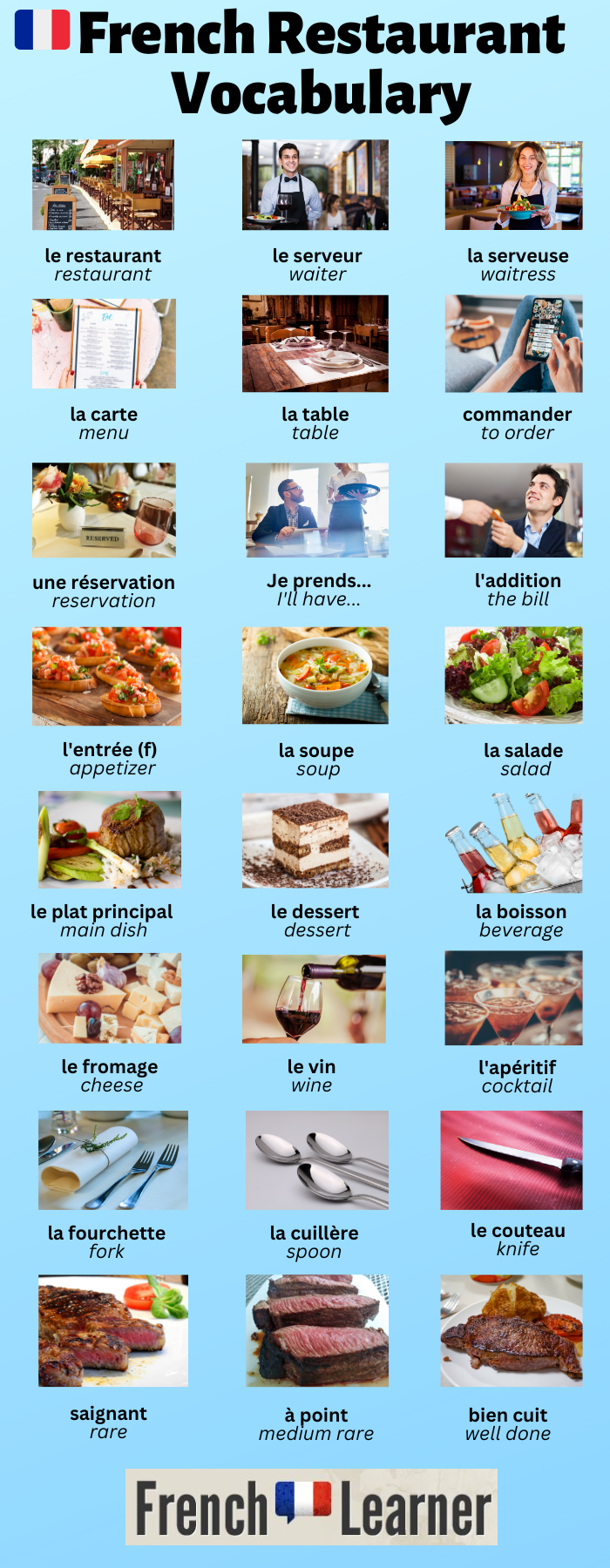
Your Restaurant Vocabulary Cheat Sheet
You've learned a lot of new words and phrases today. This infographic is an excellent summary you can use as a quick reference.
Conclusion
Excellent work today! You've successfully navigated a complete dining experience in French. You now have the vocabulary and phrases to order food and drinks confidently in a real-world setting, which is a fantastic skill for both social and professional situations.
Key Takeaways:
- Use
je voudrais...orje vais prendre...to politely order items. - Always ask for
une carafe d'eaufor free tap water. - Know your coffee:
un caféis an espresso. - Get the waiter's attention with
Excusez-moi?. - Ask for the bill with
L'addition, s'il vous plaît..
Next Lesson Preview:
Now that you can confidently order a meal, what about finding the restaurant in the first place? In our next lesson, we'll cover how to ask for and understand simple directions to a location.
À bientôt