Bonjour !
In our last lesson, you mastered asking for and understanding directions, successfully guiding yourself to different locations. Now that you've arrived at the shop, it's time to go inside!
Today's lesson focuses on the practical skill of making purchases and handling transactions. This is a core competency for your goal of achieving fluency in everyday situations, whether for personal, social, or professional life. We will cover the entire process, from politely greeting the staff and asking for what you want, to understanding the price and completing the payment.
Let's get ready to do some shopping in French!
1. The Shopping Interaction: From "Bonjour" to "Je regarde"
Just as with asking for directions, politeness is the first and most important step. In France, it's customary to greet the shop staff upon entering.
The article '58 French Shopping Phrases' from Fluentu starts with this crucial cultural tip. Let's review it.
Read the short section 'Hellos and Goodbyes'. It emphasizes the importance of 'Bonjour!' and 'Merci, au revoir!'.
Once inside, a salesperson (un vendeur / une vendeuse) might approach you with one of these phrases:
Je peux vous aider ?(May I help you?)Vous cherchez quelque chose en particulier ?(Are you looking for something in particular?)
You have two main ways to respond:
- If you're just browsing:
Non merci, je regarde seulement.(No thank you, I'm just looking.)
- If you need help:
Oui, je cherche...(Yes, I'm looking for...)Oui, je voudrais...(Yes, I would like...)
These foundational phrases set a positive tone for the rest of your shopping experience.
2. From the Market to the Boutique: Making Your Request
Let's see these phrases in action. We'll start with a common scenario: buying food at an outdoor market (un marché).
Going to the market... an Everyday French dialogue to improve your listening and speaking skills!
The video 'Going to the market...' from the 'Learn French With Alexa' channel presents a perfect real-world dialogue. We will break it down piece by piece.
Watch the segment from 02:09 to 04:32. Pay attention to how the customer makes a request and how the seller asks if she wants anything else.
Let's break down that exchange:
- The Request: The customer uses the polite phrase
je voudrais, which we've seen before.Bonjour, je voudrais un kilo de pommes et cet ananas, s'il vous plaît.(Hello, I would like a kilo of apples and this pineapple, please.)
- "Anything else?": The seller asks:
Et avec ceci ?(And with this?) - A very common way to ask "Anything else?"
- "That will be all": The customer replies:
Ce sera tout, merci.(That will be all, thank you.)
Now, let's imagine you're in a clothes shop (un magasin de vêtements). The process is similar, but the vocabulary is different.
16 French phrases to use in a "CLOTHES SHOP"
The same channel, 'Learn French With Alexa', has another excellent video for this specific scenario.
Watch from 00:20 to 01:48. This part covers key phrases for trying on clothes and asking about different sizes or colors.
Here are the key phrases for clothes shopping:
- To try something on:
Je voudrais essayer ce pantalon.(I would like to try on these trousers.) - To find the changing room:
Où est la cabine d'essayage ?(Where is the changing room?) - To ask for a different size:
Avez-vous une taille plus grande / plus petite ?(Do you have a bigger / smaller size?) - To ask for a different color:
Avez-vous cette jupe dans une autre couleur ?(Do you have this skirt in another color?)
Test your understanding!
You are in a shop and see a shirt you like, but it's a size Medium (taille M). You need a Large (taille L). How would you ask the salesperson for it?
Show answer
You could say: "Bonjour. Avez-vous cette chemise en taille L, s'il vous plaît ?" (Hello. Do you have this shirt in size L, please?)
3. Handling the Transaction: Paying the Bill
You've chosen your items, and now it's time to pay (payer). This step involves specific vocabulary for prices, payment methods, and change.
First, let's look at the essential vocabulary for the checkout counter (la caisse).
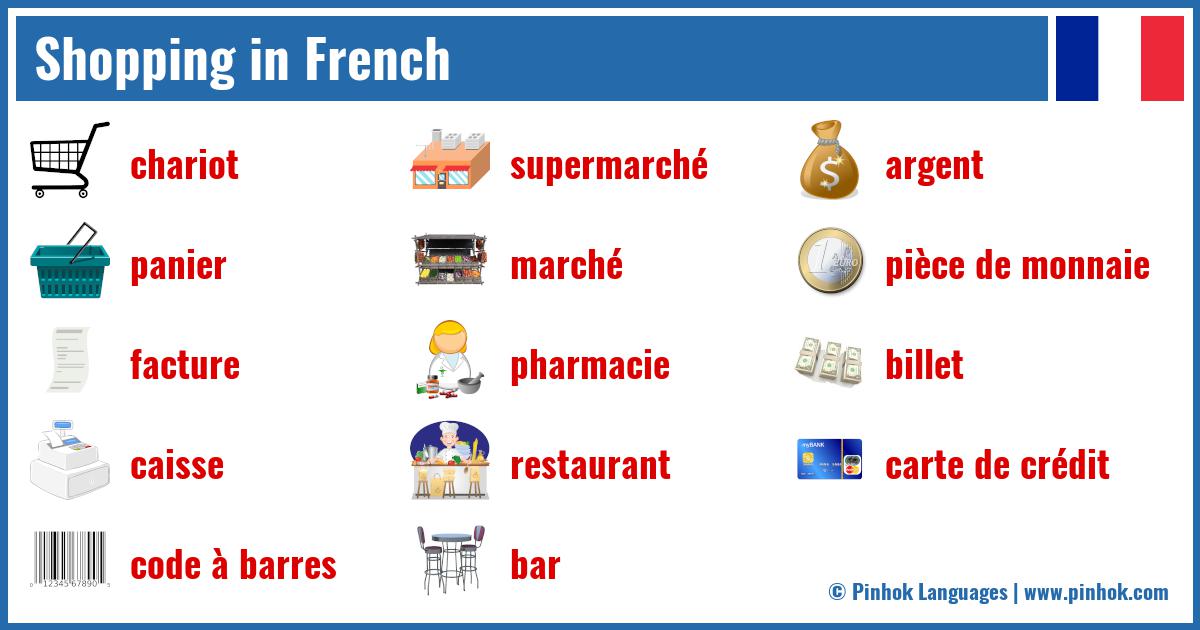
Here's how the payment process usually unfolds.
Asking for the Price and Paying
You'll need to know how to ask for the price and state how you want to pay.
French Shopping Terms - Lawless French Phrases
The Lawless French article 'French Shopping Terms' has a great section on this. Let's look at the key phrases.
Read the sections 'What you might respond…' and 'À la caisse – At the register'. Focus on the phrases for asking the price and the different ways to pay.
As the article shows, the most common questions and statements are:
- Asking the price:
C'est combien ?orCombien ça coûte ?(How much is it?) - Paying by card:
Je peux payer par carte ?(Can I pay by card?) - Paying with cash:
Je vais payer en liquide / en espèces.(I will pay in cash.)
Understanding the Total and Change
Now, let's revisit the market dialogue to see how the seller states the price and gives change.
Going to the market... an Everyday French dialogue to improve your listening and speaking skills!
Let's return to the 'Going to the market...' video. The final part of the transaction is crucial for understanding numbers and the concept of change.
Watch the segment from 04:32 to 06:04. Notice how the seller says the price ('Ça fait...') and what word she uses for 'change'.
This part is full of essential vocabulary:
- Stating the total: The seller says,
Ça fait neuf euros quarante.(That makes/is 9 euros 40.) The expressionça faitis very common for giving a total. - Giving change: The customer hands over 10 euros. The seller gives back the difference and says,
Et voici la monnaie.(And here is the change.)- Crucial point:
La monnaiemeans "change" (coins/bills returned to you), not "money" in general, which isl'argent.
- Crucial point:
Finally, you might want a receipt, un reçu or un ticket de caisse.
Conclusion
Félicitations ! You have now walked through a complete shopping transaction in French. From entering the store to leaving with your purchase, you have the phrases you need to handle the situation with confidence. This is a significant step toward functional fluency for daily life.
Key Takeaways:
- Politeness First: Always start with
Bonjourand end withMerci, au revoir. - Key Requests: Use
Je voudrais...for what you want andJe voudrais essayer...to try something on. - Asking Questions: Master
C'est combien ?(How much is it?),Avez-vous...?(Do you have...?), andOù sont les cabines d'essayage ?(Where are the changing rooms?). - The Payment: Be ready to say
Je peux payer par carte ?orJe vais payer en liquide.Understand thatla monnaieis your change.
Next Lesson Preview:
In our next lesson, we'll apply these transaction skills to another very common scenario: buying tickets for public transportation and asking about schedules. You'll see how the vocabulary we learned today is directly transferable.
À bientôt