Hello! Welcome to your second lesson.
In our last session, we established the fundamental difference between User Experience (UX) and User Interface (UI), defining UX as the overall feeling and effectiveness of a user's journey, and UI as the visual and interactive elements they use along the way. We saw that the core of good UX is a focus on the user.
Today, we'll explore the philosophy that formalizes this focus. The learning outcome for this lesson is to explain the concept of user-centered design and its core principles. This is the mindset that drives every decision in the UX field, including the words we choose as UX writers.
What is User-Centered Design (UCD)?
User-Centered Design (UCD) is exactly what it sounds like: an approach to design that puts the human user at the center of the process. It's not about what a company thinks users want; it's about deeply understanding users' actual needs, goals, and contexts, and then designing solutions to meet them.
A core characteristic of UCD is that it is an iterative process. This means designers don't expect to create a perfect product on the first try. Instead, they move through a cycle of learning, building, and testing, getting closer to the ideal solution with each loop.
To get a foundational understanding of UCD and its process, please read the following sections from an article by the Interaction Design Foundation.
What is User Centered Design (UCD)?
This article provides a clear, structured introduction to User-Centered Design. We'll start with the basic definition and the process.
Please read the first three main sections: 'What is User Centered Design (UCD)?', 'UCD is an Iterative Process', and '4 Phases in User-centered Design'. Focus on the definition and the four distinct phases of the UCD cycle.
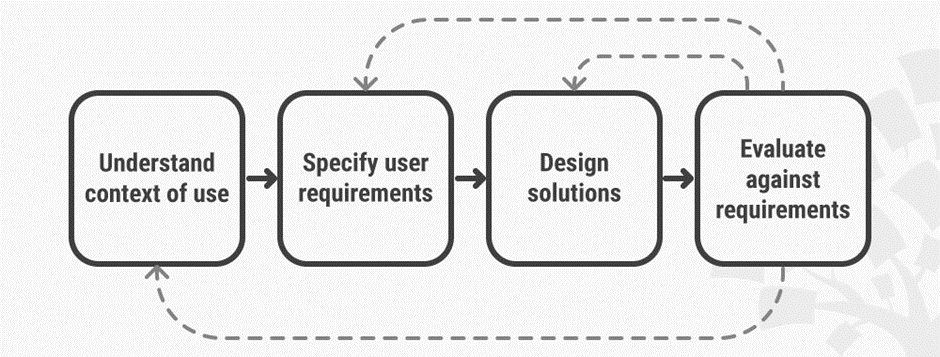
As the article explained, the UCD process generally involves four phases that are repeated as necessary:
- Understand the context of use: Who are the users? What are their goals? In what environment will they use the product?
- Specify user requirements: What exactly does the user need the product to do to meet their goals?
- Design solutions: Create wireframes, prototypes, and the actual product based on those requirements.
- Evaluate against requirements: Test the design with real users to see if it works as intended.
This cyclical process is visualized perfectly in the diagram below. The arrows show how a team moves from one stage to the next, with feedback loops (dashed lines) allowing them to return to earlier stages as they learn more.
You might also encounter the term Human-Centered Design (HCD). The two are largely interchangeable, but as UX pioneer Don Norman explains, "human" is often preferred over "user" because it fosters more empathy and reminds us we are designing for real people, not just abstract entities interacting with a system. We will see both terms used in the resources.
The Core Principles of UCD
Now that we understand what UCD is, let's explore its guiding principles. We'll hear from two of the most influential figures in the field: Don Norman and Jakob Nielsen.
First, let's watch Don Norman outline his four fundamental principles of Human-Centered Design.
The Changing Role of the Designer: Practical Human-Centered Design
In this short clip from an NNgroup presentation, Don Norman introduces the four basic principles he follows in his practice of Human-Centered Design.
Please watch the video from the beginning until 01:36. Pay close attention to the four principles he lists.
Don Norman’s principles give us a fantastic framework:
- Focus on the people: Understand their needs, capabilities, and context.
- Solve the right problem: Dig deep to find the root cause of an issue, not just the symptom.
- Think of everything as a system: Recognize that all parts of an experience are interconnected. A change in one place can have unintended consequences elsewhere.
- Always be iterating and improving: Accept that the first solution will not be perfect. Build, test, and refine continuously.
Now, let's see how these principles look in practice through the lens of another UX pioneer, Jakob Nielsen. He calls them the "immutable rules" of UX because they have remained true for decades.
The Immutable Rules of UX (Jakob Nielsen Keynote)
In this keynote, Jakob Nielsen uses a historical example to illustrate three timeless design principles and tells a powerful story about the importance of testing.
First, watch from 05:15 to 07:44. Nielsen breaks down the three principles that made a 1984 project successful: early focus on users, empirical measurement, and iterative design. Then, watch from 10:23 to 12:34. This is the story of the Vasa ship, a famous and powerful analogy for why you must test your design before you launch it.
Nielsen's analysis reinforces Norman's principles and adds crucial detail:
- Early focus on users is about research—understanding user characteristics before you start designing.
- Empirical measurement means testing with real users and observing their behavior. This isn't about guessing; it's about collecting data.
- Iterative design is the commitment to cycle through the "design, test, measure, redesign" loop as many times as needed.
The story of the Vasa ship powerfully illustrates the consequence of skipping the "evaluate" phase. As Nielsen memorably puts it: "Your design will be tested by users, either before you launch or after you launch. That's your only choice." UCD is about choosing to test before you launch to avoid sinking in the marketplace.
Why UCD Matters for a UX Writer
You might be thinking that this all sounds like it's for designers and researchers. However, the UCD mindset is absolutely critical for a UX writer. The words you write are a key part of the user interface and the overall experience. Your goal is to guide, help, and communicate with the user, and you can't do that effectively without understanding them first.
Your background in translation provides an excellent parallel. To produce a good translation, you don't just switch words; you must understand the cultural context, intent, and audience of the source text to adapt it effectively for a new audience. Similarly, to write good UX copy, you must understand the user's context, intent, and goals.
Let's look at an article that connects these ideas directly to UX writing.
UX writing: Crafting user-centric content
This blog post from LogRocket discusses the role and principles of UX writing. We'll focus on how it embeds the philosophy of user-centered design.
First, read the section 'Ten principles of goal-oriented UX writing'. Notice how principles like Empathy, Usefulness, and Clarity directly reflect a user-centered approach. Next, read the short section under the heading 'User-centered design'. This explicitly lists UCD as an essential skill for UX writers.
As the article highlights, principles of good UX writing—like empathy, usefulness, and clarity—are direct applications of the UCD philosophy.
- You can't be empathetic if you don't understand the user's feelings and frustrations (Understand context).
- You can't be useful if you don't know what the user is trying to achieve (Specify requirements).
- You can't be sure your writing is clear until you test it with real people (Evaluate).
Every time you choose a word for a button, write an error message, or craft an onboarding screen, you are making a design decision that impacts the user experience. A user-centered approach ensures those decisions are informed by the user's needs, not your own assumptions.
Lesson Summary
Great work today! We've covered the foundational philosophy that underpins all modern product design.
Here are the key takeaways:
- User-Centered Design (UCD) is an iterative design philosophy that focuses on users and their needs at every stage of the design process.
- The UCD process is a cycle of understanding user context, specifying requirements, designing solutions, and evaluating with users.
- The core principles are: focus on people, solve the right problem, see everything as a system, and use an iterative process of designing, testing, and refining.
- This mindset is essential for UX writers to create copy that is truly helpful, clear, and empathetic, effectively guiding users toward their goals.
Now that we know we need to focus on our users, how do we make them feel real and present for the entire team? In our next lesson, we'll answer that by learning about user personas, a fundamental tool for capturing and communicating user characteristics.