Hello! Welcome to the third lesson in our course.
In our last session, we explored user-centered design (UCD), the philosophy of putting the user at the heart of the design process. We learned that UCD is an iterative cycle of understanding, specifying, designing, and evaluating. A key takeaway was that to design for users, we first need to understand them deeply.
But how do we keep this understanding of a diverse group of users clear and consistent for an entire product team? How do we make sure our "user" is a tangible presence and not just an abstract idea?
Today, we'll answer that question by exploring a fundamental UX tool: the user persona. The learning outcome for this lesson is to describe what a user persona is and what information it typically contains. For a UX writer, personas are the foundation for empathy, helping you choose the right words, voice, and tone to connect with your audience.
What is a User Persona?
A user persona is a fictional, yet realistic, character that represents a key segment of your target audience. It's not a real person but an archetype created from research on real users. Think of it as a composite character whose goals, motivations, and frustrations summarize the patterns observed in a group of your actual or potential users.
The primary purpose of a persona is to help the product team (including designers, developers, and writers) step out of their own perspective and see the product through the user's eyes. This shared understanding helps guide decisions and ensures everyone is working toward the same goal: serving the user.
In your work with translation and localization, you likely developed an implicit understanding of the target audience for a text—their cultural context, reading level, and expectations. A user persona formalizes this process, creating a detailed, research-backed profile that the entire team can reference.
To start, let's watch a video by UX designer Sarah Doody, who explains what makes a persona effective and why it's so much more than just a list of demographic stats.
How to Create & Use Personas in UX | Sarah Doody, User Experience Designer
In this clip, Sarah Doody distinguishes effective UX personas from less useful marketing personas and explains their value as a decision-making tool.
Please watch from 01:32 to 03:44 and then from 05:44 to 08:23. Focus on: The difference between focusing on psychographics (behaviors, goals, attitudes) versus just demographics (age, income). How personas act as a 'gut check' to keep the team focused on user needs.
As Sarah Doody explains, the power of a persona lies in its focus on psychographics—the why behind a user's actions. Knowing a user's goals, needs, and habits is far more useful for making design decisions than knowing their income or marital status. When a team debates a feature or a line of copy, they can ask, "What would our persona need here?" This transforms a subjective argument into a user-centered discussion.
The Anatomy of a User Persona
Now that we understand what a persona is and why it's valuable, let's break down its components. What information does a persona typically contain?
While formats vary, most effective personas include a similar set of core elements. Let's explore them with the help of a detailed guide.
This article from CareerFoundry, 'How to Define a User Persona', provides a clear, step-by-step breakdown of the key information included in a well-defined persona.
Please read from the section '3. How do you define a user persona?' to '4. Additional suggestions'. As you read, pay close attention to the definitions and examples for these four key components: Header, Demographic profile, End goal(s), and Scenario.
Based on the article, we can summarize the essential components of a user persona:
- Header: A quick, memorable snapshot including a fictional name, a photo, and a quote that summarizes the persona's core attitude or goal. This helps humanize the data.
- Demographics & Background: Factual details based on research, such as age, occupation, education, and family status. This section also includes the user environment (their physical and technological context) and, most importantly, psychographics (attitudes, motivations, interests, and pain points).
- Goals: This is the most critical part. What does the user want to accomplish by using this product? Their goal is their primary motivation.
- Frustrations (or Pain Points): What problems or barriers are currently preventing the user from achieving their goals?
- Scenario/Bio: A short narrative that puts the persona in context. It can be a "day-in-the-life" story or describe a specific situation where the persona would use the product. This adds another layer of realism and empathy.
To see how these parts come together, let's look at a template and a completed example.
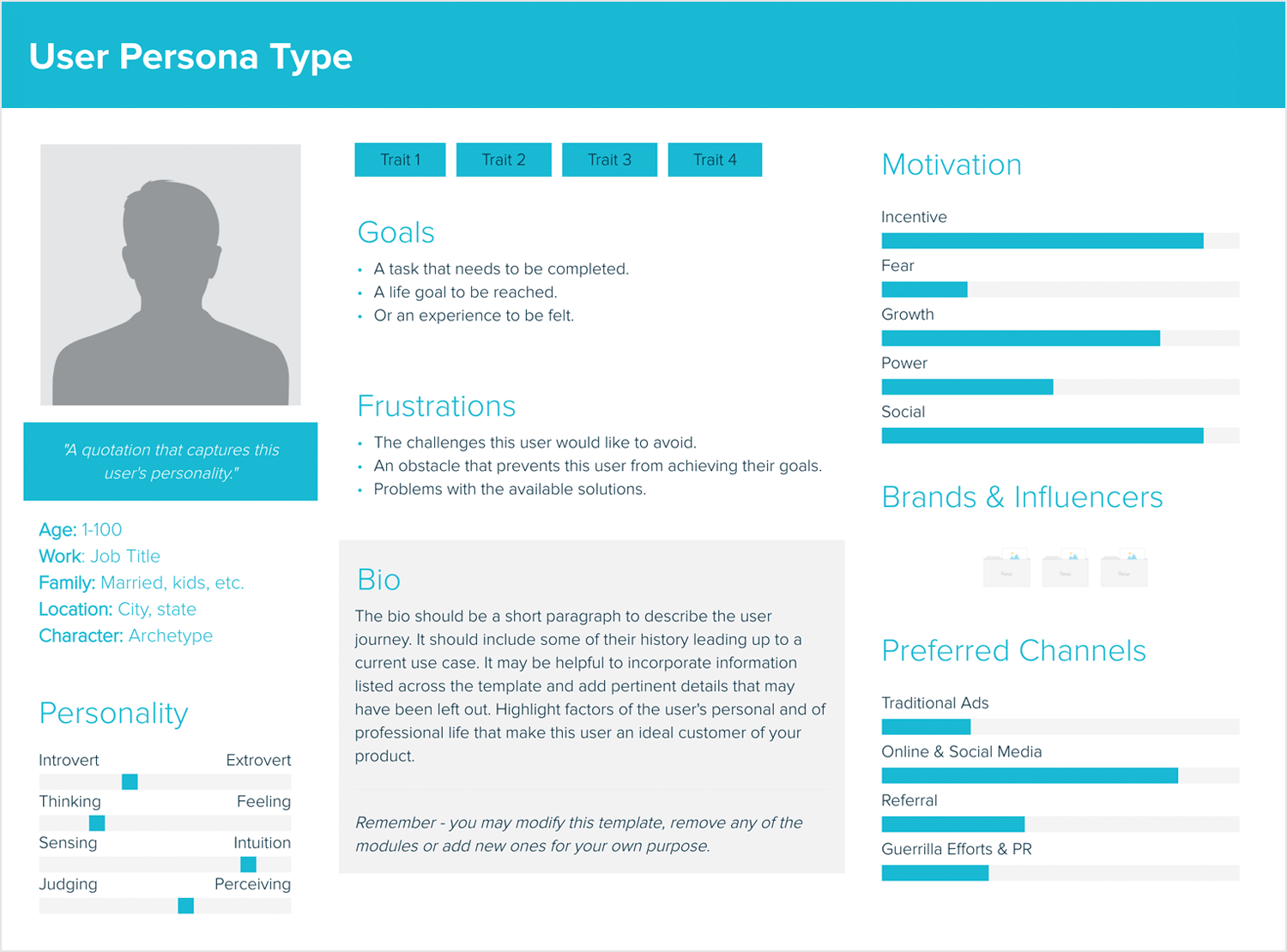

As you can see, the final document is usually a one-page summary. It's designed to be easily digestible and serve as a constant reminder of who the team is designing and writing for.
Personas for Global Audiences
Your background in localization gives you a unique advantage in understanding that a "one-size-fits-all" user doesn't exist, especially across different cultures. The concept of personas can be extended to capture these crucial differences.
Can You Design for Someone You Don't Understand? The Role of ...
This article from the Interaction Design Foundation, 'Can You Design for Someone You Don't Understand?', touches upon how personas can be adapted for cross-cultural design.
Please read the section 'Cross-Cultural Personas vs. Localized Personas vs Personas: What’s the Difference?'. Focus on the definitions of standard, localized, and cross-cultural personas.
This idea of localized and cross-cultural personas is a powerful one. It acknowledges that while a core product might be the same globally, user behaviors, expectations, and even pain points can vary significantly due to cultural context. For a UX writer, this means that the source text for an interface should be written with an awareness of these potential differences, a topic we will explore in-depth in Module 8, "Writing for Global Audiences."
Conclusion
Today we've moved from the abstract philosophy of user-centered design to a concrete tool for putting it into practice. Personas are the bridge between user research and user-focused decision-making.
Here are the key takeaways:
- A user persona is a fictional, research-based character that represents a key user group. Its purpose is to foster empathy and guide decision-making.
- The most valuable information in a UX persona is psychographic, including the user's goals, frustrations (pain points), behaviors, and motivations.
- A typical persona also includes a name, photo, quote, and a brief scenario to make it memorable and relatable.
- Personas are essential for UX writers, as they inform the tone, voice, and content needed to communicate effectively with the target user.
- The concept can be extended to create localized or cross-cultural personas to account for differences in global audiences.
We now have a clear picture of who our user is. The logical next step is to map out what they do. In our next lesson, we will learn how to describe the stages of a user journey map, a tool that visualizes the path a persona takes to achieve their goal.