Hello! Welcome to your fifth lesson.
In our last two lessons, we built a solid foundation by learning about two essential UX tools. We started with user personas to understand who our users are, and then we used user journey maps to understand what they do, think, and feel as they interact with a product.
Now, it's time to connect these concepts directly to your goal of becoming a UX writer. Today's learning outcome is to identify the role of content and language within the overall UX design process. We'll move beyond seeing UX as just wireframes and visuals, and establish where you, as a writer, fit into the picture. You'll discover that content isn't an afterthought but a fundamental, strategic part of designing an experience.
Content as a Pillar of UX Design
In the past, writing was often the last step in creating a digital product. Designers would create layouts with placeholder text (the famous "lorem ipsum"), and a writer would be asked to "fill in the blanks." This approach often leads to clunky, confusing experiences because the design wasn't built to support the actual message.
Modern UX design recognizes that this is backward. The words are not separate from the design; in many ways, the words are the design.
To see this visually, look at this common representation of the disciplines that make up User Experience Design.
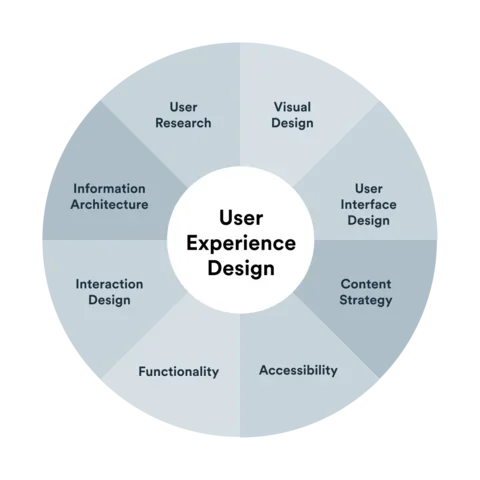
As you can see, Content Strategy is a core component, just like Visual Design or Information Architecture. Users don't distinguish between the design and the words—to them, it's all one experience.
This shift in thinking has led to the rise of a discipline called content design. To understand this evolution, let's read a short passage that explains how the role of content has matured.
What is content design? A complete guide
This article from UX Content Collective, 'What is content design?', explains the strategic importance of content. We'll focus on a section that describes its evolution.
Please read the section titled 'The history of content design'. Pay close attention to the three stages of how organizations view content roles, from 'finishing touch' to strategic influence. The final paragraph is especially important.
The key takeaway here is powerful: "users don’t separate 'content' from 'experience.' To them, the words, structures, and flows are the product."
Thinking of yourself as a "content designer" rather than just a writer helps frame your role as a proactive architect of the user experience, not just a reactive decorator. Your work involves structuring information, designing conversations, and ensuring clarity from the very beginning.
How Content Fits into the Design Process
So, if content isn't the last step, where does it fit? The answer is: everywhere.
UX writers and content designers are involved throughout the entire product development lifecycle, often called the Design Thinking Process. This process is an iterative, user-focused framework for problem-solving.
The following video provides an excellent overview of this process and details the specific tasks a UX writer performs at each stage. As you watch, notice how the tools we've already discussed—like personas and journey maps—are used by writers in their daily work.
A Beginner's Guide To UX Writing (Full Guide)
This segment from CareerFoundry's 'A Beginner's Guide To UX Writing' walks through the five stages of the design thinking process from a writer's perspective.
Watch the section that begins at 10:46 and ends at 26:35. It covers the five stages: Empathize, Define, Ideate, Prototype, and Test. Focus on the activities mentioned for writers in each stage.
That was a detailed look at the process. Let's break down the writer's role in each of those five stages:
-
Empathize: This is the research phase. The goal is to deeply understand user needs. As a writer, you wouldn't just be handed a research summary. You would actively participate by:
- Conducting user interviews.
- Analyzing user surveys.
- Performing "conversation mining": listening to the language users use on forums, social media, and support tickets to understand their pain points and goals in their own words.
-
Define: Here, you synthesize the research to define the problem you're trying to solve. This is where personas and journey maps become critical tools for a writer. You would:
- Use user personas to keep a clear picture of who you're writing for.
- Analyze user journey maps to identify every touchpoint where communication is needed and to understand the user's emotional state, which helps you determine the right tone.
- Help create content style guides to define the product's voice and tone (we'll cover this in detail in a future module).
-
Ideate & Prototype: This is where you start generating solutions and creating content. Rather than working in isolation, you collaborate closely with designers. Your tasks include:
- Drafting and exploring multiple copy options (copy explorations).
- Working directly in design tools like Figma to see how the copy looks and feels within the actual interface. This helps avoid situations where your carefully crafted text doesn't fit or feel right in the final design.
-
Test: Your writing is a hypothesis: "We believe this message will help users succeed." The testing phase validates that hypothesis. You would:
- Participate in usability tests, where you observe users interacting with your copy to see if it's clear and helpful.
- Analyze the results of A/B tests, where two different versions of copy are shown to users to see which one performs better (e.g., which button label gets more clicks).
This process shows that content is woven into every step of UX design, turning writing into a data-informed, user-centered, and collaborative discipline.
Your Background in Translation as a Strategic Advantage
Your experience in translation and localization is more than just a related skill—it's a significant strategic advantage in content design. Effective content design for global products isn't about writing in one language and then simply translating it. It's about designing content systems that are flexible and culturally aware from the start.
Let's read a final excerpt that highlights this.
What is content design? A complete guide
The same article from UX Content Collective, 'What is content design?', also provides practical examples of strategic content work. We'll look at the part about localization.
Please read the section titled 'How design and content work together'. Focus specifically on subsection 3, 'Localizing products for global markets'.
As the article explains, a content designer anticipates localization needs by:
- Designing content patterns that can adapt to cultural differences.
- Planning for UI flexibility to accommodate languages with different text lengths (a challenge you're likely very familiar with!).
- Anticipating which concepts or references won't translate directly and planning alternatives.
This proactive approach prevents costly redesigns and ensures a better user experience across all markets. Your background gives you an intuitive understanding of these challenges, making you a valuable contributor to any product team with global ambitions.
Conclusion
Today, we've firmly placed the role of language and content at the heart of the UX design process. You've seen that modern product development relies on writers as strategic partners from beginning to end.
Here are the key takeaways:
- Content is a core pillar of UX, not an afterthought. The words and the design are part of a single, unified user experience.
- Content design is the discipline of strategically creating user-centered content that is integrated into the product's architecture.
- UX writers are involved in all five stages of the design thinking process: Empathize, Define, Ideate, Prototype, and Test.
- The UX tools you've learned about, personas and journey maps, are actively used by writers to inform their content decisions.
- Your expertise in localization is a key strategic skill in content design, enabling you to create products that work for a global audience.
In our final lesson of this introductory module, we will put this foundational knowledge to work. You'll get your first hands-on practice by creating a simple user persona and a user journey map for a fictional application. This will prepare you to start thinking like a UX professional as we move into the core principles of UX writing.