Greetings, Detective.
The case of the "Mystery Client" has reached its critical juncture. We have gathered testimony from three different expert witnesses, our analytical models, and find ourselves with conflicting reports.
- The K-Nearest Neighbors analysis, focusing on the client's similarity to past cases, returned a verdict of "Poor Fit."
- The probabilistic Naive Bayes model, weighing the evidence of their attributes, concluded "Successful Engagement."
- The rule-based Decision Tree, creating a logical flowchart, sided with KNN, suggesting a classification of "Lost" (our equivalent of "Poor Fit").
We stand at a crossroads with a 2-to-1 split in the evidence. A rookie might simply call it a majority decision and close the case. But as the lead investigator, you know that the why behind a disagreement is often more revealing than the disagreement itself. Today, we will not just count votes; we will weigh them. We will formally synthesize these conflicting viewpoints using a powerful technique from the world of machine learning and, in doing so, arrive at a final, defensible conclusion.
The Wisdom of the Collective
In any complex investigation, relying on a single source of information is risky. A single witness can be mistaken, biased, or only have a partial view of the events. A panel of diverse experts, however, is far more robust. Even if individual experts have flaws, their collective judgment tends to cancel out individual errors and converge on a more accurate truth.
This is the principle behind Ensemble Methods in machine learning. Instead of trying to build one single, perfect model, we can strategically combine the predictions of several different models. The resulting "ensemble" is often more accurate and reliable than any of its individual members.

Weighing the Evidence: Hard vs. Soft Voting
When combining the outputs of our classifiers, we have two primary strategies. This is a crucial choice in our investigation, akin to deciding how to treat testimony from witnesses with varying degrees of certainty.
The following article from MCP Analytics provides an excellent overview of these two approaches.
Voting Ensemble: Hard vs Soft Voting Explained - MCP Analytics
This article clearly explains the rationale behind voting ensembles and details the two primary methods for aggregating predictions.
Please read the introduction, "What is Voting Ensemble?", to grasp the core principle. Then, read the section on "The Voting Process" to see the workflow. Finally, focus on the section "Implementing Hard Voting vs. Soft Voting" to understand the mechanics, advantages, and limitations of each strategy.
As you've just read, our two main options are:
-
Hard Voting (Majority Rule): This is the most straightforward method. We simply count the class predictions from each model and the majority wins. In our case:
- KNN: "Poor Fit"
- Naive Bayes: "Successful Engagement"
- Decision Tree: "Poor Fit"
- Result: The hard vote is 2-1 in favor of "Poor Fit".
-
Soft Voting (Averaging Probabilities): This method is more nuanced and often more powerful. It requires models that can output a probability for each class, reflecting their confidence. Instead of just a vote, each model provides a measure of its certainty. We then average these probabilities across all models and choose the class with the highest average probability. This method gives more weight to a model that is highly confident in its prediction.
Soft voting is generally preferred because it uses more information, but it relies on the models providing well-calibrated probabilities. Hard voting is simpler and can be used with any type of classifier.
Deconstructing the Disagreement
To make an informed final decision, we must understand why our models disagreed. Each model has a different "worldview," shaped by its underlying assumptions and mechanics. This causes them to draw different decision boundaries in the data.
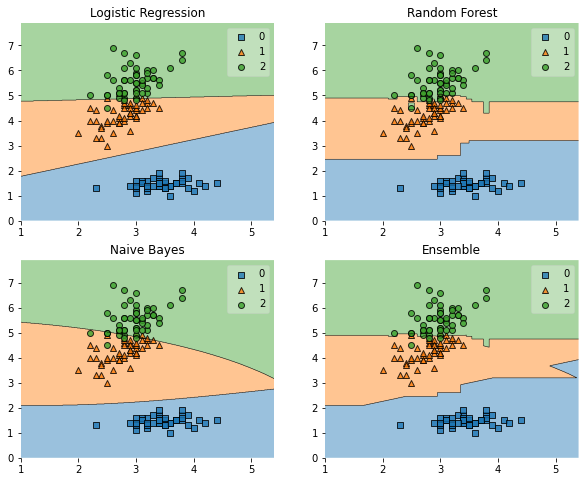
Let's revisit our three "witnesses":
- KNN: This model's decision is based entirely on the local neighborhood of the mystery client. It assumes that clients who are "close" in terms of their features will have the same outcome. Its boundary is highly flexible and data-driven.
- Decision Tree: This model creates a series of "if-then" rules, resulting in blocky, axis-aligned decision boundaries. It identifies the most informative features to split the data into pure groups.
- Naive Bayes: This is our outlier. Its fundamental assumption is that all features are independent of one another, given the class. In the context of relationship dynamics and client profiles, this is an extremely strong and likely false assumption. For example, a client's "communication style" and their "openness to experimentation" are almost certainly correlated. Naive Bayes, by its very design, ignores such interactions.
The fact that KNN and the Decision Tree agree is significant. These two models, despite their different mechanisms, are both capable of capturing complex, non-linear relationships and interactions between features. The fact that Naive Bayes stands alone suggests its "naive" independence assumption might be leading it astray in this particular case. It's possible it's missing a key interaction between client attributes that the other two models are picking up on.
This variance in performance is not unusual. In fact, comparing these specific models is a common exercise.
[PDF] Decision Tree, K-Nearest Neighbors, and Naïve Bayes Models
This research paper compares the performance of the exact three models we have used: Decision Tree, KNN, and Naïve Bayes. While their specific dataset and results are different, the key takeaway is in the comparison itself.
Please navigate to page 926 and review the summary table in the section "7.4 Summary". Notice how the three classifiers yield different accuracy scores and error counts, confirming that their performance can vary significantly on the same problem.
Final Verdict: Closing the Case
We have now analyzed all the evidence. Let's synthesize it to make our final determination.
- The Hard Vote: The simple majority rule points to "Poor Fit" with a 2-to-1 vote. This is our most straightforward piece of evidence.
- Model Reliability Analysis: We have strong theoretical reasons to be skeptical of the Naive Bayes model's conclusion. Its core assumption of feature independence is unlikely to hold true for the complex domain of human relationships and client behavior. The two models that do not make this assumption (KNN and Decision Tree) are in agreement. This gives their shared conclusion more weight.
- Synthesized Conclusion: Based on the majority vote from the hard voting ensemble and, more importantly, a critical analysis of the models' underlying assumptions, the weight of the evidence compellingly points to one conclusion. The conflicting report from Naive Bayes appears to be an artifact of its overly simplistic worldview.
Therefore, Detective, we can close this case. The final determination is that the mystery client is, as predicted by two of our three models, a "Poor Fit" for a successful engagement.
Conclusion
In this lesson, we acted as the lead investigator, synthesizing conflicting evidence to reach a final conclusion. We saw that when models disagree, the solution isn't just to pick the one we like, but to formally combine their predictions using an ensemble. We learned the difference between hard voting (majority rule) and soft voting (averaging probabilities), understanding that the latter incorporates valuable information about model confidence. Most critically, we learned to look beyond the predictions themselves and analyze why models might disagree by considering their fundamental assumptions and how they "see" the world.
Key Takeaways:
- Ensemble methods, like voting classifiers, combine multiple models to produce more robust and accurate predictions.
- Hard Voting uses a simple majority rule based on class labels.
- Soft Voting averages the probability outputs of models, incorporating their prediction confidence.
- Disagreements between models can often be explained by their different underlying assumptions (e.g., Naive Bayes's feature independence assumption).
- A comprehensive analysis involves not just counting votes but critically evaluating the "witnesses" (models) providing them.
Preview of the Next Case
You have successfully closed the "Mystery Client" case. However, a new file has just landed on your desk. The owner of a high-end lingerie boutique, a frequent collaborator with your associated photo studios, reports that something is amiss. Profits are down, but inventory records look normal. She suspects a sophisticated, slow-burn theft is underway, but she can't prove it. The case is titled "The Boutique's Inventory Heist." Your first task will be to establish a baseline by determining what the boutique's optimal inventory policy should be, so you have a benchmark against which to spot any irregularities.