Greetings, Detective.
Having successfully navigated the complexities of human profiling in the "Mystery Client" case, you now face a different kind of puzzle. A new file has landed on your desk, its contents smelling faintly of expensive perfume and quiet desperation. The case is titled "The Boutique's Inventory Heist."
Your client is Madame Evangeline, the proprietor of "L'Atelier Secret," an exclusive lingerie boutique known for its unique and sought-after designs. She reports that while her sales figures remain strong, her profits have been steadily declining. Her inventory records, meticulously kept, show no obvious signs of large-scale theft. Yet, she feels it in her bones: someone is bleeding her business dry, not with a single dramatic heist, but with a thousand tiny cuts. She suspects a sophisticated, slow-burn theft, masked by the natural ebb and flow of business.
Before we can hunt for a thief, we must first understand the scene of the crime. An inefficient system can hide losses just as effectively as a clever criminal. Our first task, therefore, is not to look for what's missing, but to define what should be there. We need to establish a baseline—a portrait of the boutique operating at peak efficiency. Only then can we spot the anomalies that will lead us to our culprit.
The Investigator's Dilemma: The Cost of Inventory
Every business that holds stock, whether it's high-tech components or high-fashion lingerie, faces a fundamental trade-off. This dilemma is the first lock we must pick to understand the boutique's operations.
- Ordering Costs: Placing an order isn't free. It involves administrative time, shipping fees from suppliers (perhaps in Paris or Milan), and processing the delivery. To minimize these costs, one might be tempted to place very large orders, but infrequently.
- Holding Costs: Storing inventory isn't free either. It ties up cash that could be used elsewhere (opportunity cost), requires secure, climate-controlled storage space (warehouse cost), and carries the risk of damage, obsolescence, or theft (insurance and shrinkage cost). To minimize these costs, one might prefer to order tiny amounts, very frequently.
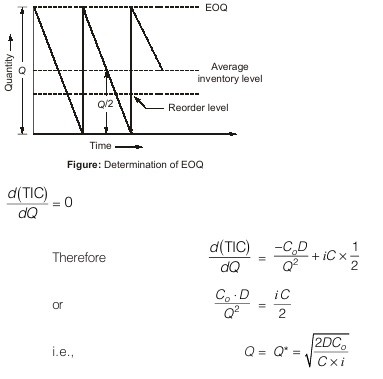
These two forces pull in opposite directions. An optimal inventory policy finds the perfect equilibrium between them. This ideal order size, which minimizes the total cost, is our first objective.

Your background in Operations Research will serve you well here. You know that this classic problem has an elegant mathematical solution. Our goal is to find the Economic Order Quantity (EOQ), the order size that minimizes the combined annual costs of ordering and holding inventory.
The Cipher: The EOQ Formula
To find this optimal quantity, we use a formula developed over a century ago—a powerful cipher for unlocking operational efficiency. Given your familiarity with the subject, we can dispense with the full derivation and focus on its application.
The formula is:
Where:
- is the Economic Order Quantity (the optimal number of units to order).
- D is the annual demand for the product in units.
- S is the ordering cost per order (also called setup cost).
- H is the holding cost per unit per year (also called carrying cost).
Before we can apply this to Madame Evangeline's business, let's refresh our practical skills in calculating it. The following video provides two excellent, step-by-step examples. The second example is particularly relevant, as it shows how to handle holding costs when they are given as a percentage of the product's value—a very common real-world scenario.
Economic Order Quantity (EOQ) in Inventory Management
This video from the Operations & Supply Chain Management University provides a clear explanation and, most importantly, detailed numerical walkthroughs for calculating EOQ.
First, watch the segment from "The EOQ Model" for a concise review of the relevant formulas. Then, carefully follow the two worked examples. The first, a tire company, is a straightforward application. Pay close attention to the second example on security monitors, as it demonstrates how to calculate the holding cost (H) when it's expressed as a percentage of the item's purchase price.
Cracking the Case: The "Midnight Seraph"
Now, let's apply this to L'Atelier Secret. Madame Evangeline has provided us access to her books. We'll start by analyzing one of her most popular items: a lingerie set called the "Midnight Seraph."
Here is the intelligence we've gathered:
- Annual Demand (D): The boutique sells approximately 1,200 "Midnight Seraph" sets per year.
- Ordering Cost (S): The fixed cost associated with placing an order with the European manufacturer (administrative work, wire transfer fees, import documentation) is $75 per order.
- Holding Cost (H): The cost to hold one "Midnight Seraph" set in inventory for a full year is estimated to be $50. This includes costs for secure storage, insurance, and the cost of capital tied up in inventory.
Your task, Detective, is to calculate the EOQ for the "Midnight Seraph." Use the formula and the data above to determine the single most cost-effective number of sets Madame Evangeline should be ordering at one time.
...
Have you completed the calculation?
You should have found that:
The Economic Order Quantity for the "Midnight Seraph" is 60 sets.
This number is our first solid piece of evidence. It tells us that under normal, stable conditions, the optimal inventory policy for the boutique is to place an order for 60 "Midnight Seraph" sets every time they replenish stock. This policy will minimize their total inventory costs for this product line.
Deepening the Investigation
A good detective never takes intel at face value. The quality of our EOQ calculation is only as good as the quality of our inputs (D, S, and H). In a real investigation, determining these values accurately is a major task in itself.
The following article from ISM provides excellent practical guidance on this very topic.
Economic Order Quantity (EOQ) Basics - ISM
This article breaks down the practical steps involved in gathering the data needed for an EOQ analysis.
Please read the section "How to Estimate Inputs for the EOQ Calculator". Focus on the methods described for estimating annual demand (D), measuring setup/order cost (S), and calculating holding cost (H).
This reading highlights that our baseline of 60 units is a powerful starting point, but in a full-blown investigation, we would need to rigorously defend how we arrived at our D, S, and H values. For now, we will proceed with the numbers provided by the client.
Conclusion
We have successfully established the first cornerstone of our investigation. By analyzing the fundamental trade-off between ordering and holding costs, we have calculated the Economic Order Quantity for the boutique's flagship product. This isn't just an academic exercise; we have defined what "normal" and "optimal" look like for this business. The EOQ of 60 units per order is now our benchmark. Any significant deviation from this in the boutique's actual order history could be a sign of inefficiency, or worse, a clue that a thief is manipulating the system.
Key Takeaways:
- Inventory management involves a core trade-off between ordering costs and holding costs.
- The Economic Order Quantity (EOQ) is the order size that minimizes the total of these two costs.
- The EOQ is calculated using the formula: .
- This optimal quantity provides a critical baseline for analyzing the efficiency and integrity of a business's inventory operations.
Preview of the Next Lesson
We've determined the optimal quantity to order. But how much should this optimal policy cost the boutique annually? In our next session, we will use our calculated EOQ to determine the total annual inventory cost. This will give us a hard dollar figure—a financial baseline—to compare against the boutique's actual expenditures. The discrepancy between the "should-be" cost and the "is" cost may just reveal the scale of the heist.