Hello! In our last session, we took the important first step into the world of 4-digit numbers by introducing the thousands place. Your child should now be able to look at a number like 5,821 and identify that the '5' represents 5 thousands, the '8' represents 8 hundreds, and so on.
Today, we'll build directly on that foundation. Our goal is to master the skill of both reading 4-digit numbers aloud and writing them out in words (their "number name"). We will also practice the reverse: converting the word form back into numerals. This lesson will connect the abstract idea of place value to the practical skills of speaking and writing numbers.
From Place Value to Number Names
The key to reading a 4-digit number is simpler than it might seem, and it relies on a skill your child already has: reading 3-digit numbers. The rule is:
- Read the digit in the thousands place and say "thousand."
- Then, read the remaining three digits as a single group, just as you would a normal 3-digit number.
Let's look at an example. The image below breaks down the number 3,264.
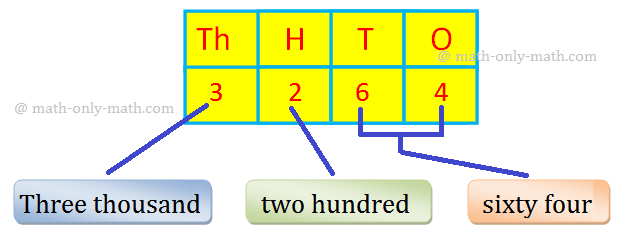
As you can see, we read the thousands place first ("Three thousand") and then read the rest of the number ("two hundred sixty-four") exactly as your child has learned before. A useful way to introduce this, as suggested in the teacher's guide from Orient BlackSwan, is to start with a familiar 3-digit number.
- Show your child the number 264. Ask them to read it aloud: "Two hundred sixty-four."
- Now, place a 3 in front of it: 3,264.
- Explain that you just add the "three thousand" part before the bit they already know.
Reading and Writing Numbers in Action
To see and hear this process clearly, the following video provides some excellent examples. It will walk you and your child through breaking down 4-digit numbers, reading them aloud, and writing their number names.
Class 3 - Maths 4 digit numbers (part 1) Introduction
Please watch the section of the video from Basic Mathematics that explains how to read and write 4-digit numbers.
Focus on the part from the two examples. Pay attention to how the speaker identifies the place value of each digit first and then combines them to form the full number name, like "Three thousand, four hundred fifty-six." Notice the mention of placing a comma after the thousands digit.
Writing Numerals and the Role of Zero
Writing a number in words is simply writing down what you say. "Five thousand, six hundred seventy-eight" becomes 5,678.
The reverse process, writing the numeral from the word form, requires careful listening for the place value "keywords" (thousand, hundred). This is where zeros can sometimes be tricky. If a place value isn't mentioned, it means a zero belongs there.
The resource from BYJU'S provides a perfect example of this.
This reading provides a clear, tabulated example of how to handle a number with zeros in the hundreds and ones places.
In the article, scroll down to the heading "Place Value Table". Focus on the table and the explanation for the number 2,040. Note the thought process: 2 thousand + 0 hundred + 4 tens + 0 ones. This leads to the word form "Two thousand forty." This demonstrates that when we don't hear "hundred" or a specific "ones" digit, we use a zero as a placeholder.
Practice Time
Now it's time for your child to practice these skills. The worksheet below offers a great set of exercises for both writing number names from numerals and writing numerals from their names. You can work through a few examples from each section together.

For additional practice, you can use the teacher's guide we've referenced. It contains a question bank with more problems.
[PDF] 4-DIGIT NUMBERS - Orient BlackSwan
This resource offers a set of practice problems and an answer key for you to check your child's work.
On page 7 of the PDF, look for "Answer Key to the Question Bank". The questions themselves are on page 5, under the heading "(I) Thousand, Building Numbers beyond 1000". You can ask your child to try question (1), parts (a) and (b), and question (2), parts (a) and (b). The answers are provided on page 7 for you to verify.
Conclusion
In this session, we have bridged the gap between knowing the place value of a digit and being able to confidently read and write entire 4-digit numbers.
Key Takeaways:
- To read a 4-digit number, say the thousands digit followed by "thousand," then read the remaining three digits as a group.
- To write a number from its word form, listen for the place value keywords ("thousand," "hundred"). If a place is not mentioned, use a zero as a placeholder.
- The comma after the thousands digit (e.g., 4,567) is a helpful visual cue that separates the thousands period from the rest of the number.
You've now equipped your child with the complete ability to recognize, understand, and communicate 4-digit numbers. In our next lesson, we will explore another way to represent these numbers by breaking them down into the sum of their place values, which is known as expanded form.