Welcome back to your course on the Indian Economy for the UPSC Prelims. In our previous lesson, we established the "who" and "why" of monetary policy, focusing on the Monetary Policy Committee (MPC) and its mandate under the Flexible Inflation Targeting framework. We learned that the MPC's primary job is to set the policy rate to achieve the inflation target.
Today, we delve into the "how." This lesson addresses the specific tools the MPC uses to implement its decisions. We will define and, more importantly, differentiate the RBI's key policy rates: the repo rate, reverse repo rate, Marginal Standing Facility (MSF), Standing Deposit Facility (SDF), and bank rate. Understanding these rates is not just about memorizing definitions; it's about grasping how the RBI steers the entire financial system to manage liquidity, control inflation, and support growth.
The Heart of the System: The Liquidity Adjustment Facility (LAF)
Before we look at each rate individually, it's essential to understand the system they operate within: the Liquidity Adjustment Facility (LAF). Think of the LAF as the RBI's primary operational tool for managing day-to-day liquidity in the banking system. It's a framework that allows banks to borrow money from the RBI or park their excess funds with it.
The LAF creates a "corridor" or a bounded range for the overnight interest rate at which banks lend to each other (known as the call money rate). This corridor has a ceiling (an upper bound), a floor (a lower bound), and a central policy rate that acts as the anchor. The rates we are about to study are the components that define this corridor.
The Anchor of the Corridor: The Policy Repo Rate
The Repo Rate is the single most important policy rate in India. It is the rate that the MPC votes on in its bi-monthly meetings.
- Definition: The repo rate is the interest rate at which the Reserve Bank of India lends money to commercial banks against the collateral of government securities. The term 'repo' stands for 'Repurchase Option', signifying an agreement where the bank commits to repurchasing the securities it has sold to the RBI at a predetermined future date and price.
Its primary function is to inject liquidity into the banking system. When banks are short of funds, they can borrow from the RBI at the repo rate.
- Impact: A lower repo rate makes borrowing from the RBI cheaper for banks, encouraging them to lower their own lending rates. This stimulates borrowing by businesses and consumers, increasing the money supply and boosting economic activity. Conversely, raising the repo rate makes borrowing more expensive, which helps to curb inflation.
For a formal definition and context, you can refer to the following resource.
RBI Monetary Policy Instruments: A Banker’s Guide – FrankBanker
This guide provides a detailed and practical explanation of the policy rates. We will use it throughout the lesson.
Start by reading the section on the Policy Repo Rate. Pay close attention to its definition and the "Practitioner note," which explains its role as the primary policy signal.
The Ceiling and the Floor: MSF and SDF
The LAF corridor is defined by two standing facilities that are available to banks on any working day without restriction. They form the upper and lower bounds for the overnight interest rate.
1. The Marginal Standing Facility (MSF) Rate: The Ceiling
The MSF acts as a safety valve for the banking system.
- Definition: The MSF is a penal rate at which banks can borrow overnight funds from the RBI when they face an acute cash shortage, even after exhausting their regular repo borrowing limit. Crucially, banks can pledge securities from their Statutory Liquidity Ratio (SLR) quota as collateral, which they are otherwise required to hold.
This facility is for emergency injections of liquidity. Because it's an emergency rate, it is set higher than the repo rate.
- Current Structure: MSF Rate = Repo Rate + 0.25% (or 25 basis points)
The MSF rate forms the ceiling of the LAF corridor. No bank will borrow from another bank in the overnight market at a rate higher than the MSF, because it can always borrow from the RBI at the MSF rate.
RBI Monetary Policy Instruments: A Banker’s Guide – FrankBanker
Now, let's understand the upper boundary of the corridor.
Read the section on the Marginal Standing Facility (MSF). Focus on its role as an "emergency borrowing window" and the special provision regarding SLR collateral.
2. The Standing Deposit Facility (SDF) Rate: The Floor
The SDF is a relatively new but critically important tool introduced in April 2022.
- Definition: The SDF is the rate at which banks can park their excess funds with the RBI on an overnight basis without receiving any collateral (i.e., no government securities) from the RBI.
Its primary function is to absorb excess liquidity from the system. It is set below the repo rate.
- Current Structure: SDF Rate = Repo Rate - 0.25% (or 25 basis points)
The SDF rate forms the floor of the LAF corridor. No bank will lend its surplus funds to another bank at a rate lower than the SDF, because it can simply deposit that money with the RBI and earn the SDF rate risk-free. The key innovation of the SDF is that it is uncollateralised, which means the RBI's ability to absorb liquidity is not constrained by the amount of government securities it holds.
RBI Monetary Policy Instruments: A Banker’s Guide – FrankBanker
Next, let's examine the floor of the policy corridor.
Read the section on the Standing Deposit Facility (SDF). Understand why the uncollateralised nature of this facility is a significant structural improvement.
The Legacy and Penal Rates: Reverse Repo and Bank Rate
While the Repo, MSF, and SDF form the active LAF corridor, two other rates are important for your exam.
1. Reverse Repo Rate: A Legacy Tool
Before the introduction of the SDF, the Reverse Repo Rate was the floor of the corridor.
- Definition: The reverse repo rate is the interest rate at which the RBI absorbs liquidity from banks against the collateral of government securities.
Notice the key difference with SDF: reverse repo is collateralised. Since April 2022, the SDF has replaced the fixed-rate reverse repo as the main absorption tool and the floor of the LAF corridor. While the reverse repo mechanism (especially the variable rate reverse repo or VRRR) is still used by RBI for fine-tuning liquidity, the fixed reverse repo rate itself is no longer the operative floor. For Prelims, it is vital to know that the SDF is the current floor, not the Reverse Repo Rate.
2. Bank Rate: The Penal Rate
The Bank Rate is one of the oldest policy rates, but its role has changed significantly.
- Definition: Historically, it was the rate at which the RBI would rediscount bills of exchange or provide long-term loans to banks. Today, its primary active role is as a penal rate. When a bank fails to maintain its required reserves (CRR or SLR), the penalty is charged at the Bank Rate.
A crucial point to remember is that the Bank Rate is now aligned with the MSF rate.
- Current Structure: Bank Rate = MSF Rate
This means whenever the MPC changes the Repo Rate, the MSF and Bank Rate are automatically adjusted upwards, and the SDF rate downwards.
RBI Monetary Policy Instruments: A Banker’s Guide – FrankBanker
Finally, let's look at the two rates that have evolved in their roles.
Read the sections on the Bank Rate and the Reverse Repo Rate. Focus on understanding the Bank Rate's current function as a penal rate and why the Reverse Repo Rate is now considered a legacy tool.
Summary and Comparison
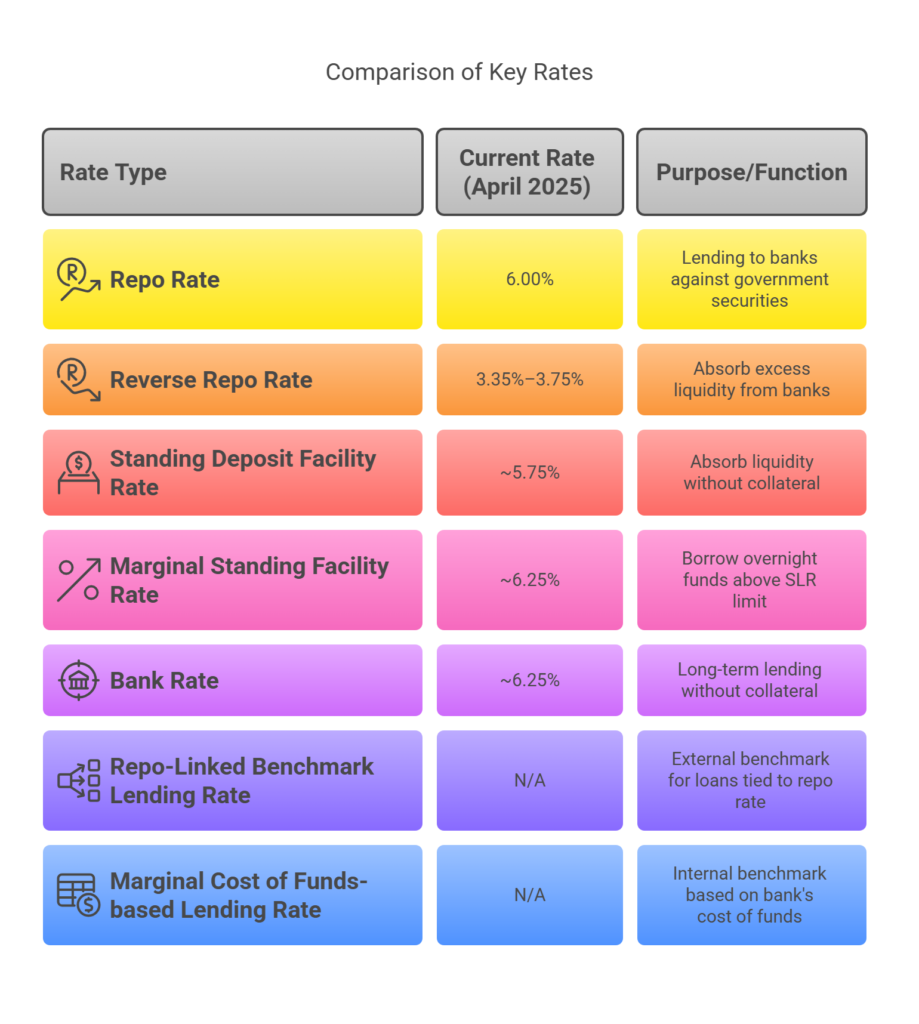
The following table and diagram bring together everything we've discussed. It's a high-yield summary for your revision.
| Rate Name | Primary Function | Collateral | Tenor | Relationship to Repo Rate | Key Feature |
|---|---|---|---|---|---|
| Repo Rate | Inject Liquidity | Required (from bank to RBI) | Short-term | Policy Anchor | Main monetary policy signalling rate. |
| MSF Rate | Inject Liquidity | Required (from SLR quota) | Overnight | Repo Rate + 0.25% | Emergency borrowing facility; Ceiling of LAF corridor. |
| SDF Rate | Absorb Liquidity | Not Required | Overnight | Repo Rate - 0.25% | Uncollateralised absorption; Floor of LAF corridor. |
| Reverse Repo | Absorb Liquidity | Required (from RBI to bank) | Short-term | No longer linked | Legacy tool, largely replaced by SDF as the floor. |
| Bank Rate | Penal Rate | Not Required | Long-term (hist.) | Aligned with MSF Rate | Penalty for CRR/SLR default; long-term lending is dormant. |
Conclusion
In this lesson, we have dissected the main interest rate tools used by the RBI. You now understand not just their individual definitions, but also how they function together as a coherent system—the LAF corridor—to guide short-term interest rates.
Here are the key takeaways for your Prelims preparation:
- The Repo Rate is the central policy rate, used for injecting liquidity against collateral.
- The LAF corridor provides a range for overnight rates, with the MSF Rate (Repo + 0.25%) as the ceiling and the SDF Rate (Repo - 0.25%) as the floor.
- The key distinction for SDF is that it is an uncollateralised absorption facility, making it a more powerful tool than the legacy Reverse Repo Rate.
- The MSF is an emergency window that allows banks to borrow against their SLR holdings.
- The Bank Rate now serves primarily as a penal rate and is aligned with the MSF rate.
In our next lesson, we will shift our focus from the price of money (interest rates) to the quantity of money. We will explore the RBI's reserve and liquidity tools, such as the Cash Reserve Ratio (CRR), Statutory Liquidity Ratio (SLR), and Open Market Operations (OMOs), which directly affect the amount of funds available in the banking system.